
A safe body temperature falls between two values. A ride requires riders to be shorter than one height or taller than another for different reasons. When a condition has two parts joined by “and” or “or,” you need a compound inequality. Mastering the difference between those two small words is the whole key to this topic.
This article covers Topic 3.2: Compound Inequalities in Unit 3, Linear Inequalities. The topic asks you to solve and graph “and” and “or” inequalities and to write compound inequalities from real-world limits.
By the end, you should be able to:
- Explain the difference between an “and” inequality and an “or” inequality.
- Solve a three-part inequality by working on all parts at once.
- Solve “or” inequalities by solving each part separately.
- Graph each type and recognize when a compound inequality has no solution or all real numbers as solutions.
“And” Versus “Or”
A compound inequality joins two inequalities. The joining word decides which numbers count as solutions.
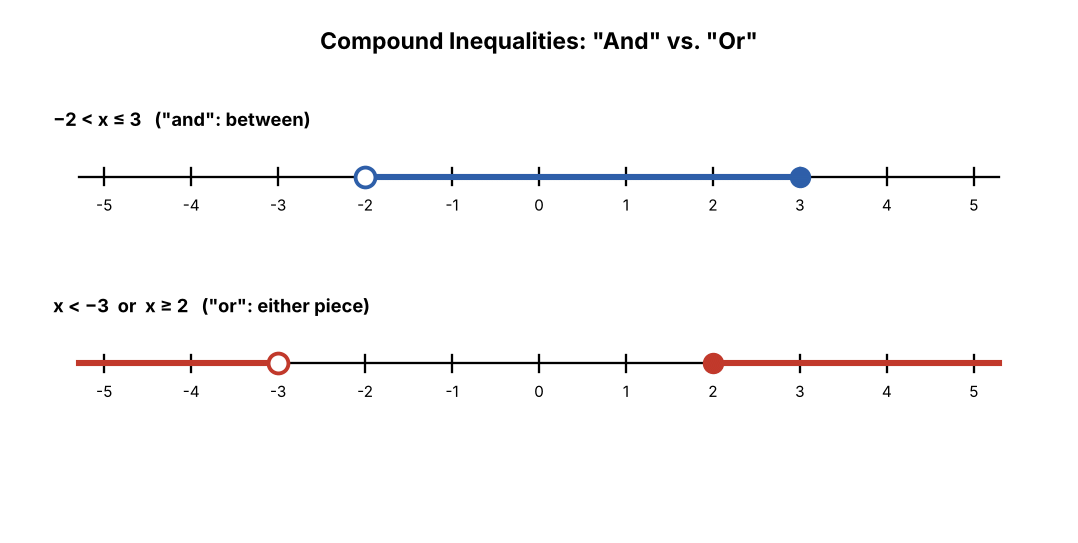
| Type | Solutions Must | Typical Graph | Example |
|---|---|---|---|
| And (conjunction) | Satisfy both parts at once. | One segment between two endpoints. | \(-2\lt x\le 5\) |
| Or (disjunction) | Satisfy at least one part. | Two rays pointing away from each other. | \(x\lt 1\) or \(x\ge 4\) |
Why does this matter? “And” describes an overlap, which is why its graph is a single bounded piece. “Or” describes a union, which is why its graph usually has two separate pieces. If you graph the wrong type, every point you shade is wrong even when your algebra is perfect.
The three-part form \(-2\lt x\le 5\) is shorthand for “\(x\gt-2\) and \(x\le 5\).” Read it from the middle outward: \(x\) is greater than \(-2\) and at most 5.
Solving “And” Inequalities
For a three-part inequality, do the same operation to all three parts at once. The goal is to leave the variable alone in the middle.
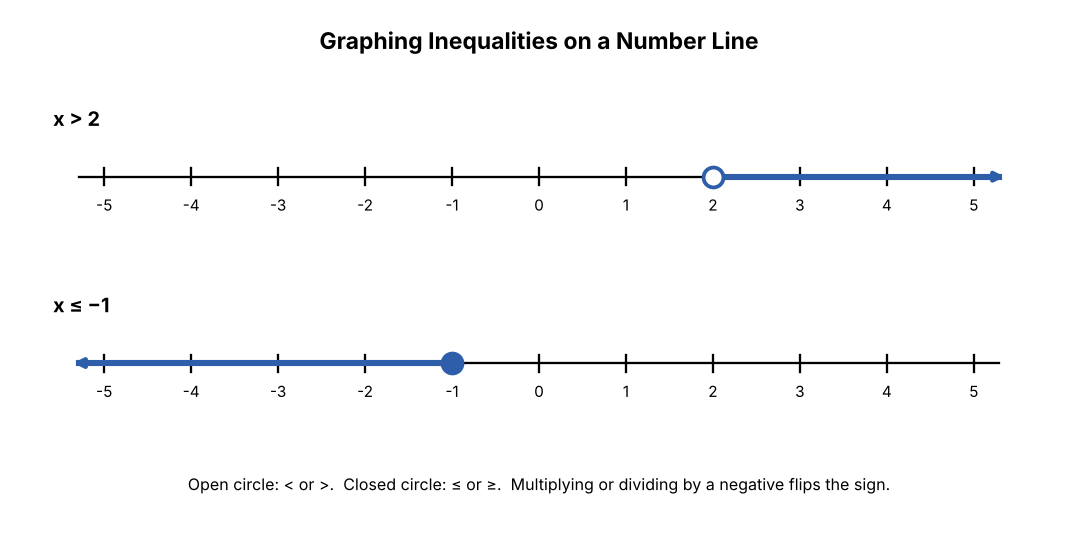
Worked example 1: Solve \(-7\le 2x-1\lt 9\).
- Add 1 to all three parts: \(-6\le 2x\lt 10\).
- Divide all three parts by 2: \(-3\le x\lt 5\).
- Graph a closed circle at \(-3\), an open circle at 5, and shade between them.
Worked example 2: Solve \(4\lt 6-2x\le 12\).
- Subtract 6 from all three parts: \(-2\lt-2x\le 6\).
- Divide all three parts by \(-2\) and reverse both symbols: \(1\gt x\ge-3\).
- Rewrite from smallest to largest: \(-3\le x\lt 1\).
Why does this matter? Example 2 reverses two symbols at once. Students often flip only one, which produces an impossible statement. Rewriting the final answer from least to greatest is a built-in check: the smaller number must end up on the left.
Solving “Or” Inequalities
Solve each part on its own, then combine the solutions with “or.”
Worked example 3: Solve \(3x+2\lt-4\) or \(5x-1\ge 14\).
- First part: subtract 2 to get \(3x\lt-6\), then divide by 3 to get \(x\lt-2\).
- Second part: add 1 to get \(5x\ge 15\), then divide by 5 to get \(x\ge 3\).
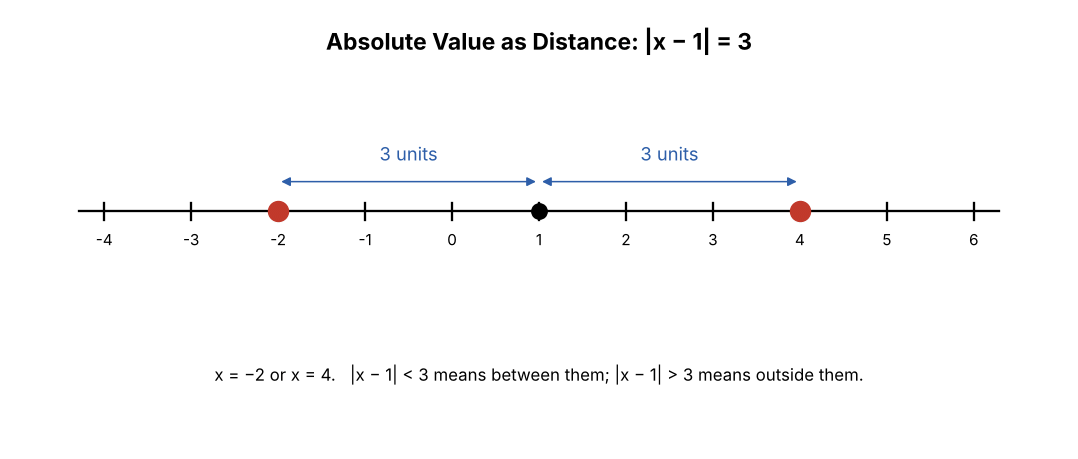
- Answer: \(x\lt-2\) or \(x\ge 3\). Graph an open circle at \(-2\) shading left and a closed circle at 3 shading right.
Special Cases
Some compound inequalities have unusual solution sets. Sketching both parts on one number line reveals them quickly.
- No solution: \(x\lt 2\) and \(x\gt 6\) has no overlap, because no number is both below 2 and above 6.
- All real numbers: \(x\lt 6\) or \(x\gt 2\) covers the whole number line, because every number satisfies at least one part.
- One part swallows the other: \(x\gt 1\) and \(x\gt 4\) simplifies to \(x\gt 4\), since only numbers above 4 satisfy both.
Why does this matter? Test writers include these cases specifically to see whether you understand “and” as overlap and “or” as union. Drawing a quick sketch takes a few seconds and prevents you from writing a meaningless answer like \(6\lt x\lt 2\).
Test-Taking Strategies
Mnemonic Devices and Memory Shortcuts
“And is a sandwich” because the variable sits between two bread slices in \(a\lt x\lt b\). “Or goes far” because its graph usually points away in two directions. For the reversal rule, remember “divide by a negative, flip them all.”
Cross-Topic Connections
- Every step builds on Topic 3.1: Solving and Graphing Inequalities.
- The inverse operations are the same ones used in Topic 2.3: Solving Multi-Step Equations.
- Overlapping solution regions return in two dimensions in Topic 6.5: Graphing Systems of Inequalities.
- Key phrases like “at least” and “between” come from Topic 1.1: Variables and Algebraic Expressions.
Common Question Formats
- Solve a three-part inequality and choose the matching graph.
- Write a compound inequality for a range, such as a thermostat setting or an acceptable weight.
- Identify whether a compound inequality has no solution or all real numbers as solutions.
- Translate a graph with two rays into an “or” statement.
Frequent Student Mistakes
- Operating on only two of the three parts. Every operation applies to all three.
- Reversing just one symbol after dividing by a negative. Both symbols must flip.
- Writing an “or” solution in sandwich form, such as \(3\le x\lt-2\), which no number can satisfy.
Test-Day Shortcuts
Before solving, glance at the joining word and predict the graph shape: one segment for “and,” two rays for “or.” Then test one point in each shaded region in the original inequality to confirm the answer.
Time Management Tips
Compound inequalities on Algebra 1 unit tests and end-of-course exams usually take about two minutes. Graph-matching items can go faster if you first eliminate choices with the wrong shape. Leave special-case questions for a quick sketch rather than full algebra.