
Writing “\(y=3x+2\)” works fine until you have several functions on the same page or need to say exactly which input you mean. Function notation solves both problems. The expression \(f(4)\) packs a whole instruction into four characters: take the function named \(f\) and use 4 as the input.
This article covers Topic 4.2: Function Notation in Unit 4, Functions. The topic asks you to evaluate functions written in \(f(x)\) notation, solve equations like \(f(x)=k\), and interpret function notation in real-world contexts.
By the end, you should be able to:
- Read \(f(x)\) correctly and explain what each part means.
- Evaluate a function for numbers, negatives, and expressions.
- Solve for the input when you know the output.
- Interpret statements like \(C(10)=45\) in context.
Reading Function Notation
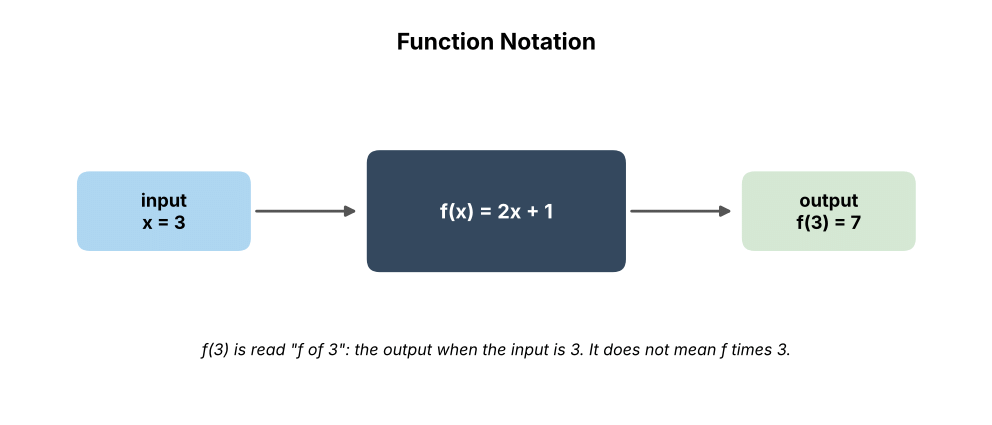
In \(f(x)=3x+2\), the letter \(f\) is the name of the function, \(x\) is the input, and \(f(x)\) is the output. You read it as “f of x.” The parentheses do not mean multiplication here. They hold the input.
| Notation | Meaning | Equivalent Statement |
|---|---|---|
| \(f(x)=3x+2\) | The rule for function \(f\) | \(y=3x+2\) |
| \(f(4)\) | The output when the input is 4 | The \(y\) value when \(x=4\) |
| \(f(4)=14\) | Input 4 gives output 14 | The point \((4, 14)\) is on the graph |
| \(f(x)=14\) | Find the input that gives output 14 | Solve \(3x+2=14\) |
Why does this matter? The third row connects notation to graphs. Every statement of the form \(f(a)=b\) is really a point \((a, b)\). Once you see that, questions about tables, graphs, and equations all become the same question.
Evaluating Functions
To evaluate, replace every \(x\) in the rule with the input inside the parentheses. Use parentheses around the substituted value.
Worked example 1: Let \(g(x)=x^{2}-4x+1\). Find \(g(-3)\).
- Substitute: \(g(-3)=(-3)^{2}-4(-3)+1\).
- Simplify: \(9+12+1=22\).
Worked example 2: Let \(f(x)=2x-5\). Find \(f(a+3)\).
- Substitute the whole expression: \(f(a+3)=2(a+3)-5\).
- Distribute and combine: \(2a+6-5=2a+1\).
You can also combine outputs. If \(f(x)=2x-5\), then \(f(4)+f(1)=3+(-3)=0\), and \(3f(2)=3(-1)=-3\). Evaluate each function call first, then do the arithmetic.
Why does this matter? Example 2 shows that an input can be any expression, not just a number. This skill appears again when you work with transformations and compositions in later courses, so practicing it now pays off.
Solving for the Input
When a question gives the output and asks for the input, set the rule equal to that output and solve.
Worked example 3: Let \(h(x)=\frac{1}{2}x+7\). For what value of \(x\) is \(h(x)=19\)?
- Set up the equation: \(\frac{1}{2}x+7=19\).
- Subtract 7: \(\frac{1}{2}x=12\).
- Multiply by 2: \(x=24\).
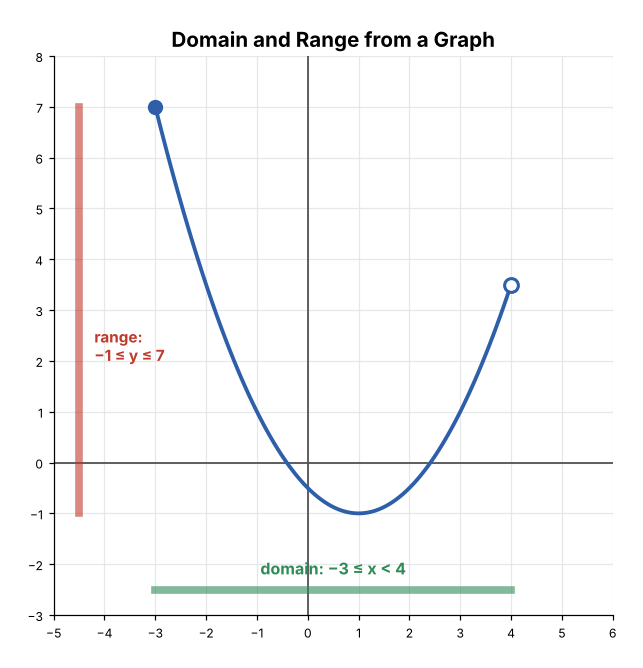
With graphs, find the output value on the \(y\) axis, move across to the graph, and read the \(x\) value below. With tables, find the output in the output column and read its input.
Why does this matter? Some functions reach the same output from more than one input. If \(p(x)=x^{2}\), then \(p(x)=9\) has two solutions, \(x=3\) and \(x=-3\). A linear function like \(h\) gives only one answer, but always check whether the question expects more than one input. Reading a graph makes this visible: draw a horizontal line at the output and count how many times it crosses the curve.
Function Notation in Context
Real-world functions use meaningful letters. Suppose \(C(m)=25+2m\) gives the cost in dollars of renting a kayak for \(m\) hours.
- \(C(3)=31\) means a 3-hour rental costs 31 dollars.
- Solving \(C(m)=45\) gives \(m=10\), so a 45-dollar budget covers a 10-hour rental.
- \(C(0)=25\) is the fixed fee you pay before using the kayak at all.
Why does this matter? Interpretation questions are common because they test understanding rather than arithmetic. Always state the input and output with their units, such as “3 hours” and “31 dollars,” when you explain what a function statement means.
Test-Taking Strategies
Mnemonic Devices and Memory Shortcuts
Think “inside in, outside out.” The value inside the parentheses is the input, and the value the function equals is the output. Also remember “f of a equals b means the point a comma b.”
Cross-Topic Connections
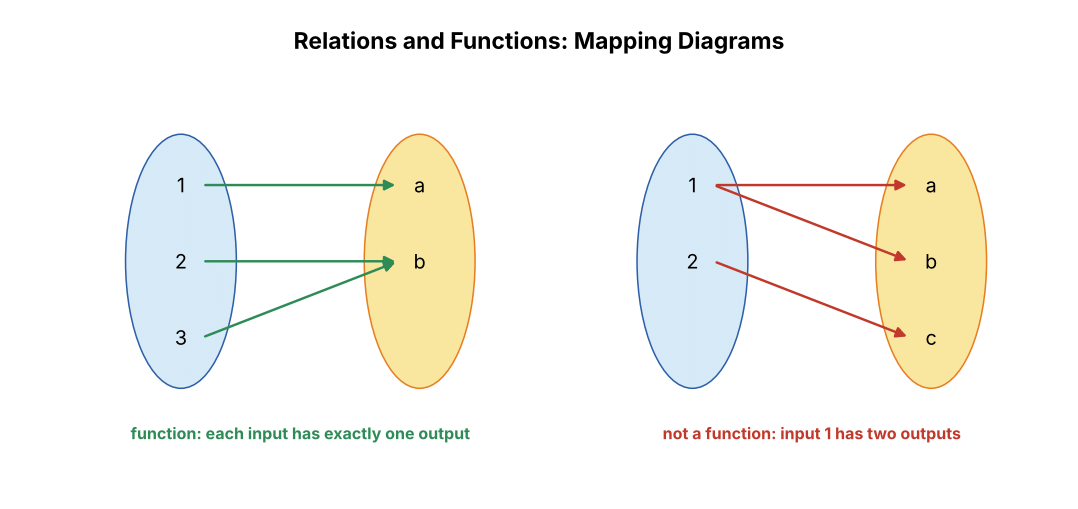
- Function notation only applies to relations that pass the test in Topic 4.1: Relations and Functions.
- Evaluating relies on careful substitution from Topic 1.2: Order of Operations.
- Solving \(f(x)=k\) uses the steps from Topic 2.2: Solving Two-Step Equations.
- Linear functions in this notation are graphed in Topic 5.5: Graphing Linear Equations.
Common Question Formats
- Evaluate a function at a given input, often a negative number.
- Find the input that produces a given output.
- Read \(f(a)\) from a graph or table.
- Interpret a statement like \(P(5)=120\) in a word problem.
Frequent Student Mistakes
- Treating \(f(x)\) as \(f\) times \(x\). The parentheses hold an input.
- Confusing \(f(4)\) with \(f(x)=4\). The first asks for an output, while the second asks for an input.
- Substituting an expression without parentheses, as in writing \(2a+3-5\) for \(f(a+3)\).
Test-Day Shortcuts
Before computing, decide whether the question gives the input or the output. Write “input” or “output” next to the given number. That single label prevents the most common mix-up in this topic.
Time Management Tips
Evaluation items on Algebra 1 unit tests and end-of-course exams usually take under a minute. Interpretation items take a bit longer because you need to read carefully, so give them about two minutes. If you are stuck, translate the notation into an ordered pair first.