
The area of a rectangle with sides \(x+3\) and \(x+5\) is a product of two binomials. Expanding that product into \(x^{2}+8x+15\) is the skill this topic builds. Multiplying polynomials is also the reverse of factoring, so getting comfortable with it now makes the next three topics much easier.
This article covers Topic 9.2: Multiplying Polynomials in Unit 9, Polynomials and Factoring. The topic asks you to multiply monomials, binomials, and larger polynomials using the distributive property and organized methods.
By the end, you should be able to:
- Multiply a monomial by a polynomial.
- Multiply two binomials using the distributive property, FOIL, or a box model.
- Multiply a binomial by a trinomial without missing any products.
- Simplify products completely and write them in standard form.
Monomial Times Polynomial
Distribute the monomial to every term, multiplying coefficients and adding exponents on matching variables.
Worked example 1: Multiply \(-3x^{2}(4x^{2}-2x+5)\).
- First term: \(-3x^{2}\cdot 4x^{2}=-12x^{4}\).
- Second term: \(-3x^{2}\cdot(-2x)=6x^{3}\).
- Third term: \(-3x^{2}\cdot 5=-15x^{2}\).
- Result: \(-12x^{4}+6x^{3}-15x^{2}\).
Why does this matter? When you multiply, exponents add. This is the opposite of combining like terms, where exponents never change. Mixing up the two rules is the most common error in Unit 9.
Binomial Times Binomial
Every method for multiplying binomials is the distributive property in disguise. Each term in the first binomial must multiply each term in the second, giving four products.
| Method | How It Works | Best For |
|---|---|---|
| Distributive | Split the first binomial and distribute each part: \((x+3)(x+5)=x(x+5)+3(x+5)\). | Seeing why the process works. |
| FOIL | Multiply First, Outer, Inner, and Last terms, then combine. | Quick binomial products. |
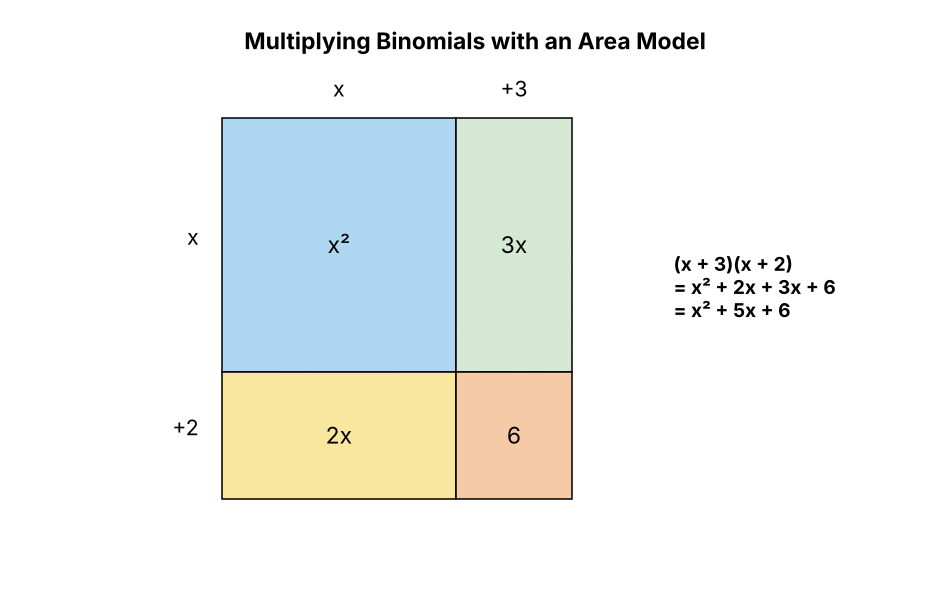
| Box model | Write one binomial across the top of a grid and one down the side. Fill each cell with a product. | Keeping track of signs and larger polynomials. |
Worked example 2: Multiply \((2x-3)(x+4)\) with FOIL.
- First: \(2x\cdot x=2x^{2}\).
- Outer: \(2x\cdot 4=8x\).
- Inner: \(-3\cdot x=-3x\).
- Last: \(-3\cdot 4=-12\).
- Combine the middle terms: \(2x^{2}+5x-12\).
The box model for the same problem has four cells: \(2x^{2}\), \(8x\), \(-3x\), and \(-12\). Like terms sit on a diagonal of the box, which makes them easy to spot and combine.
Larger Products
FOIL only works for two binomials. For anything larger, use distribution or a box model and count the products. A binomial times a trinomial produces \(2\cdot 3=6\) products before combining.
Worked example 3: Multiply \((x+2)(x^{2}-3x+4)\).
- Distribute \(x\): \(x^{3}-3x^{2}+4x\).
- Distribute 2: \(2x^{2}-6x+8\).
- Add and combine like terms: \(x^{3}-x^{2}-2x+8\).
Worked example 4: Expand \((x-5)^{2}\).
- Rewrite as a product: \((x-5)(x-5)\).
- Multiply: \(x^{2}-5x-5x+25\).
- Combine: \(x^{2}-10x+25\).
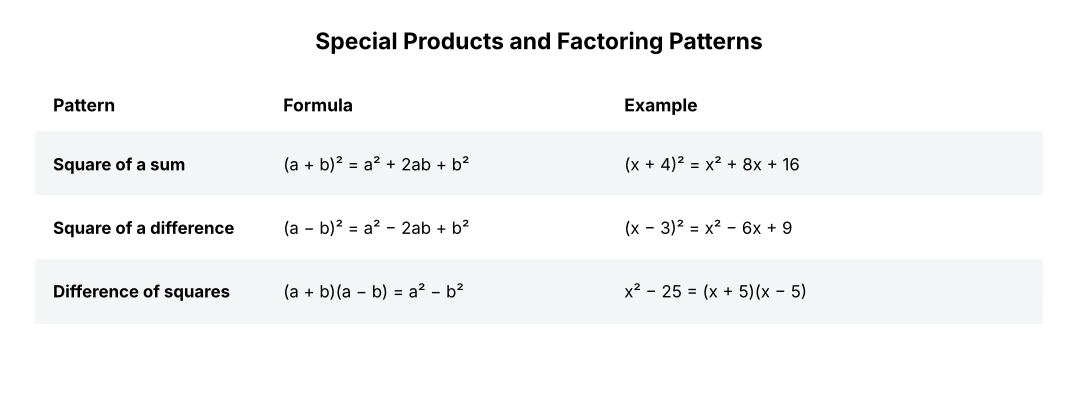
Why does this matter? Example 4 shows why \((x-5)^{2}\) is not \(x^{2}+25\) or \(x^{2}-25\). Squaring a binomial always produces a middle term. Forgetting it is so common that the next topics treat these products as special patterns worth memorizing.
A quick count also protects you. If you multiply a binomial by a trinomial and write fewer than six products before combining, you skipped one. Counting products takes two seconds and catches the most frequent omission.
Multiplying in Context
Area problems are the most common real-world use of polynomial multiplication. Suppose a garden measures \(x+3\) feet by \(x+5\) feet, and a path 2 feet wide will surround it on all sides.
- Garden area: \((x+3)(x+5)=x^{2}+8x+15\) square feet.
- Garden plus path: Each dimension grows by 4 feet, so the total area is \((x+7)(x+9)=x^{2}+16x+63\) square feet.
- Path alone: Subtract the garden from the total: \((x^{2}+16x+63)-(x^{2}+8x+15)=8x+48\) square feet.
Why does this matter? The path adds 2 feet on each side, so each dimension grows by 4 feet, not 2. Sketching a quick diagram before multiplying prevents that error and shows which product represents which region.
Test-Taking Strategies
Mnemonic Devices and Memory Shortcuts
FOIL stands for First, Outer, Inner, Last. For bigger products, remember “every term shakes hands with every term.” The number of handshakes equals the number of terms in the first polynomial times the number in the second.
Cross-Topic Connections
- Distribution is the core move from Topic 1.4: Combining Like Terms and the Distributive Property.
- Multiplying variables uses the product rule from Topic 7.1: Properties of Exponents.
- Collecting the final terms uses Topic 9.1: Adding and Subtracting Polynomials.
- Converting vertex or factored form to standard form uses this skill in Topic 10.2: Forms of Quadratic Functions.
Common Question Formats
- Multiply two binomials and choose the expanded form.
- Write the area of a rectangle or square as a polynomial.
- Find a specific coefficient in an expanded product, such as the \(x\) term.
- Identify the error in a student’s FOIL work.
Frequent Student Mistakes
- Squaring a binomial by squaring each term, as in \((x+3)^{2}=x^{2}+9\).
- Dropping a negative sign in the Inner or Last product.
- Adding coefficients instead of multiplying them in a monomial product.
Test-Day Shortcuts
If a question only asks for one coefficient, compute just the products that create that term. For the \(x\) term of \((2x-3)(x+4)\), add only the Outer and Inner products: \(8x-3x=5x\). Check full expansions by substituting \(x=1\) into both forms.
Time Management Tips
Binomial products on Algebra 1 unit tests and end-of-course exams take about a minute. Binomial-times-trinomial products take two to three minutes, so use a box model to stay organized. Count your products before combining to avoid reworking the whole problem.