
Some polynomial products show up so often that it pays to recognize them on sight. The square of a binomial and the difference of two squares follow fixed patterns. Spotting them lets you multiply in one step and factor in seconds, without listing factor pairs or splitting middle terms.
This article covers Topic 9.5: Special Products and Factoring Patterns in Unit 9, Polynomials and Factoring. The topic asks you to expand and factor perfect square trinomials and differences of two squares, and to use these patterns to factor completely.
By the end, you should be able to:
- Expand \((a+b)^{2}\), \((a-b)^{2}\), and \((a+b)(a-b)\) using patterns.
- Recognize a perfect square trinomial and factor it.
- Recognize a difference of two squares and factor it.
- Explain why a sum of two squares cannot be factored over the integers.
The Three Special Products
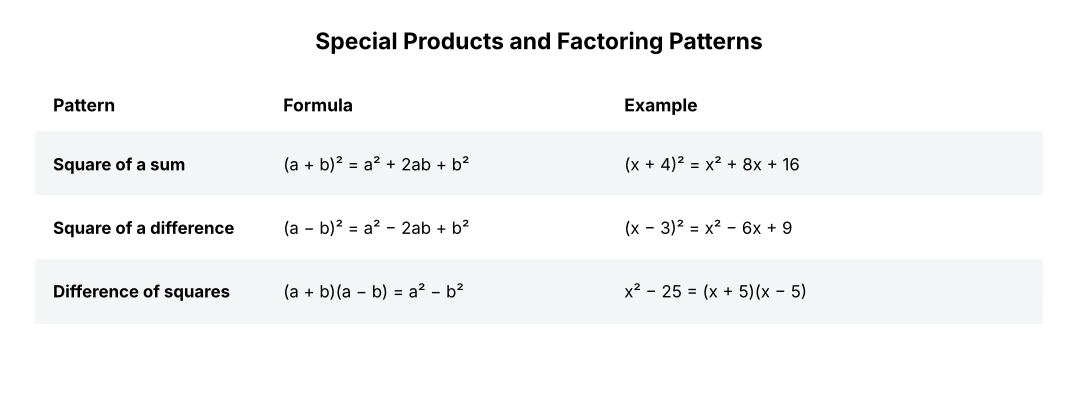
| Pattern | Formula | Example |
|---|---|---|
| Square of a sum | \((a+b)^{2}=a^{2}+2ab+b^{2}\) | \((x+6)^{2}=x^{2}+12x+36\) |
| Square of a difference | \((a-b)^{2}=a^{2}-2ab+b^{2}\) | \((3y-2)^{2}=9y^{2}-12y+4\) |
| Sum times difference | \((a+b)(a-b)=a^{2}-b^{2}\) | \((x+7)(x-7)=x^{2}-49\) |
Each pattern comes straight from FOIL. In \((a+b)(a-b)\), the Outer and Inner products are \(-ab\) and \(+ab\), which cancel. That is why the middle term disappears and only two squares remain.
Why does this matter? The middle term of a squared binomial is always twice the product of the two terms. Writing \((x+6)^{2}=x^{2}+36\) is the single most common error in this unit. Remembering “square, double, square” keeps the middle term in place.
Factoring Perfect Square Trinomials
A trinomial is a perfect square trinomial when three conditions hold:
- The first term is a perfect square, \(a^{2}\).
- The last term is a perfect square, \(b^{2}\), and it is positive.
- The middle term equals \(2ab\) or \(-2ab\).
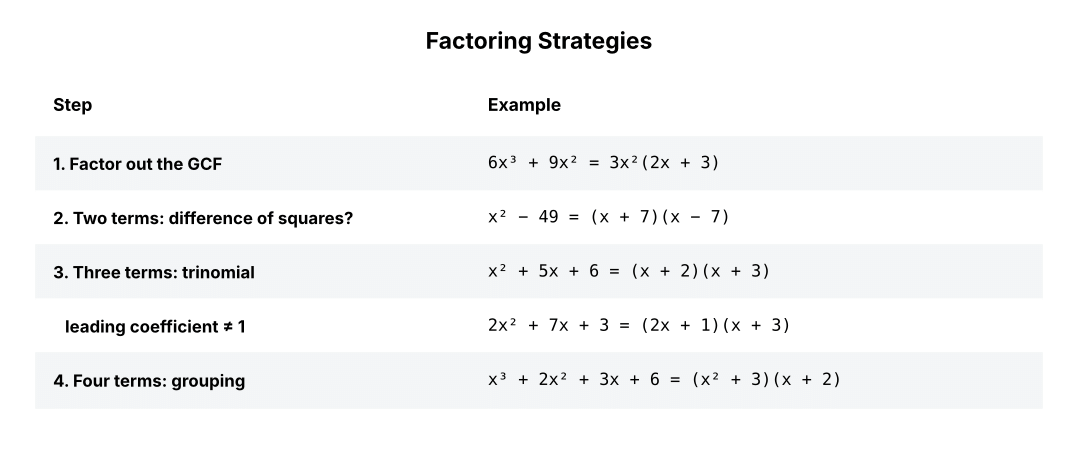
Worked example 1: Factor \(x^{2}-10x+25\).
- First term: \(x^{2}\), so \(a=x\).
- Last term: 25, so \(b=5\).
- Check the middle: \(2ab=2(x)(5)=10x\). The middle term is \(-10x\), so the pattern is a square of a difference.
- Result: \((x-5)^{2}\).
Worked example 2: Factor \(4x^{2}+12x+9\).
- \(a=2x\) and \(b=3\).
- Check: \(2(2x)(3)=12x\), which matches.
- Result: \((2x+3)^{2}\).
If the middle term does not match, the trinomial is not a perfect square. For example, \(x^{2}+8x+25\) has perfect squares at both ends, but \(2(x)(5)=10x\), not \(8x\). Use the general methods from the previous topic instead.
Factoring a Difference of Two Squares
A binomial of the form \(a^{2}-b^{2}\) factors as \((a+b)(a-b)\). Look for two perfect squares separated by subtraction.
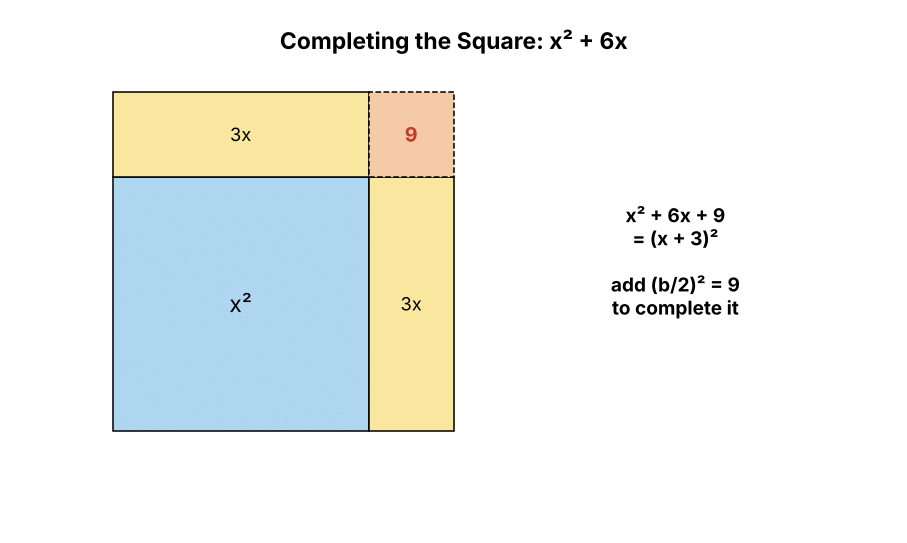
Worked example 3: Factor \(16x^{2}-81\).
- \(16x^{2}=(4x)^{2}\) and \(81=9^{2}\).
- Result: \((4x+9)(4x-9)\).
Worked example 4: Factor \(2x^{3}-50x\) completely.
- Factor out the GCF: \(2x(x^{2}-25)\).
- Recognize a difference of squares: \(x^{2}-25=(x+5)(x-5)\).
- Result: \(2x(x+5)(x-5)\).
Worked example 5: Factor \(x^{4}-16\) completely.
- First pass: \((x^{2}+4)(x^{2}-4)\).
- The second factor is another difference of squares: \(x^{2}-4=(x+2)(x-2)\).
- Result: \((x^{2}+4)(x+2)(x-2)\).
Why does this matter? A sum of two squares, like \(x^{2}+4\), cannot be factored using real numbers. No two real binomials multiply to give a positive square plus a positive square with no middle term. Recognizing that tells you when to stop factoring.
These patterns also speed up mental math. To compute \(51\cdot 49\), write it as \((50+1)(50-1)=2500-1=2499\). The same idea turns many arithmetic shortcuts into quick algebra.
Completing a Perfect Square
Many questions ask you to find the value that makes a trinomial a perfect square. Work from the pattern \(a^{2}+2ab+b^{2}\).
- Missing last term: For \(x^{2}+14x+c\), the middle term \(14x\) equals \(2ab\) with \(a=x\), so \(b=7\) and \(c=49\). Take half the middle coefficient and square it.
- Missing middle term: For \(9x^{2}+bx+16\), you have \(a=3x\) and \(b=4\), so the middle term is \(2(3x)(4)=24x\) or \(-24x\). Both signs work.
- Missing first coefficient: For \(kx^{2}+20x+25\), you have \(b=5\) and \(2ab=20x\), so \(a=2x\) and \(k=4\).
Why does this matter? The “half the middle coefficient, then square it” rule is the heart of completing the square, a method you will use to rewrite quadratics in vertex form and to derive the quadratic formula. Practicing it here makes that later topic feel familiar.
Test-Taking Strategies
Mnemonic Devices and Memory Shortcuts
For squared binomials, say “square the first, double the product, square the last.” For the difference of squares, remember “same terms, opposite signs.” A sum of squares is “stuck,” since it does not factor.
Cross-Topic Connections
- Each pattern is a shortcut for FOIL from Topic 9.2: Multiplying Polynomials.
- Always remove the GCF first, as in Topic 9.3: Factoring Out the Greatest Common Factor.
- When no pattern fits, use Topic 9.4: Factoring Trinomials.
- Perfect squares connect to square roots in Topic 8.1: Simplifying Radicals.
Common Question Formats
- Expand a squared binomial or a sum-times-difference product.
- Identify which trinomial is a perfect square.
- Factor a difference of squares, often after removing a GCF.
- Find the missing term that makes a trinomial a perfect square.
Frequent Student Mistakes
- Dropping the middle term when squaring a binomial.
- Trying to factor a sum of squares like \(x^{2}+9\).
- Stopping too early, such as leaving \(x^{2}-4\) unfactored inside \(x^{4}-16\).
Test-Day Shortcuts
Scan the first and last terms for perfect squares before trying any other method. If both are squares and the expression is a binomial with subtraction, factor it immediately. For a missing middle term, compute \(2ab\) directly.
Time Management Tips
Special-product items on Algebra 1 unit tests and end-of-course exams usually take under a minute once you spot the pattern. If no pattern appears within a few seconds, switch to general trinomial factoring rather than forcing one.