
Angles are everywhere in geometry: in triangles, polygons, parallel lines, and circles. Before you can use any of the angle theorems later in the course, you need to name angles correctly, measure them, classify them by size, and apply the Angle Addition Postulate. These skills look simple, but they underpin nearly every proof and calculation that follows.
This article covers Topic 1.4: Measuring and Classifying Angles in Unit 1, Foundations of Geometry. The topic asks you to name and measure angles, classify them as acute, right, obtuse, or straight, and use the Angle Addition Postulate and angle bisectors to find unknown measures.
By the end, you should be able to:
- Name an angle three ways and identify its vertex and sides.
- Classify angles by their measures.
- Use the Angle Addition Postulate to solve for unknown measures.
- Use the definition of an angle bisector to set up equations.
Naming Angles
An angle is formed by two rays, called sides, that share a common endpoint, called the vertex. You can name the angle with the vertex alone, with three points, or with a number.
- Three points: \(\angle ABC\) or \(\angle CBA\). The vertex must be the middle letter.
- Vertex only: \(\angle B\). This works only when one angle has its vertex at \(B\).
- Number: \(\angle 1\), written inside the angle in a diagram.
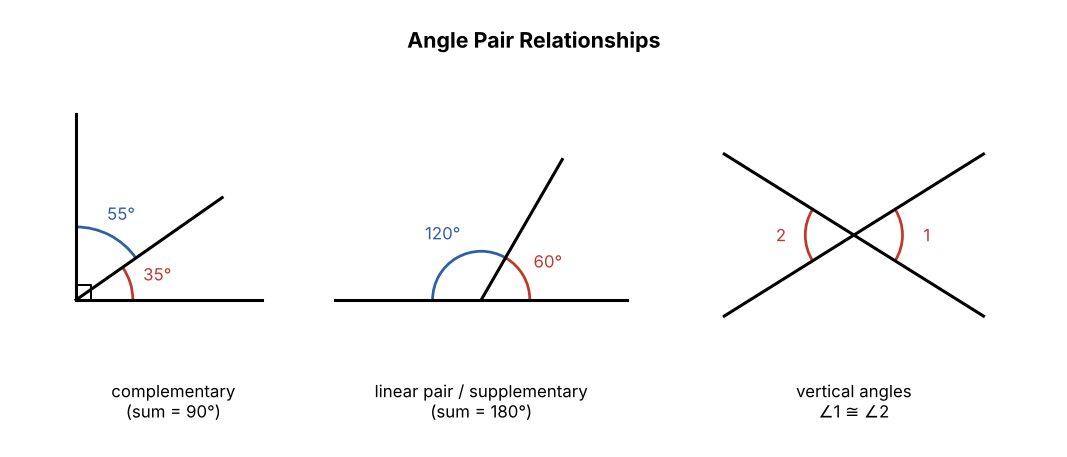
The measure of an angle is written with an \(m\): \(m\angle ABC=40^{\circ}\). As with segments, use \(\cong\) for congruent angles and \(=\) for their measures.
Why does this matter? When several angles share a vertex, naming one as \(\angle B\) is ambiguous. Tests often show a diagram with three rays from one point. Using the three-letter name with the vertex in the middle is the only way to be clear.
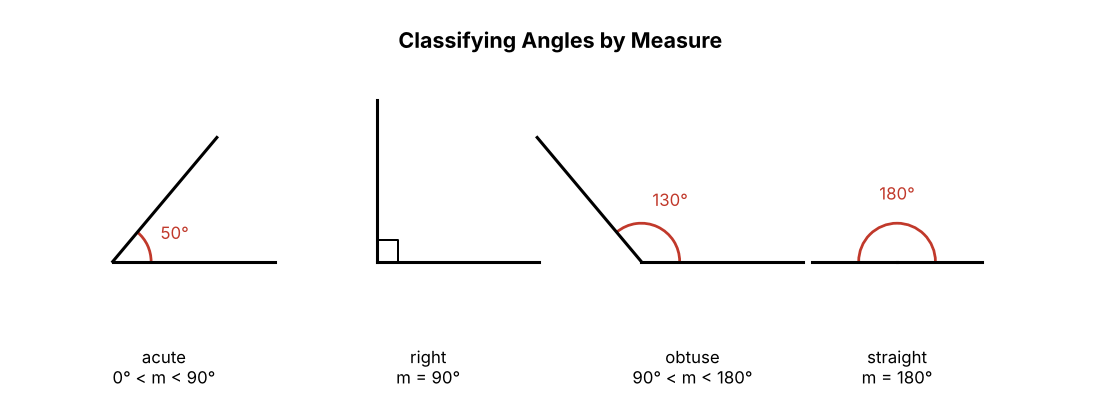
Classifying Angles
| Type | Measure | Example |
|---|---|---|
| Acute | Greater than \(0^{\circ}\) and less than \(90^{\circ}\) | The angle of a slice of pizza |
| Right | Exactly \(90^{\circ}\) | The corner of a sheet of paper |
| Obtuse | Greater than \(90^{\circ}\) and less than \(180^{\circ}\) | A reclining chair leaning back |
| Straight | Exactly \(180^{\circ}\) | Two opposite rays forming a line |
A small square at the vertex marks a right angle in a diagram. Without that mark, or a stated measure, do not assume an angle is \(90^{\circ}\), even if it looks like one.
Measuring With a Protractor
To measure an angle, place the protractor’s center on the vertex and line up one side with \(0^{\circ}\). Read the scale where the other side crosses. Protractors have two scales, so choose the one that starts at \(0^{\circ}\) on your aligned side. A quick check helps: if the angle looks acute, the reading must be less than \(90^{\circ}\). If your reading and your estimate disagree, you are probably reading the wrong scale.
The Angle Addition Postulate
If point \(D\) lies in the interior of \(\angle ABC\), then \(m\angle ABD+m\angle DBC=m\angle ABC\). Like segment addition, the parts add up to the whole.
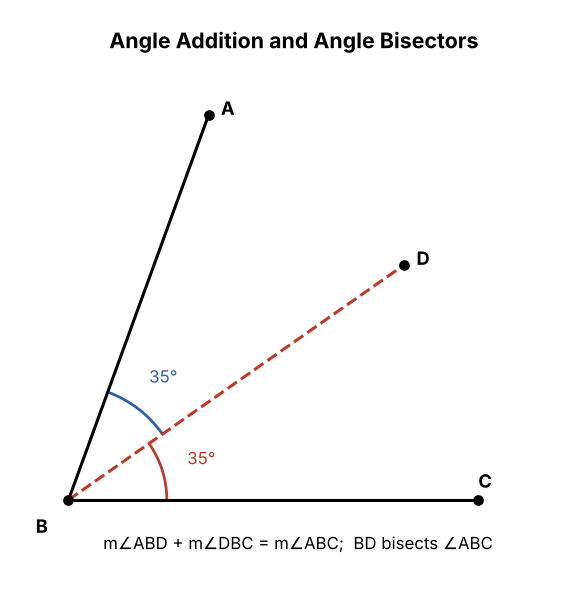
Worked example 1: \(m\angle ABD=(3x+10)^{\circ}\), \(m\angle DBC=(2x-5)^{\circ}\), and \(m\angle ABC=105^{\circ}\). Find \(x\) and \(m\angle ABD\).
- Write the equation: \((3x+10)+(2x-5)=105\).
- Combine: \(5x+5=105\).
- Solve: \(x=20\).
- Substitute: \(m\angle ABD=3(20)+10=70^{\circ}\). Check: \(m\angle DBC=35^{\circ}\), and \(70+35=105\).
Angle Bisectors
An angle bisector is a ray that divides an angle into two congruent angles. If \(\overrightarrow{BD}\) bisects \(\angle ABC\), then \(m\angle ABD=m\angle DBC\), and each equals half of \(m\angle ABC\).
Worked example 2: \(\overrightarrow{BD}\) bisects \(\angle ABC\), with \(m\angle ABD=(4x-6)^{\circ}\) and \(m\angle DBC=(2x+18)^{\circ}\). Find \(m\angle ABC\).
- Set the halves equal: \(4x-6=2x+18\).
- Solve: \(2x=24\), so \(x=12\).
- One half: \(4(12)-6=42^{\circ}\).
- Whole angle: \(m\angle ABC=84^{\circ}\).
Why does this matter? Segment midpoints and angle bisectors follow the same logic: two equal halves make a whole. Recognizing that parallel means you can solve both kinds of problems with one strategy.
Test-Taking Strategies
Mnemonic Devices and Memory Shortcuts
“Acute is a cute little angle” helps you remember acute angles are small. For naming, say “vertex in the middle.” For bisectors, “bi means two equal parts.”
Cross-Topic Connections
- Angles are built from the rays in Topic 1.1: Points, Lines, and Planes.
- Bisecting an angle mirrors finding a midpoint in Topic 1.3: The Midpoint Formula.
- Angle addition parallels segment addition in Topic 1.2: Measuring Segments and the Distance Formula.
- Solving for \(x\) uses Algebra 1 Topic 2.3: Solving Multi-Step Equations.
Common Question Formats
- Name an angle in a diagram with several rays from one vertex.
- Classify an angle given its measure or its algebraic expression.
- Use the Angle Addition Postulate to find \(x\) and an angle measure.
- Use an angle bisector to find the measure of the whole angle.
Frequent Student Mistakes
- Putting the vertex first or last in a three-letter name.
- Assuming an angle is right because it looks square.
- Reporting \(x\) instead of the angle measure the question asks for.
Test-Day Shortcuts
Estimate before calculating. If an angle in the diagram is clearly acute, any answer over \(90^{\circ}\) is wrong. Diagrams are not always to scale, but a gross mismatch usually means an algebra error.
Time Management Tips
Angle naming and classification items on Geometry unit tests and end-of-course exams take under a minute. Angle addition and bisector problems take one to two minutes. Always plug \(x\) back in to check that the parts sum to the whole.