
When two angles sit next to each other or across from each other, their measures are often linked. Complementary angles sum to \(90^{\circ}\), supplementary angles sum to \(180^{\circ}\), and vertical angles are always equal. These relationships turn diagrams full of unknown angles into simple equations, and they appear in nearly every geometry unit that follows.
This article covers Topic 1.5: Angle Pair Relationships in Unit 1, Foundations of Geometry. The topic asks you to identify adjacent angles, linear pairs, vertical angles, and complementary and supplementary angles, and to use these relationships to find unknown angle measures.
By the end, you should be able to:
- Identify adjacent angles, linear pairs, and vertical angles in a diagram.
- Distinguish complementary angles from supplementary angles.
- Use angle pair relationships to write and solve equations.
- Explain why vertical angles are congruent.
Types of Angle Pairs
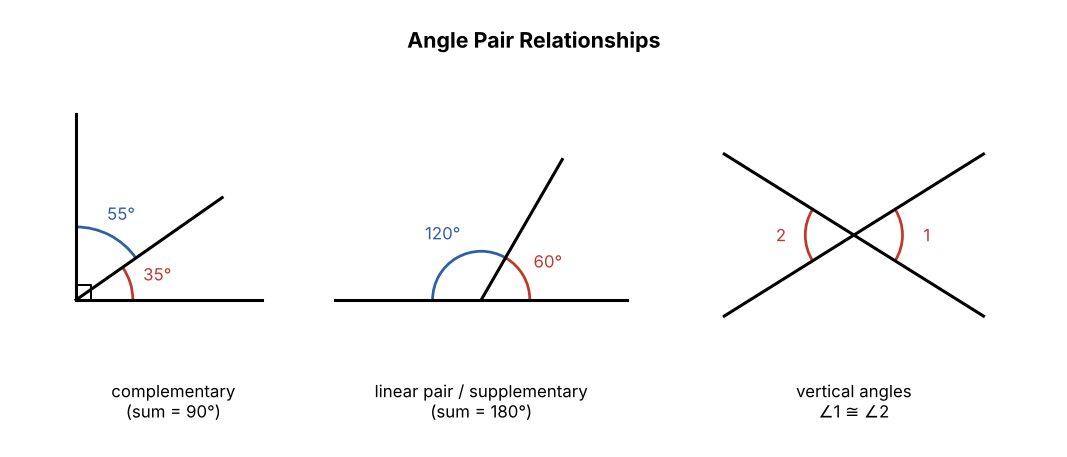
| Pair | Definition | Measure Relationship |
|---|---|---|
| Adjacent angles | Share a vertex and a side, with no overlapping interior. | No fixed relationship on their own. |
| Linear pair | Adjacent angles whose outer sides are opposite rays. | Always sum to \(180^{\circ}\). |
| Vertical angles | Nonadjacent angles formed by two intersecting lines. | Always congruent. |
| Complementary angles | Any two angles whose measures sum to \(90^{\circ}\). | Sum to \(90^{\circ}\). |
| Supplementary angles | Any two angles whose measures sum to \(180^{\circ}\). | Sum to \(180^{\circ}\). |
Why does this matter? Complementary and supplementary angles do not have to be adjacent. A \(30^{\circ}\) angle in one corner of a page and a \(60^{\circ}\) angle in another corner are still complementary. A linear pair, however, must be adjacent, and every linear pair is supplementary.
Vertical Angles
When two lines intersect, they form two pairs of vertical angles across from each other. Vertical angles are always congruent, and you can prove it with linear pairs.
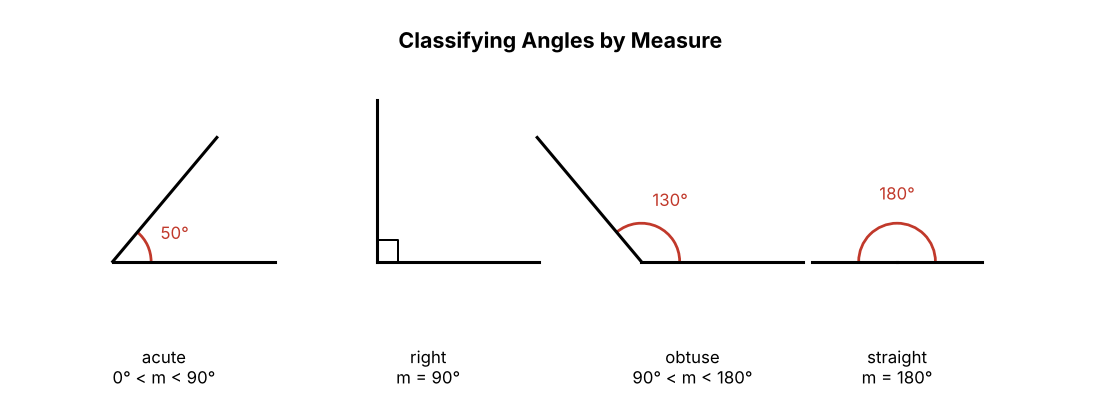
- Suppose \(\angle 1\) and \(\angle 2\) form a linear pair, so \(m\angle 1+m\angle 2=180^{\circ}\).
- \(\angle 2\) and \(\angle 3\) also form a linear pair, so \(m\angle 2+m\angle 3=180^{\circ}\).
- Both sums equal \(180^{\circ}\), so \(m\angle 1+m\angle 2=m\angle 2+m\angle 3\).
- Subtract \(m\angle 2\) from both sides: \(m\angle 1=m\angle 3\).
This short argument is your first real geometry proof. It shows how a theorem follows from definitions and the properties of equality.
Solving Angle Pair Problems
Worked example 1: Two angles are complementary. One measures \((2x+8)^{\circ}\) and the other measures \((3x+2)^{\circ}\). Find both angles.
- Write the sum: \((2x+8)+(3x+2)=90\).
- Combine: \(5x+10=90\).
- Solve: \(x=16\).
- Substitute: the angles measure \(40^{\circ}\) and \(50^{\circ}\).
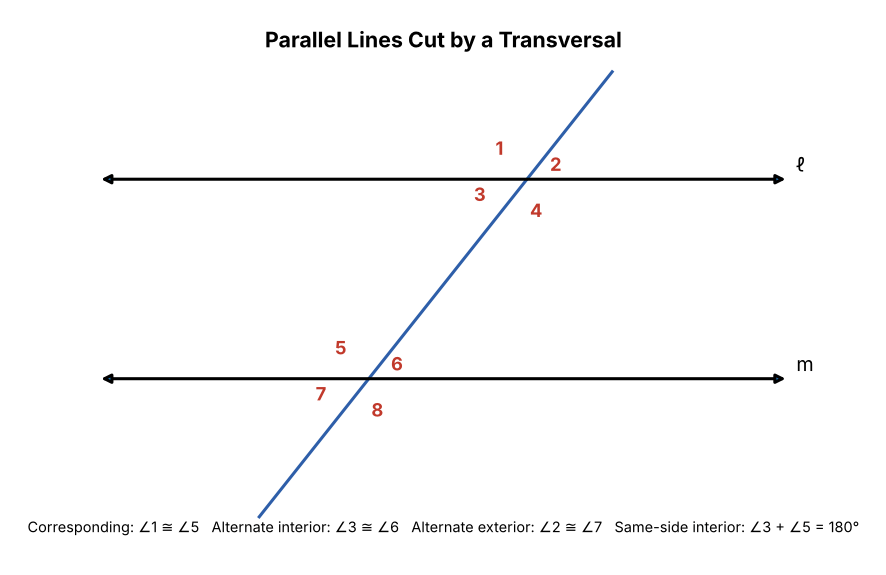
Worked example 2: Two intersecting lines form vertical angles of \((5x-12)^{\circ}\) and \((3x+20)^{\circ}\). Find each angle in the figure.
- Vertical angles are equal: \(5x-12=3x+20\).
- Solve: \(2x=32\), so \(x=16\).
- Each vertical angle measures \(5(16)-12=68^{\circ}\).
- The other pair forms linear pairs with these, so each measures \(180-68=112^{\circ}\).
Worked example 3: An angle measures \(20^{\circ}\) more than its supplement. Find both angles.
- Let the angle be \(x\). Its supplement is \(180-x\).
- Translate: \(x=(180-x)+20\).
- Solve: \(2x=200\), so \(x=100\). The supplement is \(80^{\circ}\).
Why does this matter? Example 3 shows a common word-problem format. Writing the complement as \(90-x\) or the supplement as \(180-x\) turns any “more than” or “times” sentence into a one-variable equation.
Perpendicular Lines
Perpendicular lines intersect to form right angles, written \(\ell\perp m\). When two lines are perpendicular, all four angles they form measure \(90^{\circ}\). Each adjacent pair is both a linear pair and a pair of congruent angles. If two lines form a linear pair of congruent angles, the lines must be perpendicular, because two equal angles that sum to \(180^{\circ}\) must each be \(90^{\circ}\).
Why does this matter? This converse is how you prove lines are perpendicular in later units. Instead of measuring, you show that two adjacent angles on a line are congruent, which forces both to be right angles.
Test-Taking Strategies
Mnemonic Devices and Memory Shortcuts
“C comes before S, and 90 comes before 180,” so complementary is 90 and supplementary is 180. You can also think “Corner” for complementary and “Straight” for supplementary. Vertical angles are “across the X” and always match.
Cross-Topic Connections
- Angle measures and classifications come from Topic 1.4: Measuring and Classifying Angles.
- Opposite rays that form a linear pair are defined in Topic 1.1: Points, Lines, and Planes.
- Setting vertical angles equal uses Algebra 1 Topic 2.4: Equations with Variables on Both Sides.
- Perpendicular lines on a grid have opposite reciprocal slopes, as in Algebra 1 Topic 5.7: Parallel and Perpendicular Lines.
Common Question Formats
- Identify vertical angles or linear pairs in a diagram.
- Find the complement or supplement of a given angle.
- Solve for \(x\) using a vertical angle or linear pair relationship.
- Translate an angle word problem into an equation.
Frequent Student Mistakes
- Mixing up complementary and supplementary.
- Calling adjacent angles vertical because they share a vertex.
- Setting a linear pair equal instead of adding to \(180^{\circ}\).
Test-Day Shortcuts
Once you know one angle where two lines cross, you know all four: the vertical angle is equal, and the other two are its supplement. Fill in every angle in the diagram before reading the answer choices.
Time Management Tips
Angle pair items on Geometry unit tests and end-of-course exams usually take one to two minutes. Identify the relationship first and write it as an equation before doing any arithmetic. That single step prevents most errors.