
Geometry is the first math course where you are asked not just to find answers but to prove them. Before you can write a proof, you need to understand the two ways people reason: noticing patterns and making educated guesses, or starting from facts and drawing conclusions that must be true. Telling these two apart is the foundation of every proof you will write this year.
This article covers Topic 2.1: Inductive and Deductive Reasoning in Unit 2, Reasoning and Proof. The topic asks you to make conjectures from patterns, find counterexamples, and use deductive reasoning, including the Law of Detachment and the Law of Syllogism, to reach valid conclusions.
By the end, you should be able to:
- Use inductive reasoning to make a conjecture from a pattern.
- Disprove a conjecture with a single counterexample.
- Apply the Law of Detachment and the Law of Syllogism.
- Explain why deductive reasoning, not inductive reasoning, proves a statement.
Inductive Reasoning and Conjectures
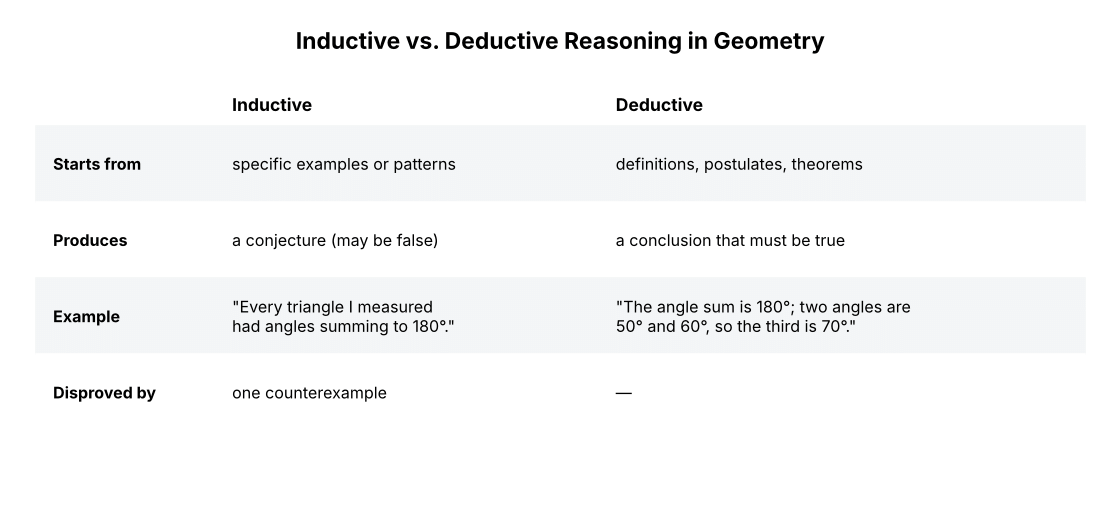
Inductive reasoning looks at specific examples, finds a pattern, and makes a general guess called a conjecture. It is how mathematicians discover new ideas, but it never proves anything.
For example, look at sums of consecutive odd numbers:
- \(1=1\)
- \(1+3=4\)
- \(1+3+5=9\)
- \(1+3+5+7=16\)
Each sum is a perfect square, so you might conjecture that the sum of the first \(n\) odd numbers is \(n^{2}\). That conjecture happens to be true, but checking four cases, or even a thousand, does not prove it for every \(n\).
Why does this matter? Patterns can break. The expression \(n^{2}+n+41\) gives a prime number for every \(n\) from 0 to 39, which could convince anyone it always produces primes. At \(n=40\), the result is \(1681=41^{2}\), which is not prime. Inductive reasoning suggests, but only deduction proves.
Counterexamples
A counterexample is a single example that shows a conjecture is false. One counterexample is enough to disprove a statement, no matter how many examples support it.
| Conjecture | Counterexample |
|---|---|
| The sum of two numbers is greater than either number. | \(5+(-2)=3\), which is less than 5. |
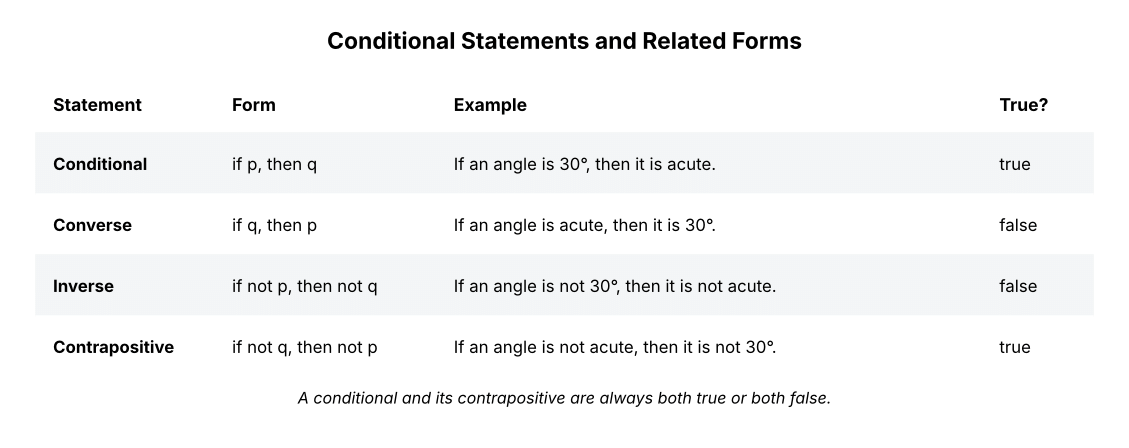
| If an angle is acute, its supplement is acute. | A \(40^{\circ}\) angle has a supplement of \(140^{\circ}\), which is obtuse. |
| All prime numbers are odd. | 2 is prime and even. |
| Squaring a number makes it larger. | \(\left(\frac{1}{2}\right)^{2}=\frac{1}{4}\), which is smaller. |
Good counterexample hunting means testing unusual cases: zero, negative numbers, fractions, the number 1, and figures with special shapes like right or isosceles triangles.
Deductive Reasoning
Deductive reasoning uses facts, definitions, postulates, and previously proven theorems to reach a conclusion that must be true. If the starting statements are true and the logic is valid, the conclusion cannot be false.
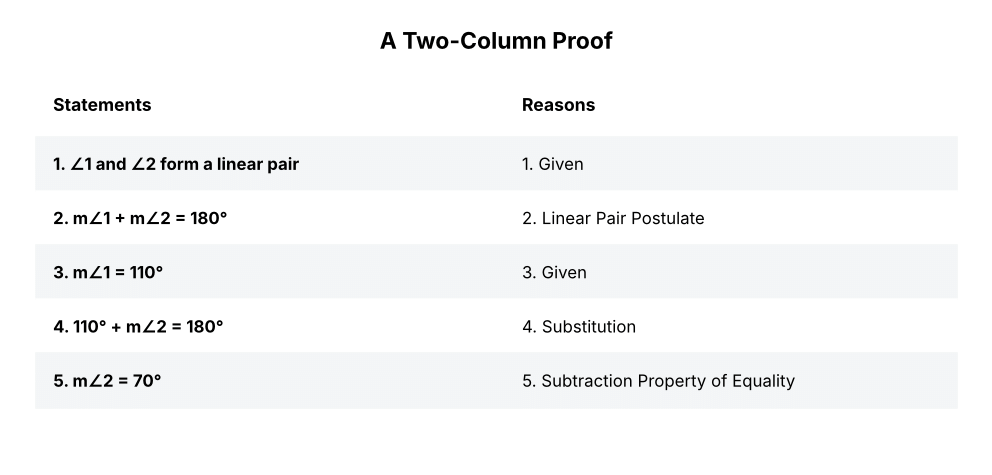
Two laws of logic do most of the work.
- Law of Detachment: If “if \(p\), then \(q\)” is true and \(p\) is true, then \(q\) is true. Example: “If an angle is a right angle, it measures \(90^{\circ}\).” Angle \(A\) is a right angle. So \(m\angle A=90^{\circ}\).
- Law of Syllogism: If “if \(p\), then \(q\)” and “if \(q\), then \(r\)” are both true, then “if \(p\), then \(r\)” is true. Example: “If it rains, the game is canceled” and “If the game is canceled, practice is moved indoors” lead to “If it rains, practice is moved indoors.”
Why does this matter? A common trap reverses the Law of Detachment. Knowing “if \(p\), then \(q\)” and that \(q\) is true does not let you conclude \(p\). If a figure is a square, it has four sides. A figure with four sides might be a rectangle or a trapezoid, so you cannot conclude it is a square.
Inductive Versus Deductive at a Glance
| Feature | Inductive | Deductive |
|---|---|---|
| Starts with | Specific examples or observations | General facts, definitions, and theorems |
| Produces | A conjecture that might be true | A conclusion that must be true |
| Can be disproved by | A single counterexample | Nothing, if the premises are true and the logic is valid |
| Used for | Discovering patterns | Writing proofs |
Test-Taking Strategies
Mnemonic Devices and Memory Shortcuts
“Inductive is In the examples; Deductive Draws a Definite conclusion.” For the Law of Syllogism, picture a chain: \(p\) links to \(q\), \(q\) links to \(r\), so \(p\) links to \(r\).
Cross-Topic Connections
- The proof that vertical angles are congruent is deductive, as shown in Topic 1.5: Angle Pair Relationships.
- Postulates used as starting facts appear in Topic 1.1: Points, Lines, and Planes.
- Properties of real numbers justify algebraic steps, as in Algebra 1 Topic 1.3: Properties of Real Numbers.
- Finding patterns in sequences is inductive reasoning, as in Algebra 1 Topic 4.4: Arithmetic Sequences.
Common Question Formats
- Make a conjecture from a number or figure pattern.
- Choose the counterexample that disproves a statement.
- Decide which conclusion follows from given statements using the Law of Detachment or Syllogism.
- Classify an argument as inductive or deductive.
Frequent Student Mistakes
- Treating many supporting examples as a proof.
- Offering an example that agrees with the conjecture as a “counterexample.”
- Reversing a conditional when applying the Law of Detachment.
Test-Day Shortcuts
For counterexample questions, test each answer choice against both parts of the statement. A true counterexample satisfies the hypothesis but fails the conclusion. For syllogism questions, write each statement as an arrow and look for a chain.
Time Management Tips
Logic items on Geometry unit tests and end-of-course exams usually take about a minute. Read each statement slowly, since one changed word can reverse the logic. Spend extra time only on multi-step syllogism chains.