
“If two angles are vertical angles, then they are congruent.” Almost every definition, postulate, and theorem in geometry can be written as an if-then statement like this one. Knowing how to rewrite these statements, and which rewrites keep their truth value, is essential for reading theorems correctly and building valid proofs.
This article covers Topic 2.2: Conditional Statements in Unit 2, Reasoning and Proof. The topic asks you to identify the hypothesis and conclusion of a conditional, write its converse, inverse, and contrapositive, determine truth values, and recognize biconditional statements.
By the end, you should be able to:
- Write a statement in if-then form and identify its hypothesis and conclusion.
- Form the converse, inverse, and contrapositive of a conditional.
- Determine whether each related statement is true or false.
- Write and evaluate biconditional statements and good definitions.
Parts of a Conditional
A conditional statement has the form “if \(p\), then \(q\),” written \(p\rightarrow q\). The part after “if” is the hypothesis, and the part after “then” is the conclusion.
Statements are not always written in if-then form. “All right angles are congruent” becomes “If two angles are right angles, then they are congruent.” “A rectangle has four right angles” becomes “If a figure is a rectangle, then it has four right angles.” Rewriting first makes the hypothesis and conclusion easy to see.
A conditional is false only when the hypothesis is true and the conclusion is false. To show a conditional is false, give one counterexample that meets the hypothesis but fails the conclusion.
Converse, Inverse, and Contrapositive
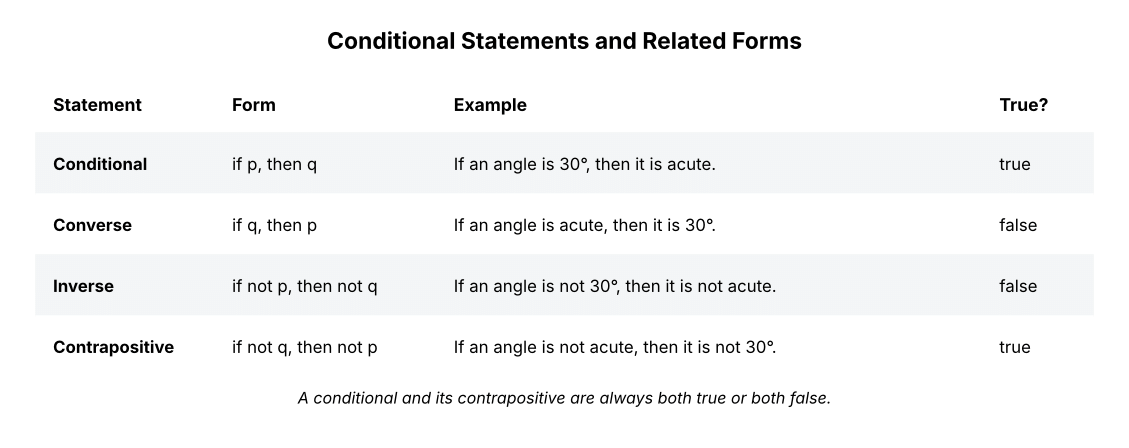
The negation of a statement \(p\), written \(\sim p\), is its opposite. From any conditional, you can form three related statements.
| Statement | Form | Example | True? |
|---|---|---|---|
| Conditional | \(p\rightarrow q\) | If an animal is a dog, then it is a mammal. | True |
| Converse | \(q\rightarrow p\) | If an animal is a mammal, then it is a dog. | False |
| Inverse | \(\sim p\rightarrow\sim q\) | If an animal is not a dog, then it is not a mammal. | False |
| Contrapositive | \(\sim q\rightarrow\sim p\) | If an animal is not a mammal, then it is not a dog. | True |
Why does this matter? A conditional and its contrapositive always share the same truth value. So do the converse and the inverse. These pairs are called logically equivalent statements. If a question tells you a conditional is true, you know immediately that its contrapositive is true, but the converse and inverse could go either way.
A cat is a counterexample to the converse above: it is a mammal but not a dog. The same cat disproves the inverse, which makes sense because the converse and inverse are equivalent.
Biconditionals and Definitions
When a conditional and its converse are both true, you can combine them into a biconditional using “if and only if,” written \(p\leftrightarrow q\).
- Conditional: If an angle measures \(90^{\circ}\), then it is a right angle. True.
- Converse: If an angle is a right angle, then it measures \(90^{\circ}\). True.
- Biconditional: An angle is a right angle if and only if it measures \(90^{\circ}\).
Every good definition can be written as a true biconditional. Testing a definition this way catches ones that are too broad. “A square is a figure with four right angles” fails, because the converse would call every rectangle a square. “A square is a quadrilateral with four congruent sides and four right angles” works in both directions.
Why does this matter? In proofs, you can use a definition in either direction because it is biconditional. If you know \(M\) is the midpoint, you can conclude the halves are congruent. If you know the halves are congruent and \(M\) lies on the segment, you can conclude \(M\) is the midpoint.
Geometry Examples
Practice with a geometry statement: “If two angles are vertical angles, then they are congruent.”
- Converse: If two angles are congruent, then they are vertical angles. False, since any two \(40^{\circ}\) angles in different places are congruent but not vertical.
- Inverse: If two angles are not vertical angles, then they are not congruent. False, for the same reason.
- Contrapositive: If two angles are not congruent, then they are not vertical angles. True.
Test-Taking Strategies
Mnemonic Devices and Memory Shortcuts
Converse swaps, inverse negates, contrapositive does both. Remember “CONverse = CONvert the order” and “CONTRApositive = swap AND negate, and it always CONTRActs to the same truth.”
Cross-Topic Connections
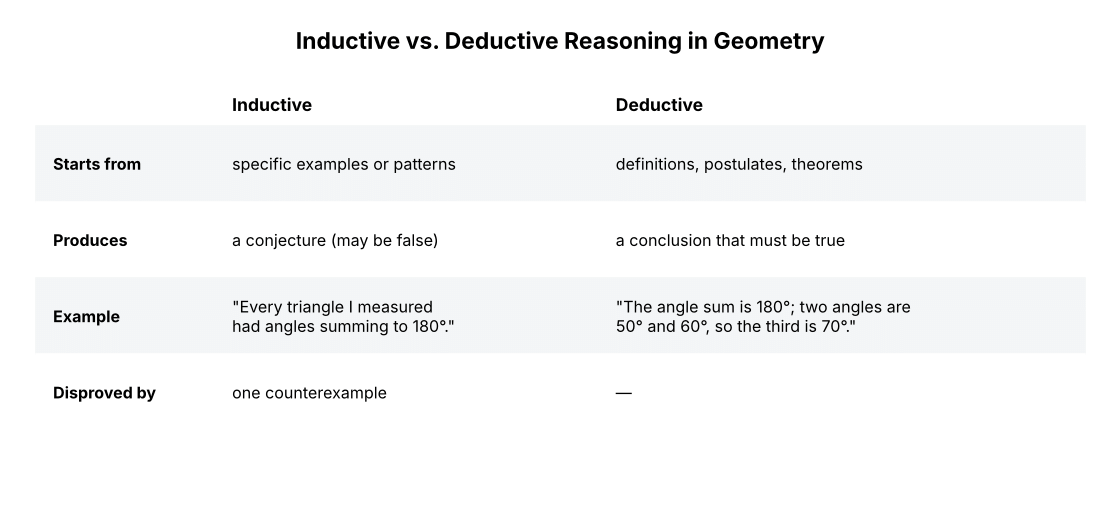
- Counterexamples come from Topic 2.1: Inductive and Deductive Reasoning.
- The vertical angle theorem used above is proven in Topic 1.5: Angle Pair Relationships.
- The midpoint definition as a biconditional appears in Topic 1.3: The Midpoint Formula.
- Angle classifications that become definitions are in Topic 1.4: Measuring and Classifying Angles.
Common Question Formats
- Identify the hypothesis or conclusion of a statement.
- Write or choose the converse, inverse, or contrapositive.
- Determine the truth value of a related statement and give a counterexample if false.
- Decide whether a statement can be written as a biconditional.
Frequent Student Mistakes
- Mixing up the inverse and the converse.
- Assuming the converse of a true statement is also true.
- Negating only one part when forming the contrapositive.
Test-Day Shortcuts
If the conditional is true, the contrapositive is true, period. Only test the converse, and the inverse will match it. That cuts the work of a four-part question in half.
Time Management Tips
Conditional statement items on Geometry unit tests and end-of-course exams usually take about a minute. Write \(p\) and \(q\) as short phrases before forming any related statement. That habit keeps long sentences from getting tangled.