
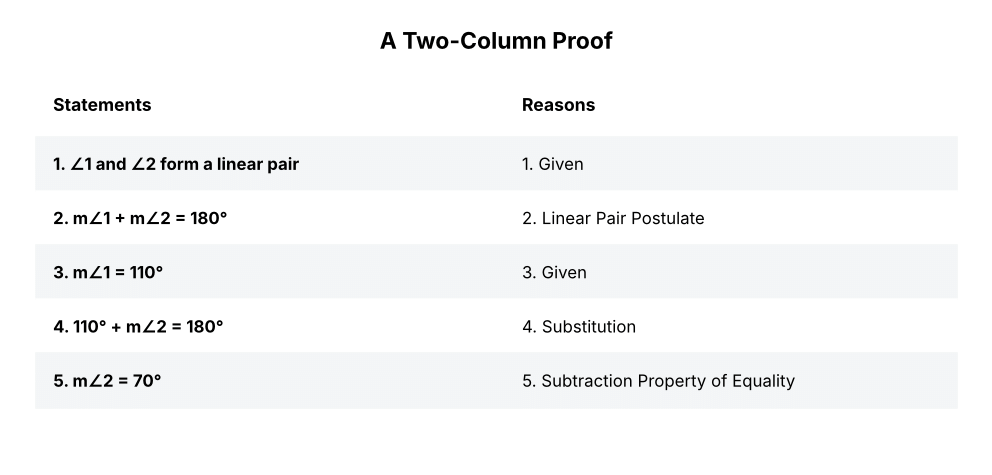
A two-column proof is a structured argument that lists each step of your reasoning in one column and the reason that justifies it in the other. It can feel strange at first, because you are asked to justify steps that seem obvious. But the format trains you to make every claim airtight, and it is the backbone of the triangle congruence and similarity proofs you will write later in the year.
This article covers Topic 2.3: Two-Column Proofs in Unit 2, Reasoning and Proof. The topic asks you to use properties of equality and congruence, definitions, postulates, and theorems to write two-column proofs about segments and angles.
By the end, you should be able to:
- Name the properties of equality and congruence used to justify steps.
- Set up a two-column proof from a given statement and a goal.
- Write algebraic proofs that justify each step of solving an equation.
- Write geometric proofs about segments and angles using definitions and postulates.
The Building Blocks of Reasons
Every statement in a proof needs a reason. Reasons come from five sources: given information, definitions, postulates, theorems you have already proven, and properties.
| Property | Equality | Congruence |
|---|---|---|
| Reflexive | \(a=a\) | \(\overline{AB}\cong\overline{AB}\) |
| Symmetric | If \(a=b\), then \(b=a\). | If \(\angle A\cong\angle B\), then \(\angle B\cong\angle A\). |
| Transitive | If \(a=b\) and \(b=c\), then \(a=c\). | If \(\overline{AB}\cong\overline{CD}\) and \(\overline{CD}\cong\overline{EF}\), then \(\overline{AB}\cong\overline{EF}\). |
| Substitution | If \(a=b\), then \(b\) can replace \(a\) in any expression. | Used through the matching measures. |
The addition, subtraction, multiplication, and division properties of equality justify doing the same operation to both sides of an equation. The distributive property justifies removing parentheses.
Why does this matter? Students lose the most points on reasons, not statements. “Because it’s obvious” or “algebra” will not earn credit. Each reason must name a specific property, definition, postulate, or theorem.
Algebraic Proofs
An algebraic proof justifies each step of solving an equation.
Worked example 1: Prove that if \(3(x-2)=15\), then \(x=7\).
| Statements | Reasons |
|---|---|
| 1. \(3(x-2)=15\) | 1. Given |
| 2. \(3x-6=15\) | 2. Distributive property |
| 3. \(3x=21\) | 3. Addition property of equality |
| 4. \(x=7\) | 4. Division property of equality |
Geometric Proofs
Geometric proofs follow the same structure but use definitions and postulates about figures. Start with the given information, and end with the statement you need to prove.
Worked example 2: Given: \(M\) is the midpoint of \(\overline{AB}\) and \(AM=5\). Prove: \(AB=10\).
| Statements | Reasons |
|---|---|
| 1. \(M\) is the midpoint of \(\overline{AB}\); \(AM=5\) | 1. Given |
| 2. \(AM=MB\) | 2. Definition of midpoint |
| 3. \(MB=5\) | 3. Substitution property of equality |
| 4. \(AM+MB=AB\) | 4. Segment Addition Postulate |
| 5. \(5+5=AB\) | 5. Substitution property of equality |
| 6. \(AB=10\) | 6. Simplify, then symmetric property of equality |
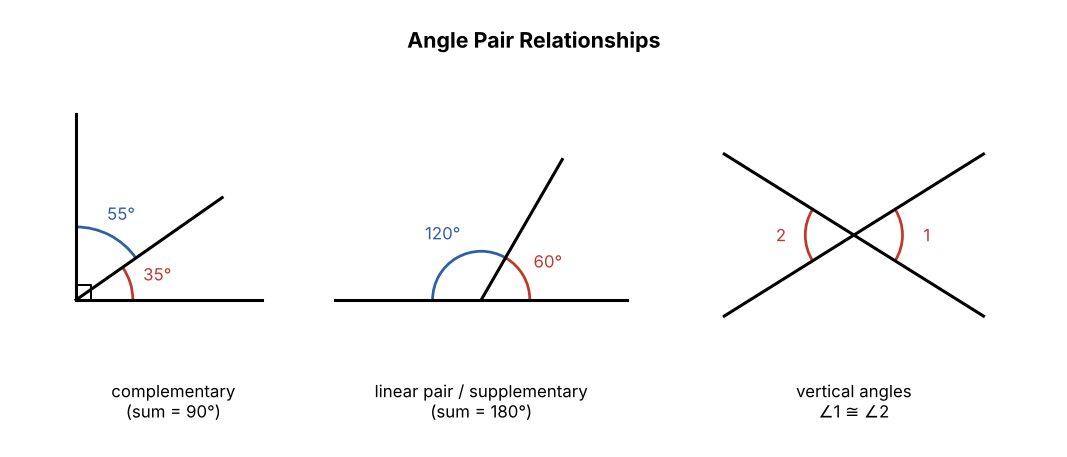
Worked example 3: Given: \(\angle 1\) and \(\angle 2\) are supplementary, and \(\angle 2\) and \(\angle 3\) are supplementary. Prove: \(\angle 1\cong\angle 3\).
| Statements | Reasons |
|---|---|
| 1. \(\angle 1\) and \(\angle 2\) are supplementary; \(\angle 2\) and \(\angle 3\) are supplementary | 1. Given |
| 2. \(m\angle 1+m\angle 2=180^{\circ}\); \(m\angle 2+m\angle 3=180^{\circ}\) | 2. Definition of supplementary angles |
| 3. \(m\angle 1+m\angle 2=m\angle 2+m\angle 3\) | 3. Substitution property of equality |
| 4. \(m\angle 1=m\angle 3\) | 4. Subtraction property of equality |
| 5. \(\angle 1\cong\angle 3\) | 5. Definition of congruent angles |
Why does this matter? Example 3 proves the Congruent Supplements Theorem. Once proven, you can cite it as a single reason in later proofs instead of repeating all five steps.
Planning a Proof
Before writing, mark the given information on the diagram and look at what you need to prove. Then work backward: ask what statement would lead directly to the goal, and what you would need to know to get that statement. Most short proofs follow a predictable path from given facts, to definitions that turn figures into equations, to algebra, and back to a statement about figures.
Test-Taking Strategies
Mnemonic Devices and Memory Shortcuts
Reflexive means “a mirror image of itself.” Symmetric means “swap sides.” Transitive means “pass it along,” like a relay baton. For proof structure, remember “Given first, goal last.”
Cross-Topic Connections
- Deductive reasoning drives every proof, as in Topic 2.1: Inductive and Deductive Reasoning.
- Definitions used as reasons are biconditionals, as shown in Topic 2.2: Conditional Statements.
- The Segment Addition Postulate comes from Topic 1.2: Measuring Segments and the Distance Formula.
- Properties of equality match those in Algebra 1 Topic 1.3: Properties of Real Numbers.
Common Question Formats
- Fill in missing statements or reasons in a partially completed proof.
- Name the property that justifies a single step.
- Complete an algebraic proof for a linear equation.
- Write a short proof about midpoints, bisectors, or supplementary angles.
Frequent Student Mistakes
- Using a definition in the wrong direction or citing the theorem you are trying to prove.
- Writing \(=\) between figures or \(\cong\) between numbers.
- Skipping the step that turns a congruence into an equation of measures.
Test-Day Shortcuts
On fill-in-the-blank proofs, look at the statements directly above and below the blank. The missing reason usually explains exactly how one becomes the other. If a measure was replaced with a number, the reason is substitution.
Time Management Tips
Short proofs on Geometry unit tests and end-of-course exams typically take three to five minutes. Sketch your plan in the margin first, then write the columns. If you get stuck, fill in every step you know from both ends and connect them in the middle.