
When a line crosses two parallel lines, it creates eight angles, and only two different measures appear among them. Learning which angles match and which ones add to \(180^{\circ}\) lets you fill in an entire diagram from a single given angle. This topic is one of the most heavily tested in geometry because it shows up again inside triangles, parallelograms, and proofs.
This article covers Topic 3.1: Angles Formed by Parallel Lines and Transversals in Unit 3, Parallel and Perpendicular Lines. The topic asks you to identify angle pairs formed by a transversal and to use the parallel line theorems to find angle measures and solve equations.
By the end, you should be able to:
- Identify corresponding, alternate interior, alternate exterior, and same-side interior angles.
- State which pairs are congruent and which are supplementary when the lines are parallel.
- Find all eight angle measures from one given angle.
- Write and solve equations using these relationships.
Transversals and Angle Pairs
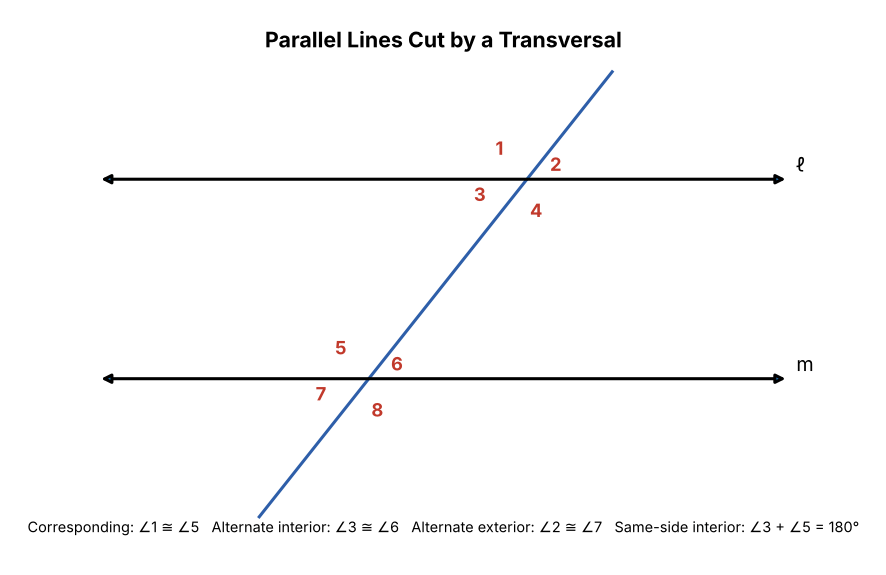
A transversal is a line that intersects two or more coplanar lines at different points. With two lines and a transversal, the eight angles form four kinds of special pairs. Picture the two lines as horizontal and the transversal as slanted. “Interior” means between the two lines, and “exterior” means outside them.
| Pair | Location | If Lines Are Parallel |
|---|---|---|
| Corresponding angles | Same position at each intersection, such as both upper right. | Congruent |
| Alternate interior angles | Between the lines, on opposite sides of the transversal. | Congruent |
| Alternate exterior angles | Outside the lines, on opposite sides of the transversal. | Congruent |
| Same-side interior angles | Between the lines, on the same side of the transversal. Also called consecutive interior angles. | Supplementary |
Why does this matter? These relationships hold only when the lines are parallel. If the lines are not parallel, corresponding angles still exist as a pair, but their measures are not equal. Always check for parallel arrows or a stated \(\parallel\) symbol before applying a theorem.
The Parallel Line Theorems
The Corresponding Angles Postulate states that if two parallel lines are cut by a transversal, corresponding angles are congruent. The other relationships follow from it using vertical angles and linear pairs:
- Alternate Interior Angles Theorem: Alternate interior angles are congruent.
- Alternate Exterior Angles Theorem: Alternate exterior angles are congruent.
- Same-Side Interior Angles Theorem: Same-side interior angles are supplementary.
Filling In a Diagram
When parallel lines are cut by a transversal, every angle is either equal to a given angle or supplementary to it. If one angle measures \(65^{\circ}\), then:
- Every acute-looking angle in the figure measures \(65^{\circ}\).
- Every obtuse-looking angle measures \(180-65=115^{\circ}\).
That shortcut works because each intersection has two pairs of vertical angles, and the two intersections are copies of each other when the lines are parallel. Only perpendicular transversals break the acute-obtuse split, since then all eight angles are \(90^{\circ}\).
Solving Equations
Worked example 1: Two parallel lines are cut by a transversal. Alternate interior angles measure \((4x+15)^{\circ}\) and \((6x-25)^{\circ}\). Find \(x\) and the angle measure.
- Alternate interior angles are congruent: \(4x+15=6x-25\).
- Solve: \(40=2x\), so \(x=20\).
- Substitute: \(4(20)+15=95^{\circ}\).
Worked example 2: Same-side interior angles measure \((3y+10)^{\circ}\) and \((2y+20)^{\circ}\). Find \(y\) and both angles.
- Same-side interior angles are supplementary: \((3y+10)+(2y+20)=180\).
- Combine: \(5y+30=180\), so \(y=30\).
- The angles measure \(100^{\circ}\) and \(80^{\circ}\), which sum to \(180^{\circ}\).
Why does this matter? The first step decides everything. If you set supplementary angles equal or add congruent angles to \(180^{\circ}\), the algebra will be correct but the answer will be wrong. Name the relationship in words before writing the equation.
Perpendicular Transversals
If a transversal is perpendicular to one of two parallel lines, it is perpendicular to the other as well. This follows directly from corresponding angles: a \(90^{\circ}\) angle at one intersection forces a \(90^{\circ}\) corresponding angle at the other. Railroad ties perpendicular to one rail are perpendicular to both.
Test-Taking Strategies
Mnemonic Devices and Memory Shortcuts
Draw a “Z” for alternate interior angles, since they sit in the corners of a Z shape. Draw an “F” for corresponding angles. Same-side interior angles sit inside a “C” or “U” and add to \(180^{\circ}\).
Cross-Topic Connections
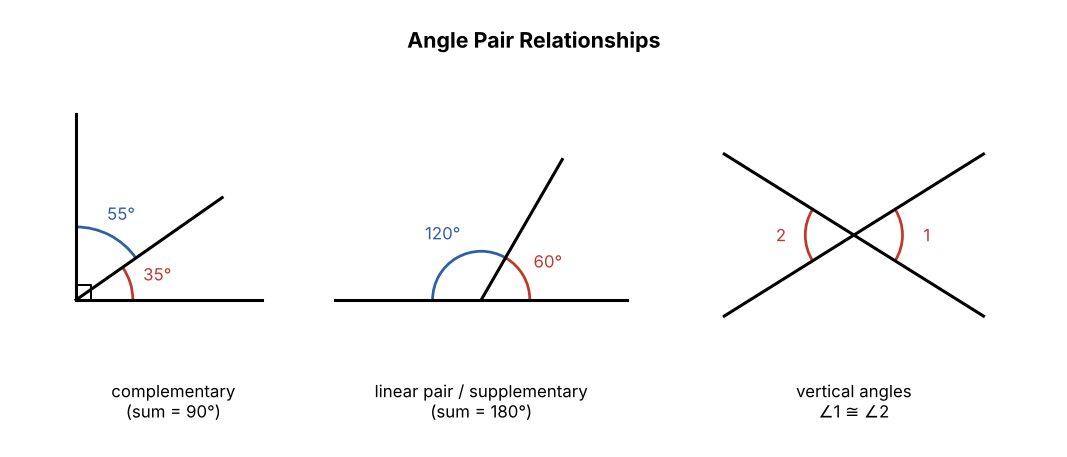
- Vertical angles and linear pairs at each intersection come from Topic 1.5: Angle Pair Relationships.
- Proving these theorems uses the format from Topic 2.3: Two-Column Proofs.
- The converses of these theorems are in Topic 2.2: Conditional Statements, applied next to proving lines parallel.
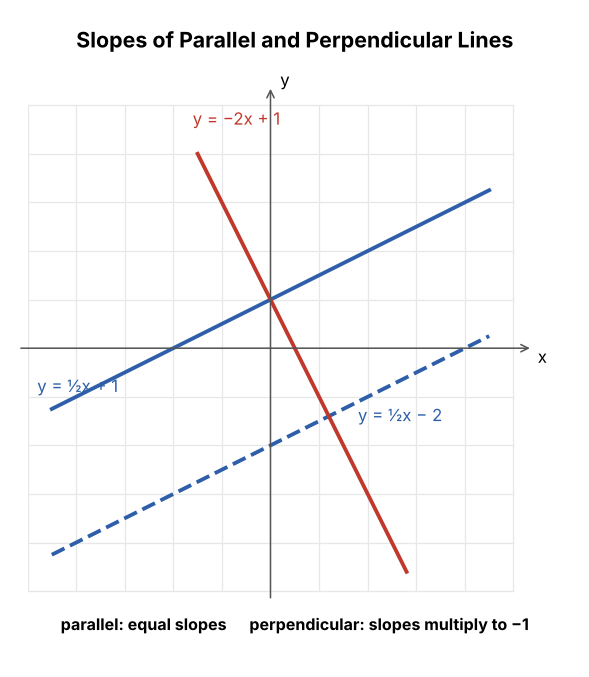
- Parallel lines on a grid share a slope, as in Algebra 1 Topic 5.7: Parallel and Perpendicular Lines.
Common Question Formats
- Identify the type of angle pair from a diagram.
- Find a missing angle given one measure and parallel lines.
- Solve for \(x\) when two related angles are given as expressions.
- Find multiple angle measures in a figure with two transversals.
Frequent Student Mistakes
- Applying parallel line theorems when the lines are not marked parallel.
- Setting same-side interior angles equal instead of supplementary.
- Confusing alternate interior with same-side interior angles.
Test-Day Shortcuts
Use the acute-obtuse rule: in a parallel line diagram, all acute angles are equal, all obtuse angles are equal, and any acute plus any obtuse equals \(180^{\circ}\). This answers most single-angle questions in seconds.
Time Management Tips
Parallel line angle items on Geometry unit tests and end-of-course exams typically take one to two minutes. Label every angle you can find before answering. Multi-transversal diagrams take longer, so work outward from the given angle one intersection at a time.