
In the last topic, you started with parallel lines and found angle measures. This topic runs the logic in reverse: you start with angle measures and decide whether the lines are parallel. The tools are the converses of the parallel line theorems, and they let you prove lines parallel without ever measuring the distance between them.
This article covers Topic 3.2: Proving Lines Parallel in Unit 3, Parallel and Perpendicular Lines. The topic asks you to use the converses of the parallel line theorems to decide whether lines are parallel, to find values that make lines parallel, and to write proofs that conclude two lines are parallel.
By the end, you should be able to:
- State the converses of the corresponding, alternate interior, alternate exterior, and same-side interior angle theorems.
- Decide whether two lines are parallel from given angle measures.
- Find the value of \(x\) that makes two lines parallel.
- Use the transitive property of parallel lines and write parallel-line proofs.
The Converse Theorems
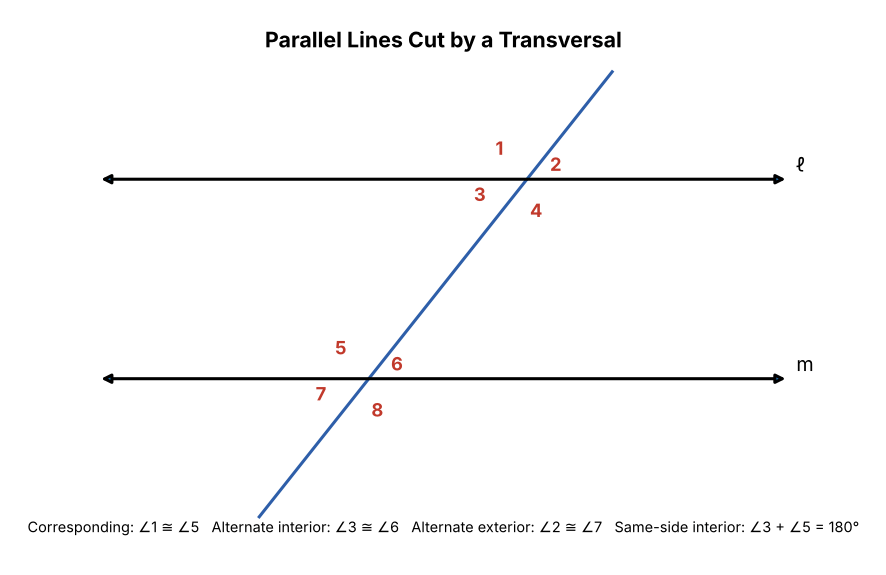
Each parallel line theorem from the previous topic has a true converse. Instead of “if the lines are parallel, then the angles are related,” each converse says “if the angles are related, then the lines are parallel.”
| Converse | If This Is True About the Angles | Then |
|---|---|---|
| Corresponding Angles Converse | Corresponding angles are congruent. | The lines are parallel. |
| Alternate Interior Angles Converse | Alternate interior angles are congruent. | The lines are parallel. |
| Alternate Exterior Angles Converse | Alternate exterior angles are congruent. | The lines are parallel. |
| Same-Side Interior Angles Converse | Same-side interior angles are supplementary. | The lines are parallel. |
Why does this matter? In a proof, the direction of the theorem decides which one you cite. If you know the lines are parallel and conclude something about angles, cite the original theorem. If you know something about angles and conclude the lines are parallel, cite the converse. Citing the wrong direction is the most common reason-column error in this unit.
Deciding Whether Lines Are Parallel
Look for one special angle pair and check whether it meets the converse condition.
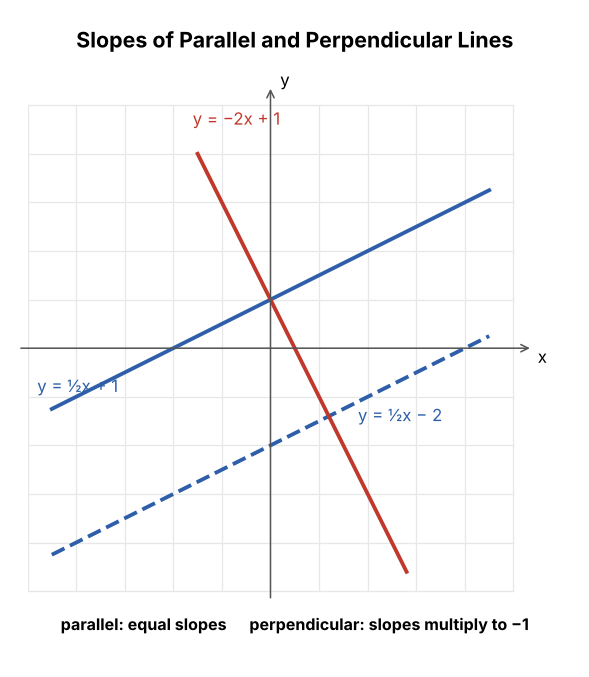
Worked example 1: A transversal crosses lines \(\ell\) and \(m\). Same-side interior angles measure \(72^{\circ}\) and \(118^{\circ}\). Are the lines parallel?
Same-side interior angles must sum to \(180^{\circ}\) for the lines to be parallel. Here \(72+118=190\), so the lines are not parallel. They will meet on the side where the interior angles are smaller.
Worked example 2: Corresponding angles measure \(58^{\circ}\) and \(58^{\circ}\). Since corresponding angles are congruent, the lines are parallel by the Corresponding Angles Converse.
Finding the Value That Makes Lines Parallel
Worked example 3: Alternate exterior angles measure \((7x-9)^{\circ}\) and \((5x+21)^{\circ}\). For what value of \(x\) are the lines parallel?
- For parallel lines, the angles must be congruent: \(7x-9=5x+21\).
- Solve: \(2x=30\), so \(x=15\).
- Check: both angles measure \(96^{\circ}\).
Worked example 4: Same-side interior angles measure \((2x+40)^{\circ}\) and \((3x-10)^{\circ}\). Find \(x\) so the lines are parallel.
- The angles must be supplementary: \((2x+40)+(3x-10)=180\).
- Solve: \(5x+30=180\), so \(x=30\).
- Check: \(100^{\circ}\) and \(80^{\circ}\) sum to \(180^{\circ}\).
More Ways to Prove Lines Parallel
Two more theorems are useful, especially with several lines in a figure.
- Transitive Property of Parallel Lines: If \(a\parallel b\) and \(b\parallel c\), then \(a\parallel c\). Lines parallel to the same line are parallel to each other.
- Perpendicular Transversal Converse: In a plane, if two lines are both perpendicular to the same line, then they are parallel to each other. Shelves mounted at right angles to the same wall bracket are parallel.
Worked example 5: A short proof.
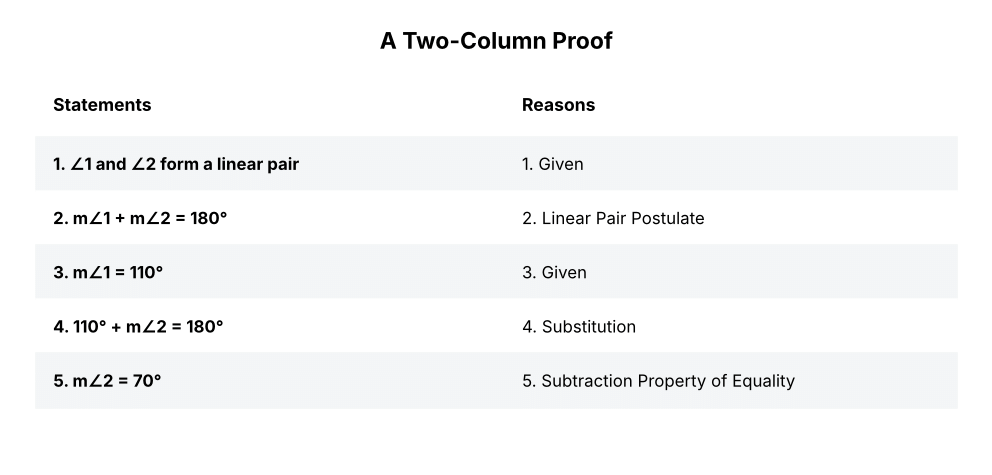
| Statements | Reasons |
|---|---|
| 1. \(\angle 1\cong\angle 2\), and \(\angle 1\) and \(\angle 2\) are alternate interior angles for lines \(\ell\) and \(m\) | 1. Given |
| 2. \(\ell\parallel m\) | 2. Alternate Interior Angles Converse |
Why does this matter? Proving lines parallel is often an intermediate step. Once you establish \(\ell\parallel m\), you can use the original parallel line theorems to find more congruent angles. Longer proofs frequently use a converse first and an original theorem second.
Test-Taking Strategies
Mnemonic Devices and Memory Shortcuts
Think “Angles to lines means converse; lines to angles means original.” For same-side interior angles, remember “supplementary sides, parallel lines.”
Cross-Topic Connections
- The original theorems come from Topic 3.1: Angles Formed by Parallel Lines and Transversals.
- Converses and their truth values are explained in Topic 2.2: Conditional Statements.
- Proof structure follows Topic 2.3: Two-Column Proofs.
- Supplementary angle equations build on Topic 1.5: Angle Pair Relationships.
Common Question Formats
- Decide whether lines are parallel from given angle measures.
- Find \(x\) so that two lines are parallel.
- Choose the theorem that justifies a parallel line conclusion.
- Identify which pair of lines in a multi-line figure is parallel.
Frequent Student Mistakes
- Citing the original theorem when the converse is needed.
- Requiring same-side interior angles to be congruent instead of supplementary.
- Concluding lines are parallel from congruent vertical angles, which are congruent for any intersecting lines.
Test-Day Shortcuts
In multi-line figures, check which two lines the special pair actually connects. An angle pair proves only the two lines on either side of its transversal are parallel. Trace the transversal with your finger to be sure.
Time Management Tips
Parallel-proof items on Geometry unit tests and end-of-course exams usually take one to three minutes. Decide on the angle relationship first, since that one choice determines both the equation and the theorem name.