
On the coordinate plane, you don’t need a protractor to tell whether lines are parallel or perpendicular. Slope does the job. Parallel lines rise at exactly the same rate, and perpendicular lines have slopes that are opposite reciprocals. These two facts connect Algebra 1 and Geometry, and they are the key to coordinate proofs about quadrilaterals and triangles.
This article covers Topic 3.3: Slopes of Parallel and Perpendicular Lines in Unit 3, Parallel and Perpendicular Lines. The topic asks you to use slope to classify lines as parallel, perpendicular, or neither, and to write equations of lines parallel or perpendicular to a given line through a given point.
By the end, you should be able to:
- Calculate slope from two points or an equation.
- Classify two lines as parallel, perpendicular, or neither using slope.
- Write the equation of a line parallel or perpendicular to a given line.
- Find the distance from a point to a line using a perpendicular segment.
Slope Review
The slope of a line through \((x_{1},y_{1})\) and \((x_{2},y_{2})\) is \(m=\frac{y_{2}-y_{1}}{x_{2}-x_{1}}\). In slope-intercept form, \(y=mx+b\), the slope is the coefficient of \(x\).
- Positive slope: The line rises from left to right.
- Negative slope: The line falls from left to right.
- Zero slope: The line is horizontal.
- Undefined slope: The line is vertical, because the run is zero.
The Two Slope Rules
| Relationship | Slope Rule | Example |
|---|---|---|
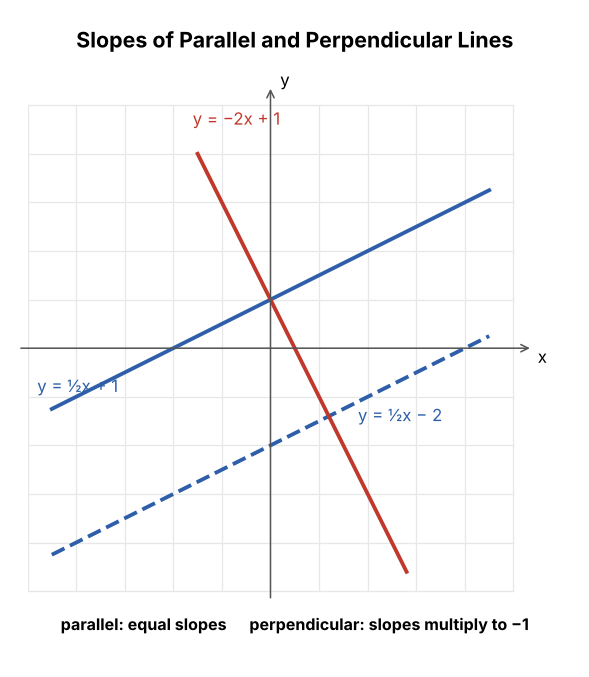
| Parallel | Equal slopes, different \(y\)-intercepts. | \(y=2x+1\) and \(y=2x-5\) |
| Perpendicular | Slopes are opposite reciprocals, so their product is \(-1\). | \(y=\frac{3}{4}x\) and \(y=-\frac{4}{3}x+2\) |
| Special case | A horizontal line and a vertical line are perpendicular. | \(y=3\) and \(x=-1\) |
Why does this matter? To find an opposite reciprocal, flip the fraction and change the sign. The opposite reciprocal of \(\frac{2}{5}\) is \(-\frac{5}{2}\), and of \(-3\) is \(\frac{1}{3}\). Students often flip without changing the sign, or change the sign without flipping. Both mistakes give a line that is neither parallel nor perpendicular.
Two lines with the same slope and the same \(y\)-intercept are not parallel. They are the same line, called coincident.
Classifying Lines
Worked example 1: Classify the lines \(2x+3y=6\) and \(3x-2y=4\).
- Rewrite the first: \(3y=-2x+6\), so \(y=-\frac{2}{3}x+2\). Slope: \(-\frac{2}{3}\).
- Rewrite the second: \(-2y=-3x+4\), so \(y=\frac{3}{2}x-2\). Slope: \(\frac{3}{2}\).
- Multiply the slopes: \(-\frac{2}{3}\cdot\frac{3}{2}=-1\). The lines are perpendicular.
Worked example 2: Line \(p\) passes through \((1,2)\) and \((4,8)\). Line \(q\) passes through \((0,-1)\) and \((2,3)\). Slope of \(p\): \(\frac{8-2}{4-1}=2\). Slope of \(q\): \(\frac{3-(-1)}{2-0}=2\). The slopes match and the lines are different, so \(p\parallel q\).
Writing Parallel and Perpendicular Lines
Worked example 3: Write the equation of the line through \((6,-1)\) that is perpendicular to \(y=3x-4\).
- The given slope is 3, so the perpendicular slope is \(-\frac{1}{3}\).
- Use point-slope form: \(y-(-1)=-\frac{1}{3}(x-6)\).
- Simplify: \(y+1=-\frac{1}{3}x+2\), so \(y=-\frac{1}{3}x+1\).
Worked example 4: Write the line through \((-2,5)\) parallel to \(y=-4x+7\). The slope stays \(-4\). Then \(y-5=-4(x+2)\), which simplifies to \(y=-4x-3\).
Why does this matter? These equations power coordinate proofs. To show a quadrilateral is a rectangle, you show opposite sides have equal slopes and adjacent sides have slopes with a product of \(-1\). Each check is just a slope calculation.
Distance From a Point to a Line
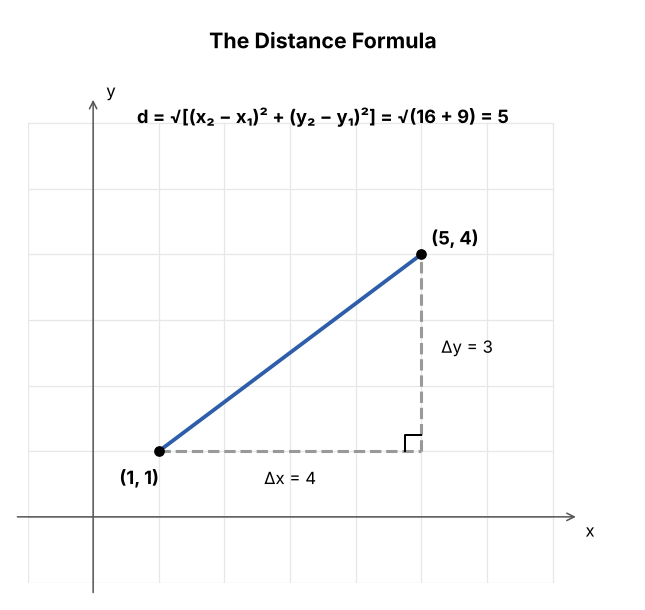
The shortest distance from a point to a line is along the perpendicular segment. To find it, write the perpendicular line through the point, find where it intersects the original line, and use the distance formula between the point and that intersection. For the point \((6,-1)\) and line \(y=3x-4\) above, the perpendicular \(y=-\frac{1}{3}x+1\) meets the line at \((1.5,0.5)\), and the distance is \(\sqrt{4.5^{2}+1.5^{2}}\approx 4.74\).
Why does this matter? Any other segment from the point to the line is the hypotenuse of a right triangle whose leg is the perpendicular segment, so it is always longer. That is why “distance from a point to a line” always means the perpendicular distance. The same idea defines the distance between two parallel lines: measure along any segment perpendicular to both.
Test-Taking Strategies
Mnemonic Devices and Memory Shortcuts
“Parallel: same slope. Perpendicular: flip and switch.” Flip the fraction, switch the sign. Check perpendicular slopes by multiplying: the product must be \(-1\).
Cross-Topic Connections
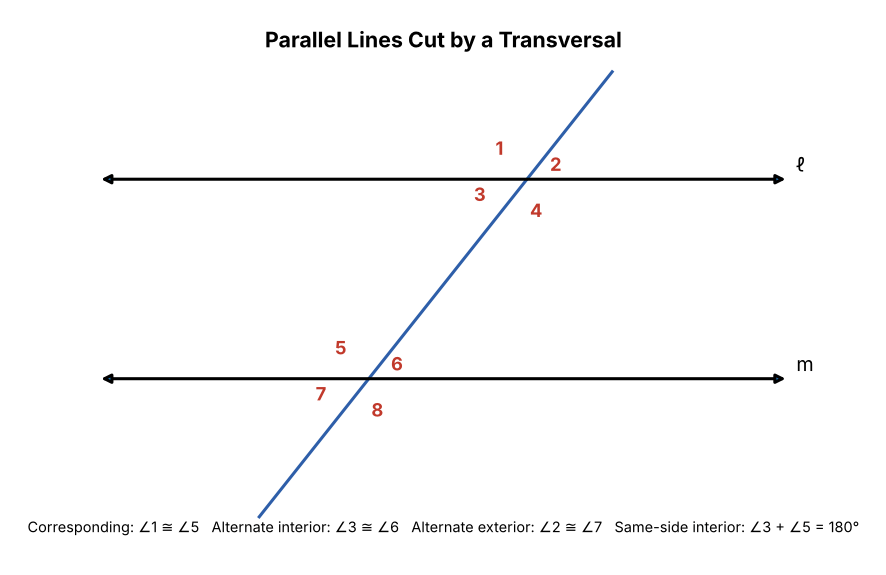
- Angle-based parallel proofs come from Topic 3.2: Proving Lines Parallel.
- The slope formula is reviewed in Algebra 1 Topic 5.1: How to Find Slope.
- Writing the new line uses Algebra 1 Topic 5.3: Point-Slope Form.
- The shortest distance uses the formula from Topic 1.2: Measuring Segments and the Distance Formula.
Common Question Formats
- Classify two lines given in standard or slope-intercept form.
- Write a line parallel or perpendicular to a given line through a point.
- Find a missing coordinate that makes two segments perpendicular.
- Use slopes to classify a quadrilateral on the coordinate plane.
Frequent Student Mistakes
- Reading the slope from standard form without solving for \(y\).
- Flipping a slope without changing its sign.
- Calling coincident lines parallel.
Test-Day Shortcuts
For a line in standard form \(Ax+By=C\), the slope is \(-\frac{A}{B}\). A parallel line keeps \(A\) and \(B\) and changes \(C\). A perpendicular line swaps \(A\) and \(B\) and changes one sign. This saves a rewrite step.
Time Management Tips
Slope classification items on Geometry unit tests and end-of-course exams take about a minute. Writing a new line takes one to two minutes. Distance-to-a-line problems take longer, so set up all three steps before calculating.