
Triangles are the most important shape in geometry. Every polygon can be split into triangles, and most proofs about other figures eventually come back to triangle facts. The first two facts you need are how to classify a triangle and the rule that its three angles always add up to \(180^{\circ}\).
This article covers Topic 5.1: Classifying Triangles and the Triangle Sum Theorem in Unit 5, Triangles. The topic asks you to classify triangles by their sides and angles, apply the Triangle Sum Theorem, and use the Exterior Angle Theorem to find unknown measures.
By the end, you should be able to:
- Classify a triangle by its sides and by its angles.
- Explain why the interior angles of a triangle sum to \(180^{\circ}\).
- Use the Exterior Angle Theorem to find missing angles.
- Solve equations involving triangle angle expressions.
Classifying Triangles
Every triangle gets two names: one based on its sides and one based on its angles.
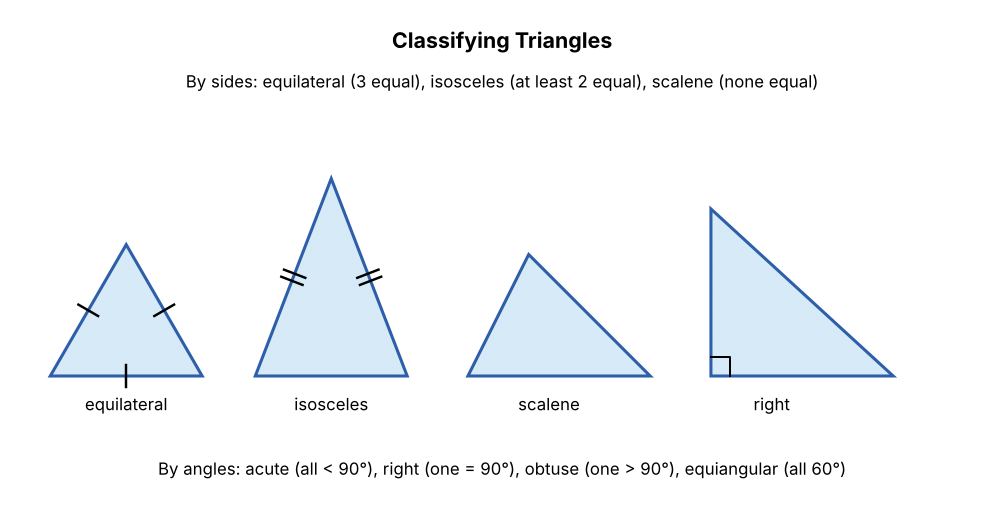
| By Sides | Definition | By Angles | Definition |
|---|---|---|---|
| Scalene | No congruent sides | Acute | Three acute angles |
| Isosceles | At least two congruent sides | Right | One right angle |
| Equilateral | Three congruent sides | Obtuse | One obtuse angle |
| Equiangular | Three congruent angles |
Combine the names to describe a triangle fully, such as “isosceles right triangle” or “scalene obtuse triangle.” Every equilateral triangle is also isosceles, because it has at least two congruent sides.
Why does this matter? A triangle can never have two right angles or two obtuse angles, because the third angle would leave nothing for the rest of the \(180^{\circ}\). Classification questions often include impossible combinations, like “obtuse equilateral,” that you can eliminate on sight.
The Triangle Sum Theorem
The Triangle Sum Theorem states that the measures of the interior angles of a triangle add up to \(180^{\circ}\).
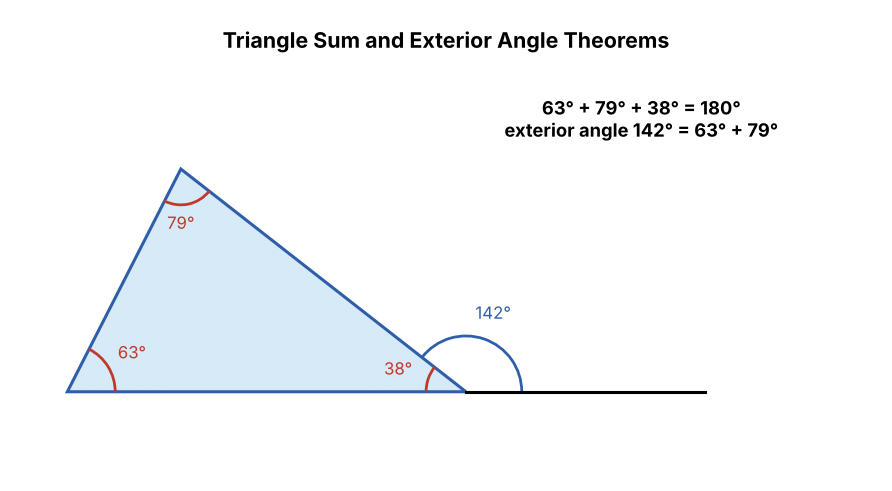
The proof uses parallel lines. Draw a line through one vertex parallel to the opposite side. The three angles at that vertex form a straight line, so they sum to \(180^{\circ}\). The two outer angles are alternate interior angles with the other two triangle angles, so they are congruent to them. That means the three triangle angles also sum to \(180^{\circ}\).
Worked example 1: A triangle has angles of \((2x+10)^{\circ}\), \((3x)^{\circ}\), and \((x+20)^{\circ}\). Find each angle.
- Set the sum equal to 180: \((2x+10)+3x+(x+20)=180\).
- Combine: \(6x+30=180\), so \(x=25\).
- The angles measure \(60^{\circ}\), \(75^{\circ}\), and \(45^{\circ}\). Their sum is \(180^{\circ}\), and the triangle is acute.
Two quick corollaries follow. The acute angles of a right triangle are complementary, since together they make up the other \(90^{\circ}\). Each angle of an equiangular triangle measures \(60^{\circ}\).
The Exterior Angle Theorem
An exterior angle is formed by one side of a triangle and the extension of an adjacent side. The two interior angles that are not next to it are called the remote interior angles.
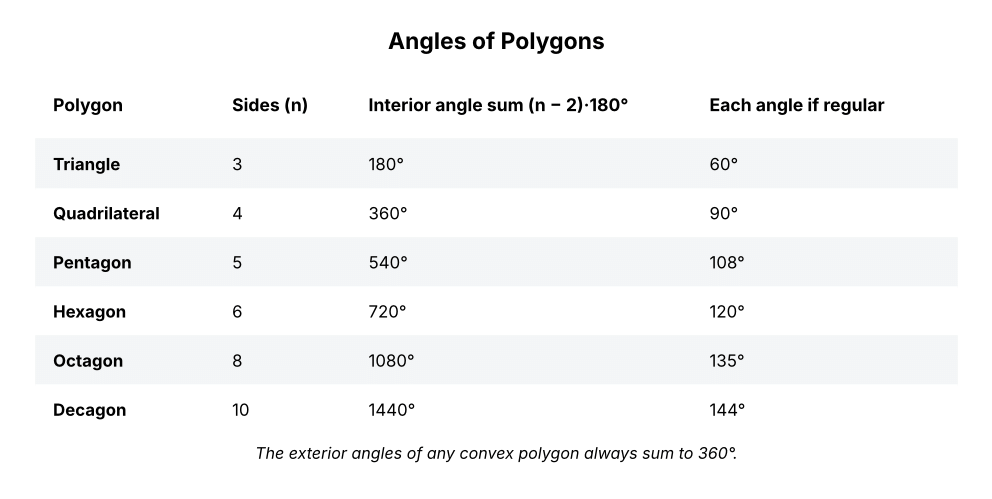
The Exterior Angle Theorem states that an exterior angle equals the sum of its two remote interior angles. It follows from the Triangle Sum Theorem: the exterior angle and its adjacent interior angle form a linear pair, so both the exterior angle and the two remote angles equal \(180^{\circ}\) minus the adjacent angle.
Worked example 2: An exterior angle measures \((5x-6)^{\circ}\). Its remote interior angles measure \((2x+4)^{\circ}\) and \(50^{\circ}\). Find \(x\) and the exterior angle.
- Set up the theorem: \(5x-6=(2x+4)+50\).
- Solve: \(3x=60\), so \(x=20\).
- The exterior angle measures \(5(20)-6=94^{\circ}\). Check: the remote angles are \(44^{\circ}\) and \(50^{\circ}\), which sum to \(94^{\circ}\).
Why does this matter? The Exterior Angle Theorem saves a step. Without it, you would find the third interior angle first and then subtract from \(180^{\circ}\). With it, one equation does the job, which is especially useful in diagrams with several overlapping triangles.
Exterior Angle Sum
If you take one exterior angle at each vertex of any triangle, those three exterior angles always add to \(360^{\circ}\). Picture walking around the triangle: at each corner you turn through the exterior angle, and after three turns you face your original direction, a full \(360^{\circ}\) turn. This same idea extends to every polygon in a later unit.
Test-Taking Strategies
Mnemonic Devices and Memory Shortcuts
“Inside is 180, outside is 360.” For the Exterior Angle Theorem, think “the outside equals the two far insides.” Scalene means “skewed,” with no equal sides.
Cross-Topic Connections
- The proof uses alternate interior angles from Topic 3.1: Angles Formed by Parallel Lines and Transversals.
- Exterior angles form linear pairs, as in Topic 1.5: Angle Pair Relationships.
- Angle types come from Topic 1.4: Measuring and Classifying Angles.
- Formal justification follows Topic 2.3: Two-Column Proofs.
Common Question Formats
- Classify a triangle given its side lengths or angle measures.
- Find a missing interior angle using the Triangle Sum Theorem.
- Find an exterior angle or a remote interior angle.
- Solve for \(x\) when angles are written as expressions.
Frequent Student Mistakes
- Adding the adjacent interior angle in the Exterior Angle Theorem instead of the two remote ones.
- Calling a triangle equilateral when only two sides are marked congruent.
- Stopping at \(x\) when the question asks for an angle measure.
Test-Day Shortcuts
In a right triangle, find a missing acute angle by subtracting the known acute angle from \(90^{\circ}\). In diagrams with an exterior angle, look for the remote pair immediately rather than solving for all three interior angles.
Time Management Tips
Triangle angle items on Geometry unit tests and end-of-course exams typically take one to two minutes. Diagrams with several triangles take longer, so label every angle you can find before solving for the one asked.