
Every triangle contains a set of special segments, and each one has a surprising property. Midsegments run parallel to a side at exactly half its length. Perpendicular bisectors meet at a point equally distant from all three vertices. Medians meet at the triangle’s balance point. These segments show up in construction problems, coordinate proofs, and real design questions like placing a cell tower equally far from three towns.
This article covers Topic 5.5: Midsegments, Bisectors, Medians, and Altitudes in Unit 5, Triangles. The topic asks you to apply the Triangle Midsegment Theorem, identify the four points of concurrency, and use their properties to find lengths.
By the end, you should be able to:
- Apply the Triangle Midsegment Theorem to find lengths.
- Define perpendicular bisectors, angle bisectors, medians, and altitudes.
- Name the point of concurrency for each and state its key property.
- Use the centroid’s 2 to 1 ratio to find segment lengths along a median.
The Triangle Midsegment Theorem
A midsegment connects the midpoints of two sides of a triangle. Every triangle has three. The Triangle Midsegment Theorem says a midsegment is parallel to the third side and half as long.
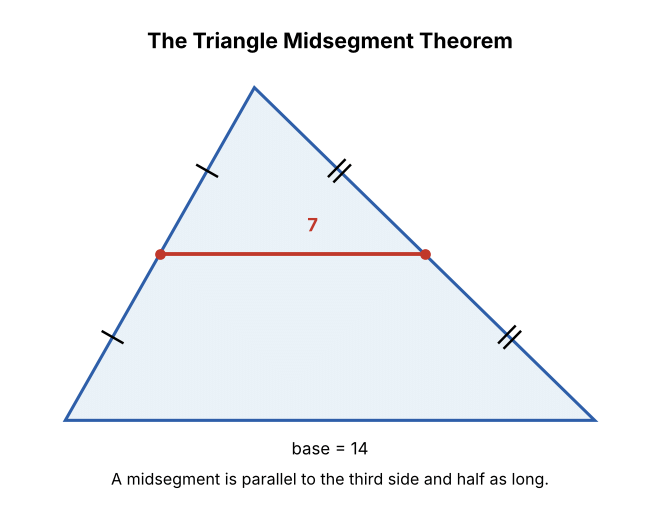
Worked example 1: In \(\triangle ABC\), \(D\) and \(E\) are the midpoints of \(\overline{AB}\) and \(\overline{AC}\). If \(DE=3x-1\) and \(BC=4x+6\), find \(BC\).
- The midsegment is half the third side: \(3x-1=\frac{1}{2}(4x+6)\).
- Simplify: \(3x-1=2x+3\), so \(x=4\).
- Substitute: \(BC=4(4)+6=22\). Check: \(DE=11\), which is half of 22.
Why does this matter? The midsegment cuts off a smaller triangle that is a half-size copy of the original. That is your first look at similarity: the small triangle has the same angles, with every side half as long.
Four Special Segments
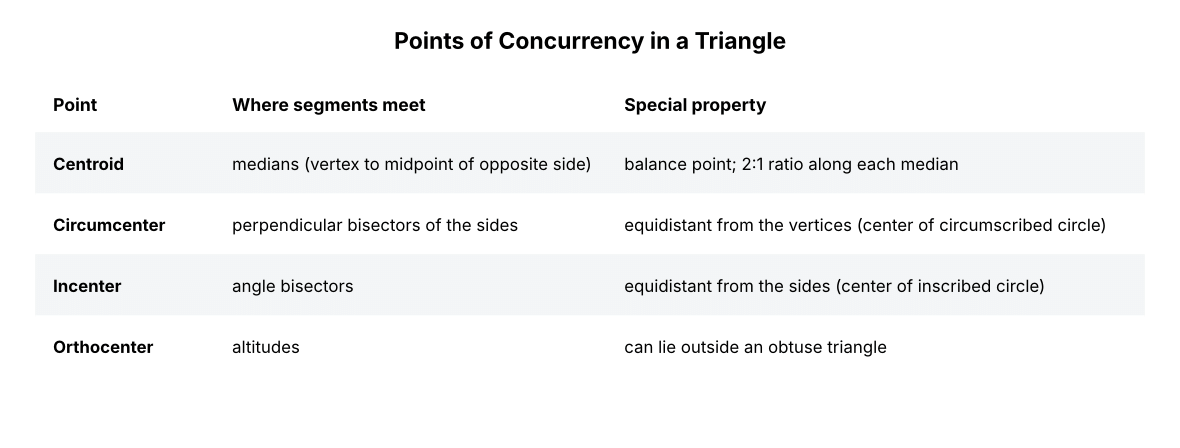
| Segment | Definition | Point of Concurrency |
|---|---|---|
| Perpendicular bisector | A line perpendicular to a side at its midpoint. | Circumcenter |
| Angle bisector | A ray that splits an angle into two congruent angles. | Incenter |
| Median | A segment from a vertex to the midpoint of the opposite side. | Centroid |
| Altitude | A segment from a vertex perpendicular to the line containing the opposite side. | Orthocenter |
In each case, the three segments of the same type always meet at a single point, called a point of concurrency.
Properties of the Points of Concurrency
- Circumcenter: Equidistant from the three vertices. It is the center of the circle that passes through all three vertices. It lies inside an acute triangle, on the hypotenuse of a right triangle, and outside an obtuse triangle.
- Incenter: Equidistant from the three sides. It is the center of the largest circle that fits inside the triangle, and it is always inside.
- Centroid: The balance point, always inside the triangle. It divides each median in a \(2:1\) ratio, so the distance from a vertex to the centroid is twice the distance from the centroid to the midpoint.
- Orthocenter: Where the altitudes meet. It can be inside, on, or outside the triangle, depending on its angles.
Why does this matter? Word problems describe these points without naming them. “Equally far from three cities” means the circumcenter. “Equally far from three roads” means the incenter. “Balance a triangular sign on one point” means the centroid. Translating the description is the hardest part.
Using the Centroid Ratio
Worked example 2: In \(\triangle PQR\), \(G\) is the centroid and \(\overline{PM}\) is a median with \(PM=18\). Find \(PG\) and \(GM\).
- The centroid divides the median in a \(2:1\) ratio from the vertex.
- \(PG=\frac{2}{3}(18)=12\).
- \(GM=\frac{1}{3}(18)=6\).
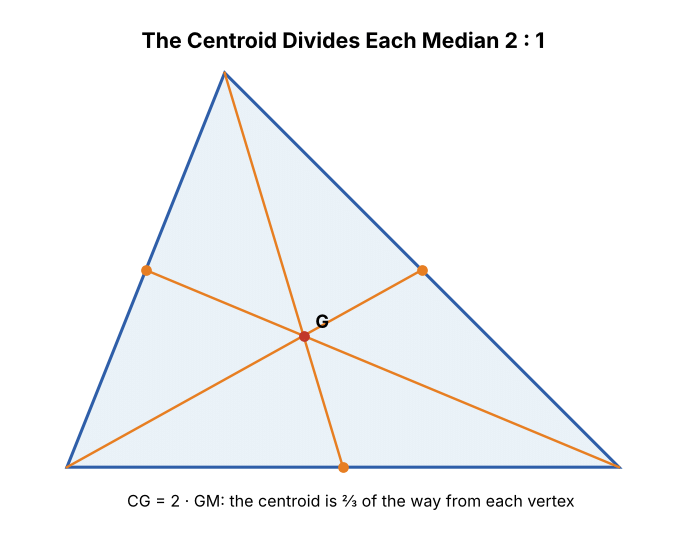
On the coordinate plane, the centroid is the average of the three vertices: \(\left(\frac{x_{1}+x_{2}+x_{3}}{3},\frac{y_{1}+y_{2}+y_{3}}{3}\right)\). For vertices \((0,0)\), \((6,0)\), and \((3,9)\), the centroid is \((3,3)\).
Why does this matter? Students often split the median in half, but the centroid is not the midpoint of a median. It sits two-thirds of the way from the vertex. If a question gives the short piece, triple it to get the whole median.
Test-Taking Strategies
Mnemonic Devices and Memory Shortcuts
Pair them up: “Perpendicular bisectors and Circumcenter,” “Angle bisectors and Incenter,” “Medians and Centroid,” “Altitudes and Orthocenter.” Some students remember the pairs as “Pop Corn,” “Ice Cream,” “Mud Cake,” and “All Over,” matching each first letter.
Cross-Topic Connections
- Midpoints are found with Topic 1.3: The Midpoint Formula.
- Parallel midsegments can be verified with Topic 3.3: Slopes of Parallel and Perpendicular Lines.
- The vertex bisector in an isosceles triangle plays all four roles, as noted in Topic 5.4: Isosceles and Equilateral Triangles.
- Angle bisectors are defined in Topic 1.4: Measuring and Classifying Angles.
Common Question Formats
- Find a side length or midsegment length using the Midsegment Theorem.
- Identify which point of concurrency matches a description.
- Find lengths along a median using the centroid ratio.
- Locate a centroid or circumcenter on the coordinate plane.
Frequent Student Mistakes
- Confusing medians with altitudes. Medians go to midpoints; altitudes are perpendicular.
- Splitting a median in half at the centroid instead of in a \(2:1\) ratio.
- Assuming every point of concurrency lies inside the triangle.
Test-Day Shortcuts
For centroid coordinates, just average the three vertices. For midsegments, double the midsegment to get the third side or halve the side to get the midsegment, without writing a full equation.
Time Management Tips
Midsegment and centroid items on Geometry unit tests and end-of-course exams take one to two minutes. Matching a description to a point of concurrency takes under a minute once the pairs are memorized.