
Isosceles and equilateral triangles have a special balance: equal sides sit across from equal angles. That simple link between sides and angles lets you find missing measures quickly and supplies congruent parts for proofs. It also explains why every equilateral triangle has three \(60^{\circ}\) angles.
This article covers Topic 5.4: Isosceles and Equilateral Triangles in Unit 5, Triangles. The topic asks you to identify the parts of an isosceles triangle, apply the Base Angles Theorem and its converse, and use the properties of equilateral triangles to solve problems.
By the end, you should be able to:
- Name the legs, base, vertex angle, and base angles of an isosceles triangle.
- Apply the Base Angles Theorem and its converse.
- Use the fact that equilateral triangles are equiangular, with \(60^{\circ}\) angles.
- Solve for unknown sides and angles using these relationships.
Parts of an Isosceles Triangle
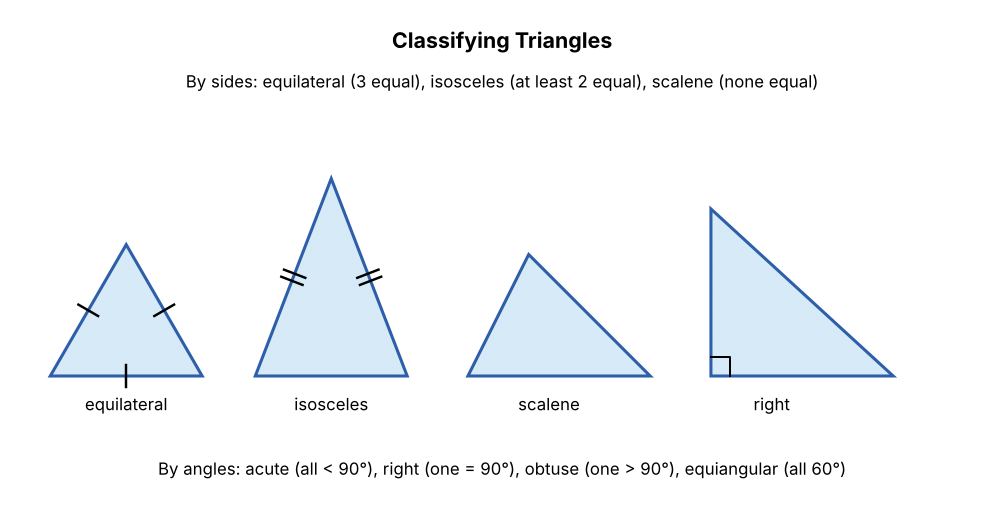
An isosceles triangle has at least two congruent sides.
- The two congruent sides are the legs.
- The third side is the base.
- The angle formed by the legs is the vertex angle.
- The two angles that include the base are the base angles.
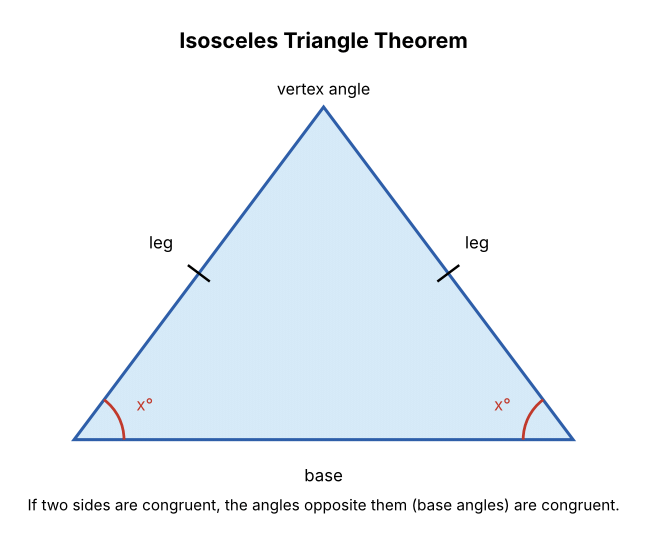
The base is not always drawn at the bottom. Identify it as the side that is not congruent to the others, and the base angles as the angles touching it.
The Base Angles Theorem and Its Converse
| Theorem | Statement |
|---|---|
| Base Angles Theorem | If two sides of a triangle are congruent, then the angles opposite them are congruent. |
| Converse | If two angles of a triangle are congruent, then the sides opposite them are congruent. |
The proof uses congruent triangles. Draw the bisector of the vertex angle. It splits the isosceles triangle into two triangles that are congruent by SAS: the legs match, the bisected angles match, and the bisector is shared. By CPCTC, the base angles are congruent.
Why does this matter? Both directions are useful. Equal sides tell you about angles, and equal angles tell you about sides. Pay attention to the word “opposite”: the congruent angles sit across from the congruent sides, not next to them.
Solving Isosceles Problems
Worked example 1: In an isosceles triangle, the vertex angle measures \(40^{\circ}\). Find each base angle.
- The base angles are equal, so call each one \(x\).
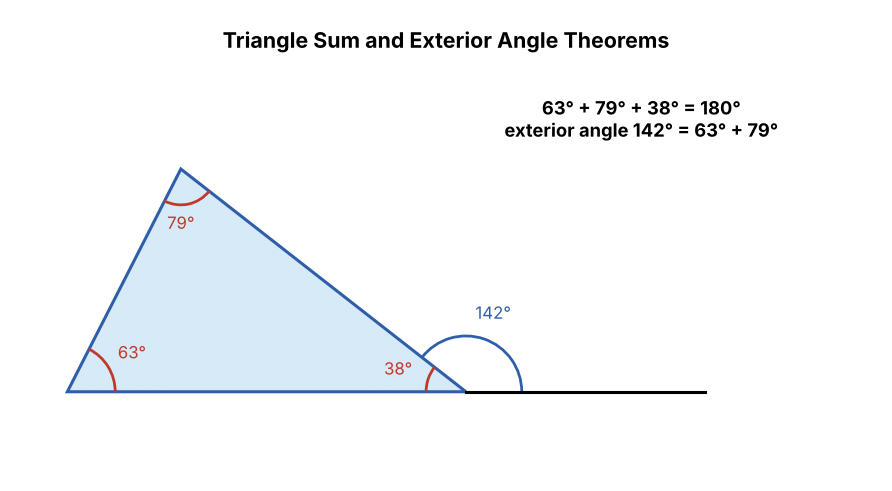
- Use the Triangle Sum Theorem: \(40+2x=180\).
- Solve: \(x=70^{\circ}\).
Worked example 2: In \(\triangle ABC\), \(\angle B\cong\angle C\), \(AB=3x+4\), and \(AC=5x-8\). Find \(AB\).
- By the converse, the sides opposite the congruent angles are congruent: \(AC\) is opposite \(\angle B\), and \(AB\) is opposite \(\angle C\).
- Set them equal: \(3x+4=5x-8\), so \(x=6\).
- Substitute: \(AB=3(6)+4=22\).
Worked example 3: A base angle measures \((2y+10)^{\circ}\) and the vertex angle measures \((y+20)^{\circ}\). Find \(y\).
- Two base angles plus the vertex angle sum to 180: \(2(2y+10)+(y+20)=180\).
- Simplify: \(5y+40=180\), so \(y=28\).
- The base angles are \(66^{\circ}\) each and the vertex angle is \(48^{\circ}\).
Equilateral Triangles
Applying the Base Angles Theorem to every pair of sides gives two corollaries:
- If a triangle is equilateral, then it is equiangular. Each angle measures \(\frac{180^{\circ}}{3}=60^{\circ}\).
- If a triangle is equiangular, then it is equilateral.
Why does this matter? Any time you see an equilateral triangle in a diagram, you instantly know three \(60^{\circ}\) angles. In composite figures, those angles often combine with linear pairs or parallel lines to unlock the rest of the diagram.
The Vertex Angle Bisector
In an isosceles triangle, the bisector of the vertex angle does more than split the angle. It is also the perpendicular bisector of the base, the median to the base, and the altitude to the base. One segment plays four roles. That fact explains why an isosceles triangle has a line of symmetry through its vertex angle.
Test-Taking Strategies
Mnemonic Devices and Memory Shortcuts
“Equal sides, equal opposite angles.” For equilateral triangles, remember “three sides, three sixties.” If a vertex angle is \(v\), each base angle is \(\frac{180-v}{2}\).
Cross-Topic Connections
- The angle sum used in every problem comes from Topic 5.1: Classifying Triangles and the Triangle Sum Theorem.
- The proof of the Base Angles Theorem uses Topic 5.2: Triangle Congruence: SSS and SAS.
- The line of symmetry connects to Topic 4.2: Reflections.
- Setting legs equal uses Algebra 1 Topic 2.4: Equations with Variables on Both Sides.
Common Question Formats
- Find a base angle given the vertex angle, or the reverse.
- Find a side length using the converse of the Base Angles Theorem.
- Solve for \(x\) when angles or sides are expressions.
- Find angles in composite figures that include equilateral triangles.
Frequent Student Mistakes
- Setting the vertex angle equal to a base angle.
- Matching each angle to an adjacent side instead of the opposite side.
- Assuming the base is the bottom side of the drawing.
Test-Day Shortcuts
If one base angle is known, double it and subtract from \(180^{\circ}\) to get the vertex angle in one step. If the vertex angle is known, subtract it from \(180^{\circ}\) and halve the result.
Time Management Tips
Isosceles angle items on Geometry unit tests and end-of-course exams take about a minute. Problems with expressions take one to two minutes. Mark the congruent sides and their opposite angles on the diagram before setting up any equation.