
When a line parallel to one side of a triangle cuts across the other two sides, it divides them proportionally. That fact, and a few related theorems, let you find missing segment lengths without ever setting up two separate similar triangles. They are shortcuts that grow directly out of similarity, and they appear often in multiple-choice questions with diagrams full of parallel lines.
This article covers Topic 7.3: Proportionality Theorems in Unit 7, Similarity. The topic asks you to apply the Triangle Proportionality Theorem and its converse, the theorem about parallel lines cutting transversals, and the Triangle Angle Bisector Theorem.
By the end, you should be able to:
- Apply the Triangle Proportionality Theorem to find segment lengths.
- Use the converse to decide whether a segment is parallel to a side.
- Find lengths when three or more parallel lines cut two transversals.
- Apply the Triangle Angle Bisector Theorem.
The Triangle Proportionality Theorem
In \(\triangle ABC\), suppose \(\overline{DE}\parallel\overline{BC}\), with \(D\) on \(\overline{AB}\) and \(E\) on \(\overline{AC}\). The Triangle Proportionality Theorem says the parallel segment divides the two sides proportionally:
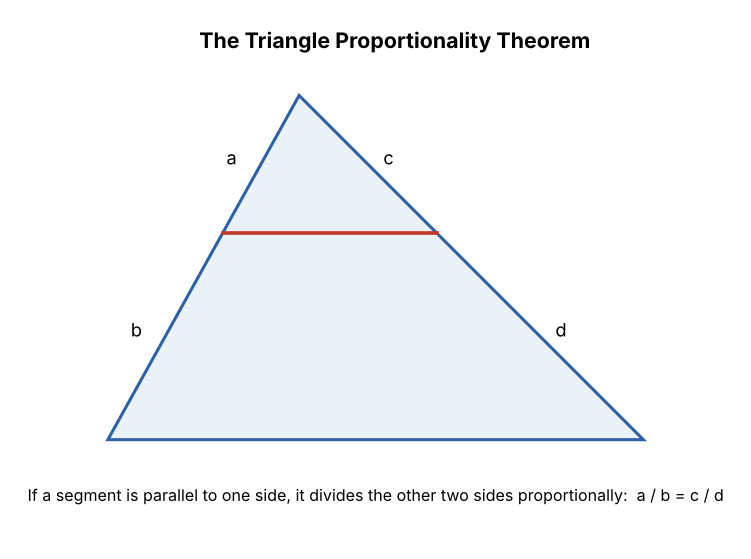
\(\frac{AD}{DB}=\frac{AE}{EC}\)
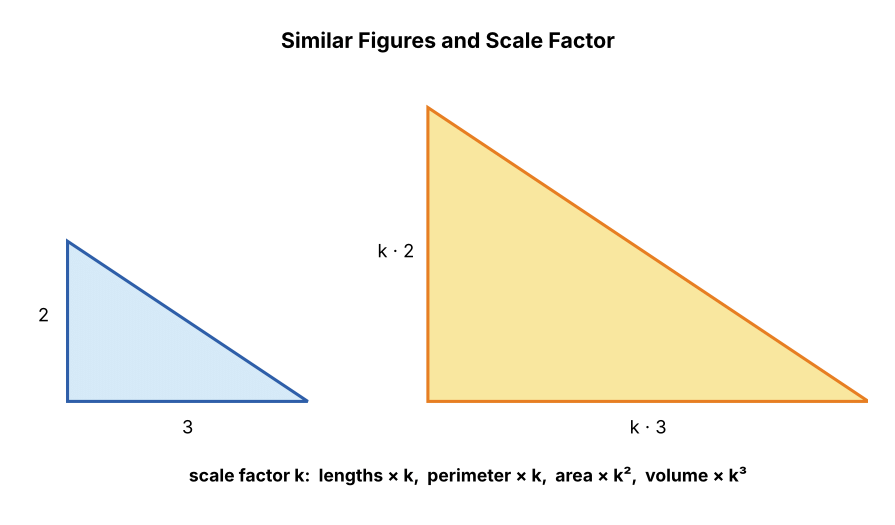
This follows from the similar triangles \(\triangle ADE\sim\triangle ABC\), but it uses the pieces of the sides instead of the whole sides, which is often more convenient.
Worked example 1: \(AD=6\), \(DB=9\), and \(AE=8\). Find \(EC\).
- Set up: \(\frac{6}{9}=\frac{8}{EC}\).
- Cross multiply: \(6\cdot EC=72\), so \(EC=12\).
Worked example 2: \(AD=x+2\), \(DB=10\), \(AE=6\), and \(EC=12\). Find \(x\).
- Set up: \(\frac{x+2}{10}=\frac{6}{12}\).
- Cross multiply: \(12(x+2)=60\), so \(x+2=5\) and \(x=3\).
Why does this matter? The theorem compares piece to piece, while similar triangle proportions compare part to whole. Mixing the two in one proportion, such as \(\frac{AD}{DB}=\frac{DE}{BC}\), gives a wrong answer. Use pieces with pieces, or wholes with wholes, but never mix them.
The Converse
The converse states that if a segment divides two sides of a triangle proportionally, then it is parallel to the third side.
Worked example 3: In \(\triangle PQR\), \(S\) lies on \(\overline{PQ}\) and \(T\) lies on \(\overline{PR}\). \(PS=4\), \(SQ=6\), \(PT=5\), and \(TR=7.5\). Is \(\overline{ST}\parallel\overline{QR}\)?
- Compare ratios: \(\frac{4}{6}=\frac{2}{3}\) and \(\frac{5}{7.5}=\frac{2}{3}\).
- The ratios are equal, so \(\overline{ST}\parallel\overline{QR}\).
If the ratios had differed, even slightly, the segment would not be parallel. For instance, with \(TR=8\) instead, \(\frac{5}{8}\) does not equal \(\frac{2}{3}\), so \(\overline{ST}\) would tilt and eventually meet line \(QR\).
Why does this matter? The converse gives you a way to prove lines parallel using only lengths, with no angle measures at all. That is especially handy on the coordinate plane or in diagrams where only segment lengths are labeled.
Three Parallel Lines
If three or more parallel lines cut two transversals, they divide the transversals proportionally. Picture the lines on notebook paper crossed by two slanted pencils.
Worked example 4: Three parallel streets cross two avenues. On the first avenue, the blocks between the streets measure 300 feet and 450 feet. On the second avenue, the first block measures 360 feet. Find the second block.
- Set up: \(\frac{300}{450}=\frac{360}{x}\).
- Cross multiply: \(300x=162000\), so \(x=540\) feet.
A special case follows: if the parallel lines cut off congruent segments on one transversal, they cut off congruent segments on every transversal.
The Triangle Angle Bisector Theorem
An angle bisector of a triangle divides the opposite side into segments proportional to the other two sides. In \(\triangle ABC\), if \(\overline{AD}\) bisects \(\angle A\) and meets \(\overline{BC}\) at \(D\), then:
\(\frac{BD}{DC}=\frac{AB}{AC}\)
Worked example 5: \(AB=12\), \(AC=18\), and \(BC=20\). Find \(BD\).
- Let \(BD=x\), so \(DC=20-x\).
- Set up: \(\frac{x}{20-x}=\frac{12}{18}\).
- Cross multiply: \(18x=240-12x\), so \(30x=240\) and \(x=8\).
Why does this matter? The longer neighboring side gets the longer piece of the opposite side. Here \(AC\) is longer, so \(DC=12\) is longer than \(BD=8\). That quick size check confirms your proportion is set up in the right order.
Test-Taking Strategies
Mnemonic Devices and Memory Shortcuts
“Top over bottom equals top over bottom” for pieces cut by a parallel line. For the angle bisector, “each piece follows its neighbor”: the piece next to a side is proportional to that side.
Cross-Topic Connections
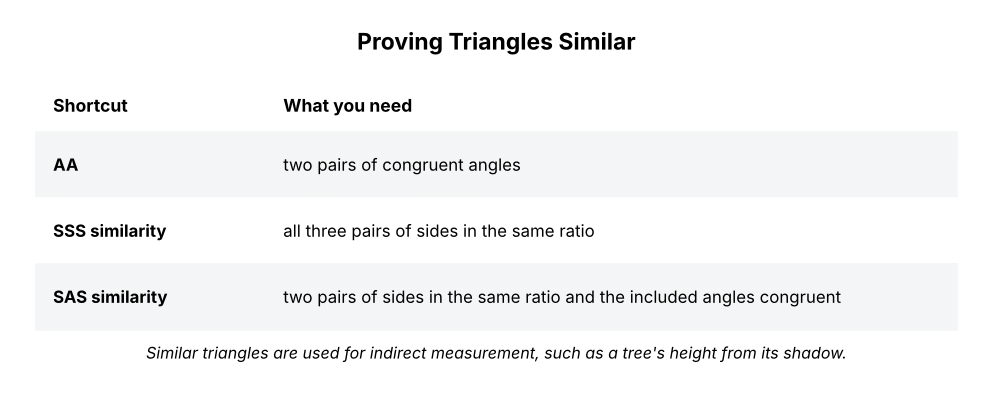
- These theorems come from AA similarity in Topic 7.2: Proving Triangles Similar.
- Proportions and scale factors are reviewed in Topic 7.1: Ratios and Similar Polygons.
- Parallel lines and transversals come from Topic 3.1: Angles Formed by Parallel Lines and Transversals.
- The midsegment is the special case where the ratio is 1, from Topic 5.5: Midsegments, Bisectors, Medians, and Altitudes.
Common Question Formats
- Find a missing segment when a line is parallel to a side.
- Decide whether a segment is parallel to a side using the converse.
- Find lengths along transversals cut by parallel lines.
- Use the Angle Bisector Theorem to find a piece of a side.
Frequent Student Mistakes
- Mixing pieces and whole sides in the same proportion.
- Pairing a piece with the wrong neighboring side in the Angle Bisector Theorem.
- Using the parallel segment’s length in a piece-to-piece proportion.
Test-Day Shortcuts
Look for a simple ratio first. If one side is split 2 to 3, the other side is too. Scaling mentally often finds the answer without cross multiplying.
Time Management Tips
Proportionality items on Geometry unit tests and end-of-course exams take one to two minutes. Angle bisector problems with an unknown split take a little longer, so define \(x\) and the leftover piece before writing the proportion.