
The Pythagorean Theorem may be the most famous result in all of mathematics. It connects the three sides of every right triangle, and its converse lets you test whether a triangle is right, acute, or obtuse from its side lengths alone. You will use it to find distances, check corners in construction, and solve problems throughout the rest of the course.
This article covers Topic 8.1: The Pythagorean Theorem and Its Converse in Unit 8, Right Triangles and Trigonometry. The topic asks you to find missing side lengths in right triangles, recognize Pythagorean triples, and use the converse to classify triangles by their angles.
By the end, you should be able to:
- State the Pythagorean Theorem and identify the hypotenuse and legs.
- Find a missing side length and leave answers in simplest radical form.
- Recognize common Pythagorean triples and their multiples.
- Use the converse to classify a triangle as right, acute, or obtuse.
The Theorem
In a right triangle, the two sides that form the right angle are the legs, and the side opposite the right angle is the hypotenuse. The hypotenuse is always the longest side. The Pythagorean Theorem states that for legs \(a\) and \(b\) and hypotenuse \(c\):
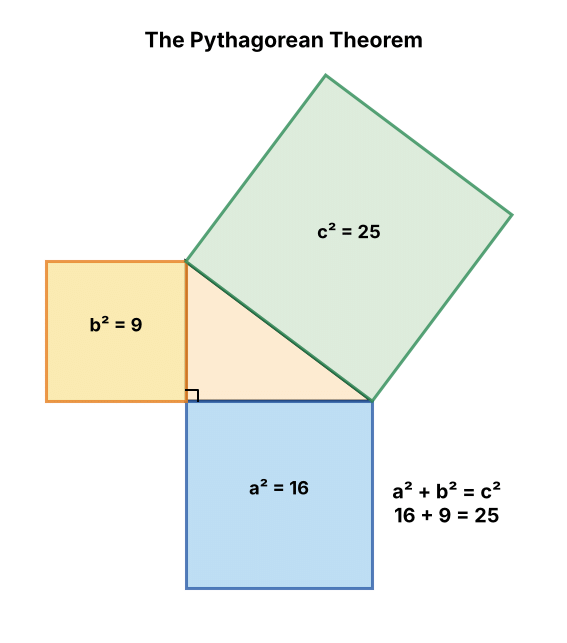
\(a^{2}+b^{2}=c^{2}\)
One classic proof arranges four copies of the triangle inside a large square. The empty space in the middle has area \(c^{2}\), and rearranging the triangles shows the same empty space as two squares with areas \(a^{2}\) and \(b^{2}\).
Finding Missing Sides
Worked example 1: The legs of a right triangle are 7 and 24. Find the hypotenuse.
- Substitute: \(7^{2}+24^{2}=c^{2}\).
- Simplify: \(49+576=625\).
- Take the square root: \(c=25\).
Worked example 2: A right triangle has a hypotenuse of 12 and one leg of 8. Find the other leg.
- Substitute: \(8^{2}+b^{2}=12^{2}\).
- Simplify: \(64+b^{2}=144\), so \(b^{2}=80\).
- Simplify the radical: \(b=\sqrt{80}=4\sqrt{5}\approx 8.94\).
Why does this matter? When finding a leg, you subtract; when finding the hypotenuse, you add. Students who always add get a “leg” longer than the hypotenuse, which is impossible. If your leg comes out longer than the hypotenuse, you added when you should have subtracted.
Pythagorean Triples
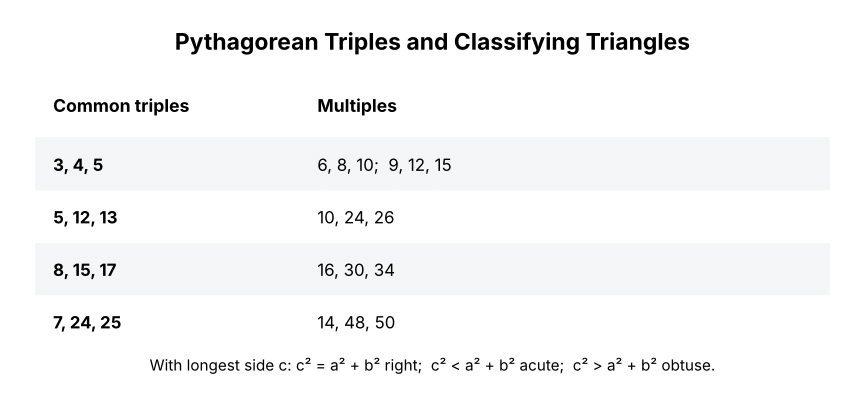
A Pythagorean triple is a set of three whole numbers that satisfy the theorem. Recognizing them saves time.
| Basic Triple | Multiples |
|---|---|
| 3, 4, 5 | 6, 8, 10; 9, 12, 15; 15, 20, 25 |
| 5, 12, 13 | 10, 24, 26; 15, 36, 39 |
| 8, 15, 17 | 16, 30, 34 |
| 7, 24, 25 | 14, 48, 50 |
Multiplying every number in a triple by the same factor always produces another triple, because the triangles are similar.
The Converse and Classifying Triangles
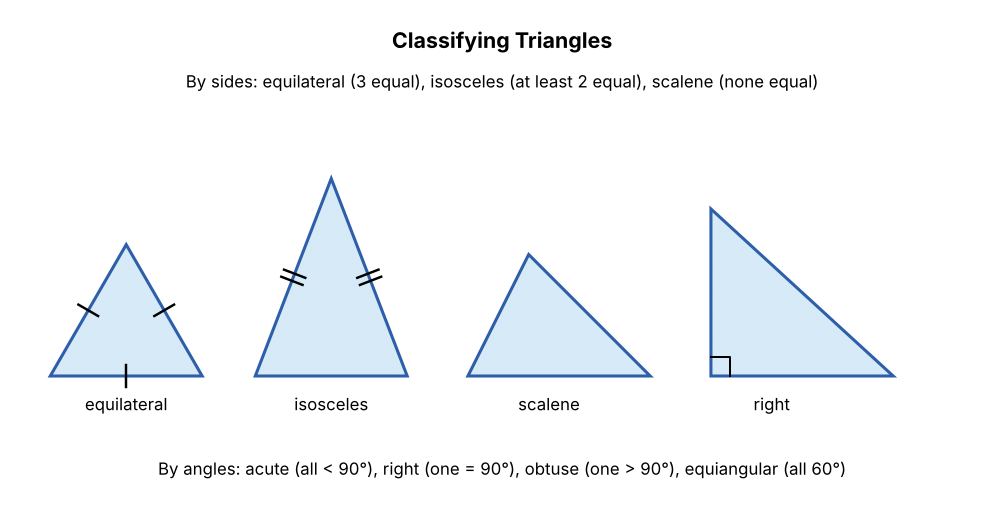
The Converse of the Pythagorean Theorem says that if \(a^{2}+b^{2}=c^{2}\) for the side lengths of a triangle, then the triangle is a right triangle. Comparing \(a^{2}+b^{2}\) with \(c^{2}\), where \(c\) is the longest side, classifies any triangle:
| Comparison | Triangle Type |
|---|---|
| \(a^{2}+b^{2}=c^{2}\) | Right |
| \(a^{2}+b^{2}\gt c^{2}\) | Acute |
| \(a^{2}+b^{2}\lt c^{2}\) | Obtuse |
Worked example 3: Classify a triangle with sides 6, 9, and 11.
- Check that it is a triangle: \(6+9=15\), which is greater than 11.
- Compare: \(6^{2}+9^{2}=36+81=117\) and \(11^{2}=121\).
- Since \(117\lt 121\), the triangle is obtuse.
Why does this matter? When the longest side grows past the “right” length, the angle across from it opens wider than \(90^{\circ}\). That intuition helps you remember which inequality means obtuse: a long \(c\) makes \(c^{2}\) the bigger side of the comparison.
Real-World Use
Builders use the 3-4-5 triple to check square corners. Measure 3 feet along one wall and 4 feet along the other. If the diagonal between those marks is exactly 5 feet, the corner is a right angle. A ladder problem works the same way: a 13-foot ladder with its base 5 feet from a wall reaches 12 feet up the wall. TV and phone screens are measured along the diagonal for the same reason, so a screen’s width and height are the legs of a right triangle whose hypotenuse is the advertised size.
Test-Taking Strategies
Mnemonic Devices and Memory Shortcuts
“Legs squared add up to the long side squared.” For classifying, “bigger \(c\) squared means obtuse, smaller means acute.” Memorize 3-4-5, 5-12-13, 8-15-17, and 7-24-25.
Cross-Topic Connections
- The distance formula is this theorem on a grid, from Topic 1.2: Measuring Segments and the Distance Formula.
- Always confirm a valid triangle first, using Topic 5.6: Triangle Inequalities.
- Radical answers are simplified with Algebra 1 Topic 8.1: Simplifying Radicals.
- Rhombus diagonals form right triangles, as in Topic 6.3: Rectangles, Rhombuses, and Squares.
Common Question Formats
- Find a missing leg or hypotenuse.
- Decide whether three lengths form a right triangle.
- Classify a triangle as acute, right, or obtuse.
- Solve a ladder, ramp, or diagonal word problem.
Frequent Student Mistakes
- Adding when solving for a leg.
- Using a leg as \(c\) in the converse instead of the longest side.
- Leaving \(\sqrt{80}\) unsimplified when simplest radical form is required.
Test-Day Shortcuts
Before squaring, check whether the sides are a multiple of a known triple. Divide by a common factor: 15, 36, 39 divided by 3 gives 5, 12, 13. Recognizing triples turns a calculation into a lookup.
Time Management Tips
Pythagorean items on Geometry unit tests and end-of-course exams take about a minute. Classification items take a similar time. Word problems take two minutes, mostly for the sketch, which you should always draw.