
Two right triangles appear so often that their side ratios are worth memorizing: the 45-45-90 triangle and the 30-60-90 triangle. With their patterns, you can find every side from just one, without the Pythagorean Theorem and without a calculator. They show up in squares, equilateral triangles, hexagons, and the unit circle.
This article covers Topic 8.2: Special Right Triangles in Unit 8, Right Triangles and Trigonometry. The topic asks you to use the side ratios of 45-45-90 and 30-60-90 triangles to find missing lengths and to apply them inside other figures.
By the end, you should be able to:
- State the side ratios for 45-45-90 and 30-60-90 triangles.
- Find all sides of a special right triangle from any one side.
- Explain where each ratio comes from.
- Use special right triangles inside squares, equilateral triangles, and hexagons.
The 45-45-90 Triangle
A 45-45-90 triangle is an isosceles right triangle. Its legs are congruent, and its hypotenuse is \(\sqrt{2}\) times a leg.
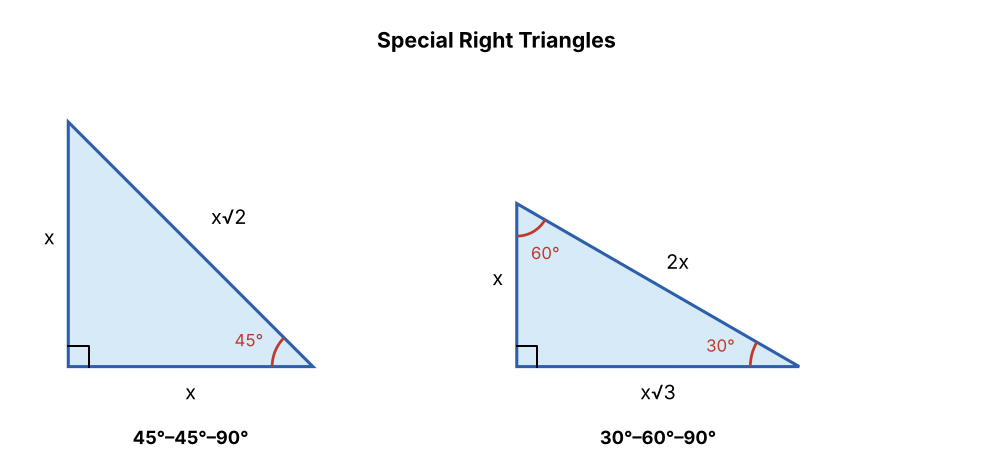
\(\text{leg}:\text{leg}:\text{hypotenuse}=x:x:x\sqrt{2}\)
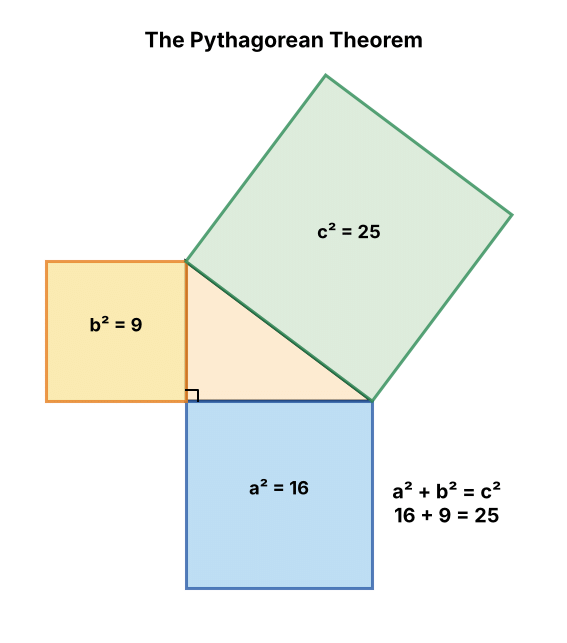
The ratio comes from the Pythagorean Theorem: \(x^{2}+x^{2}=2x^{2}\), and \(\sqrt{2x^{2}}=x\sqrt{2}\). It is also exactly half of a square cut along its diagonal.
Worked example 1: A leg measures 7. The other leg is 7 and the hypotenuse is \(7\sqrt{2}\).
Worked example 2: The hypotenuse measures 10. Find each leg.
- Set up: \(x\sqrt{2}=10\), so \(x=\frac{10}{\sqrt{2}}\).
- Rationalize: \(\frac{10}{\sqrt{2}}\cdot\frac{\sqrt{2}}{\sqrt{2}}=\frac{10\sqrt{2}}{2}=5\sqrt{2}\).
- Each leg is \(5\sqrt{2}\approx 7.07\).
Why does this matter? A shortcut for this direction: a leg equals half the hypotenuse times \(\sqrt{2}\). For a hypotenuse of 10, that is \(5\sqrt{2}\) in one step, with no rationalizing needed.
The 30-60-90 Triangle
A 30-60-90 triangle is half of an equilateral triangle. Its sides follow this pattern:
\(\text{short leg}:\text{long leg}:\text{hypotenuse}=x:x\sqrt{3}:2x\)
| Side | Opposite Angle | Length |
|---|---|---|
| Short leg | \(30^{\circ}\) | \(x\) |
| Long leg | \(60^{\circ}\) | \(x\sqrt{3}\) |
| Hypotenuse | \(90^{\circ}\) | \(2x\) |
Cut an equilateral triangle with side \(2x\) down the middle. The hypotenuse is \(2x\), the short leg is half the base, \(x\), and the Pythagorean Theorem gives the height: \(\sqrt{4x^{2}-x^{2}}=x\sqrt{3}\).
Worked example 3: The hypotenuse is 18. The short leg is \(\frac{18}{2}=9\), and the long leg is \(9\sqrt{3}\).
Worked example 4: The long leg is 12. Find the other sides.
- Set up: \(x\sqrt{3}=12\), so \(x=\frac{12}{\sqrt{3}}=\frac{12\sqrt{3}}{3}=4\sqrt{3}\).
- Short leg: \(4\sqrt{3}\approx 6.93\).
- Hypotenuse: \(2\cdot 4\sqrt{3}=8\sqrt{3}\approx 13.86\).
Why does this matter? Always find the short leg first. Every other side is a simple multiple of it. If you are given the long leg, divide by \(\sqrt{3}\); if you are given the hypotenuse, divide by 2.
Special Triangles Inside Other Figures
- Square: A diagonal splits a square into two 45-45-90 triangles. A square with side 6 has a diagonal of \(6\sqrt{2}\).
- Equilateral triangle: An altitude splits it into two 30-60-90 triangles. An equilateral triangle with side 10 has height \(5\sqrt{3}\).
- Regular hexagon: A hexagon splits into six equilateral triangles. The distance from the center to a side, called the apothem, is the long leg of a 30-60-90 triangle.
Why does this matter? Many area problems hide a special right triangle. To find the area of an equilateral triangle with side 10, you need its height, \(5\sqrt{3}\), so the area is \(\frac{1}{2}\cdot 10\cdot 5\sqrt{3}=25\sqrt{3}\). Without the 30-60-90 pattern, you would need the Pythagorean Theorem and more steps.
When to Use the Ratios
Special right triangle ratios apply only when you know the triangle has angles of 45-45-90 or 30-60-90. Look for these clues:
- A right triangle with two congruent legs or one \(45^{\circ}\) angle is a 45-45-90 triangle.
- A right triangle with a \(30^{\circ}\) or \(60^{\circ}\) angle is a 30-60-90 triangle.
- A right triangle whose hypotenuse is exactly twice one leg is a 30-60-90 triangle.
If none of these clues appear, use the Pythagorean Theorem or trigonometry instead. Ratios are faster, but only when they truly apply.
Test-Taking Strategies
Mnemonic Devices and Memory Shortcuts
For 45-45-90, “\(x\), \(x\), \(x\) root 2.” For 30-60-90, “\(x\), \(x\) root 3, \(2x\),” and remember “1, 2, 3”: the sides involve 1, root 3, and 2, with root 3 always on the long leg. The smallest side faces the smallest angle.
Cross-Topic Connections
- Both ratios come from Topic 8.1: The Pythagorean Theorem and Its Converse.
- The 30-60-90 triangle is half an equilateral triangle, from Topic 5.4: Isosceles and Equilateral Triangles.
- Rationalizing answers uses Algebra 1 Topic 8.3: Rationalizing the Denominator.
- Larger angles face longer sides, as in Topic 5.6: Triangle Inequalities.
Common Question Formats
- Find missing sides given one side of a special right triangle.
- Find the diagonal of a square or the height of an equilateral triangle.
- Give answers in simplest radical form.
- Use special triangles to find area or perimeter of a composite figure.
Frequent Student Mistakes
- Putting \(\sqrt{3}\) on the hypotenuse instead of the long leg.
- Multiplying by \(\sqrt{2}\) when given the hypotenuse instead of dividing.
- Leaving a radical in the denominator.
Test-Day Shortcuts
Check your answer by size order. In a 30-60-90 triangle, \(x\lt x\sqrt{3}\lt 2x\), since \(\sqrt{3}\approx 1.73\). If your hypotenuse is not the longest side, you placed a factor on the wrong side.
Time Management Tips
Special right triangle items on Geometry unit tests and end-of-course exams take about a minute once the ratios are memorized. Composite figure problems take two to three minutes, so sketch the hidden triangle before computing.