
Special right triangles only cover angles of \(30^{\circ}\), \(45^{\circ}\), and \(60^{\circ}\). What about a ramp that rises at \(12^{\circ}\) or a kite string at \(52^{\circ}\)? Trigonometry handles every angle. The three basic trig ratios, sine, cosine, and tangent, connect any acute angle of a right triangle to the ratio of two of its sides.
This article covers Topic 8.3: Sine, Cosine, and Tangent Ratios in Unit 8, Right Triangles and Trigonometry. The topic asks you to identify opposite and adjacent sides, write the three trig ratios, use them to find missing side lengths, and explain why the ratios depend only on the angle.
By the end, you should be able to:
- Label the opposite side, adjacent side, and hypotenuse relative to an angle.
- Write the sine, cosine, and tangent of an acute angle as ratios.
- Use a trig ratio and a calculator to find a missing side.
- Explain the relationship between the sine and cosine of complementary angles.
Labeling the Sides
In a right triangle, the labels “opposite” and “adjacent” depend on which acute angle you are looking at, called the reference angle \(\theta\).
- Hypotenuse: Always the side across from the right angle.
- Opposite: The side across from \(\theta\), not touching it.
- Adjacent: The leg that touches \(\theta\) and is not the hypotenuse.
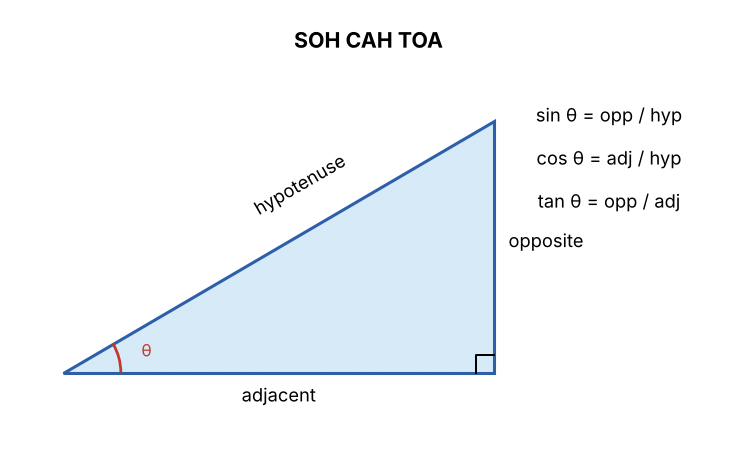
Why does this matter? Switching reference angles swaps opposite and adjacent. The leg that is opposite one acute angle is adjacent to the other. Relabel every time the angle in the question changes.
The Three Ratios
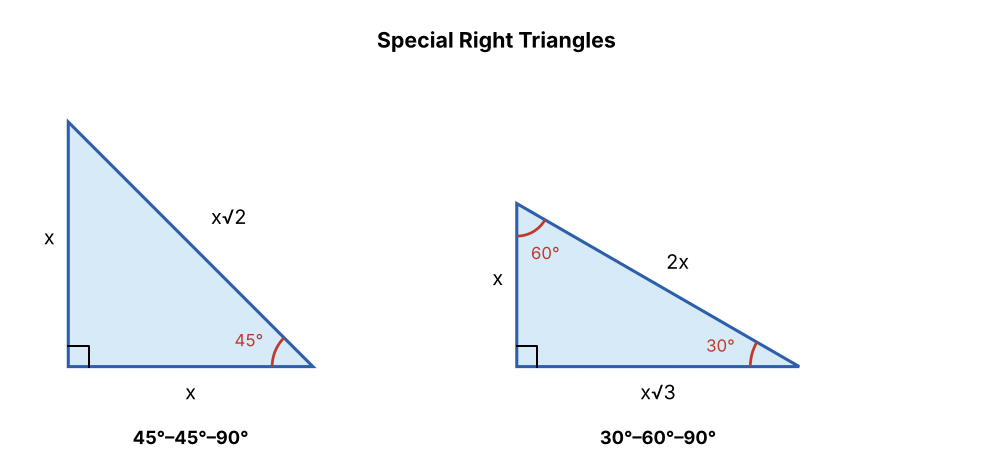
| Ratio | Definition | Example for a 3-4-5 Triangle |
|---|---|---|
| Sine | \(\sin\theta=\frac{\text{opposite}}{\text{hypotenuse}}\) | \(\frac{3}{5}=0.6\) |
| Cosine | \(\cos\theta=\frac{\text{adjacent}}{\text{hypotenuse}}\) | \(\frac{4}{5}=0.8\) |
| Tangent | \(\tan\theta=\frac{\text{opposite}}{\text{adjacent}}\) | \(\frac{3}{4}=0.75\) |
The example assumes \(\theta\) is the angle opposite the side of length 3. Because all right triangles with the same acute angle are similar by AA, the ratios depend only on the angle, not on the size of the triangle. That is why a calculator can give you \(\sin 35^{\circ}\) without knowing anything about your triangle.
Finding Missing Sides
Choose the ratio that uses the side you know and the side you want. A simple decision process works every time:
- Mark the reference angle.
- Label the known side and the unknown side as opposite, adjacent, or hypotenuse.
- Pick the one ratio that contains exactly those two labels.
The side you do not know and do not need is ignored completely, which keeps each problem to a single equation.
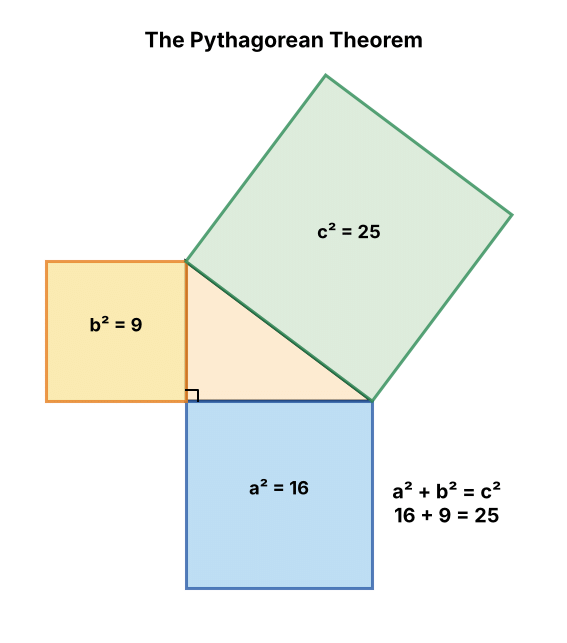
Worked example 1: In a right triangle, \(\theta=35^{\circ}\) and the hypotenuse is 20. Find the side opposite \(\theta\).
- Opposite and hypotenuse means sine: \(\sin 35^{\circ}=\frac{x}{20}\).
- Multiply: \(x=20\sin 35^{\circ}\).
- Calculate: \(x\approx 20(0.5736)\approx 11.47\).
Worked example 2: \(\theta=50^{\circ}\) and the adjacent side is 8. Find the hypotenuse.
- Adjacent and hypotenuse means cosine: \(\cos 50^{\circ}=\frac{8}{h}\).
- Solve for \(h\): \(h=\frac{8}{\cos 50^{\circ}}\).
- Calculate: \(h\approx\frac{8}{0.6428}\approx 12.45\).
Worked example 3: A ramp makes a \(12^{\circ}\) angle with the ground and rises 2 feet. How long is its horizontal run?
- Opposite is 2, and the run is adjacent, so use tangent: \(\tan 12^{\circ}=\frac{2}{r}\).
- Solve: \(r=\frac{2}{\tan 12^{\circ}}\approx\frac{2}{0.2126}\approx 9.41\) feet.
Why does this matter? When the unknown is in the denominator, you divide by the trig value instead of multiplying. Examples 2 and 3 both put the unknown on the bottom. If your answer is shorter than a leg when you were solving for a hypotenuse, you multiplied when you should have divided.
Sine and Cosine of Complementary Angles
The two acute angles of a right triangle are complementary. The side opposite one is adjacent to the other, so:
\(\sin\theta=\cos(90^{\circ}-\theta)\)
For example, \(\sin 30^{\circ}=\cos 60^{\circ}=0.5\), and \(\sin 72^{\circ}=\cos 18^{\circ}\). This is where the name “cosine” comes from: the sine of the complementary angle. Tests often ask you to find a value of \(x\) that makes \(\sin(2x)=\cos(x+30)\) true; set the angles to sum to \(90^{\circ}\) and solve, giving \(x=20\).
Test-Taking Strategies
Mnemonic Devices and Memory Shortcuts
Use SOH-CAH-TOA: Sine is Opposite over Hypotenuse, Cosine is Adjacent over Hypotenuse, Tangent is Opposite over Adjacent. For complementary angles, “co” means “complement.”
Cross-Topic Connections
- Trig ratios work because of AA similarity from Topic 7.2: Proving Triangles Similar.
- Exact values for 30, 45, and 60 degrees come from Topic 8.2: Special Right Triangles.
- The third side can be checked with Topic 8.1: The Pythagorean Theorem and Its Converse.
- Complementary acute angles come from Topic 5.1: Classifying Triangles and the Triangle Sum Theorem.
Common Question Formats
- Write a trig ratio as a fraction from a labeled triangle.
- Find a missing side using sine, cosine, or tangent.
- Solve a ramp, ladder, or shadow word problem.
- Use \(\sin\theta=\cos(90^{\circ}-\theta)\) to match equivalent expressions.
Frequent Student Mistakes
- Labeling opposite and adjacent relative to the wrong angle.
- Calculator in radian mode instead of degree mode.
- Multiplying by the trig value when the unknown is in the denominator.
Test-Day Shortcuts
Check your calculator mode before the test begins: \(\sin 30\) should equal 0.5. Also remember that sine and cosine of acute angles are always between 0 and 1, so a hypotenuse must always be longer than the leg you started with.
Time Management Tips
Trig ratio items on Geometry unit tests and end-of-course exams take one to two minutes. Label the triangle first, then pick the ratio, then compute. That fixed order prevents most errors.