
Knowing the trig ratios lets you find sides. But what if you know the sides and need an angle, such as how steep a wheelchair ramp is or the angle a ladder makes with the ground? Inverse trig functions answer that question. Together with the Pythagorean Theorem, they let you solve a right triangle completely: every side and every angle.
This article covers Topic 8.4: Solving Right Triangles in Unit 8, Right Triangles and Trigonometry. The topic asks you to use inverse trig functions to find acute angles, solve right triangles from limited information, and model angle of elevation and depression problems.
By the end, you should be able to:
- Use inverse sine, cosine, and tangent to find an acute angle.
- Solve a right triangle given two sides, or one side and one acute angle.
- Distinguish angles of elevation from angles of depression.
- Set up and solve real-world right triangle problems.
Inverse Trig Functions
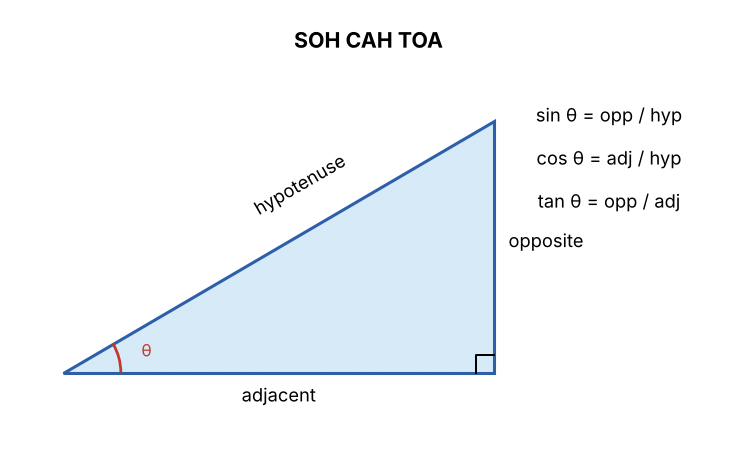
If \(\sin\theta=0.5\), what is \(\theta\)? The inverse sine, written \(\sin^{-1}\) or arcsin, answers that question: \(\theta=\sin^{-1}(0.5)=30^{\circ}\). The inverse functions take a ratio and return an angle.
| If You Know | Use | To Find |
|---|---|---|
| Opposite and hypotenuse | \(\sin^{-1}\left(\frac{\text{opp}}{\text{hyp}}\right)\) | The angle |
| Adjacent and hypotenuse | \(\cos^{-1}\left(\frac{\text{adj}}{\text{hyp}}\right)\) | The angle |
| Opposite and adjacent | \(\tan^{-1}\left(\frac{\text{opp}}{\text{adj}}\right)\) | The angle |
Why does this matter? The \(-1\) is not an exponent. \(\sin^{-1}(x)\) means “the angle whose sine is \(x\),” not \(\frac{1}{\sin x}\). Calculators place inverse trig functions on the second-function key above sin, cos, and tan.
Solving a Right Triangle
To solve a right triangle means to find all three sides and both acute angles. You need two pieces of information besides the right angle, and at least one must be a side.
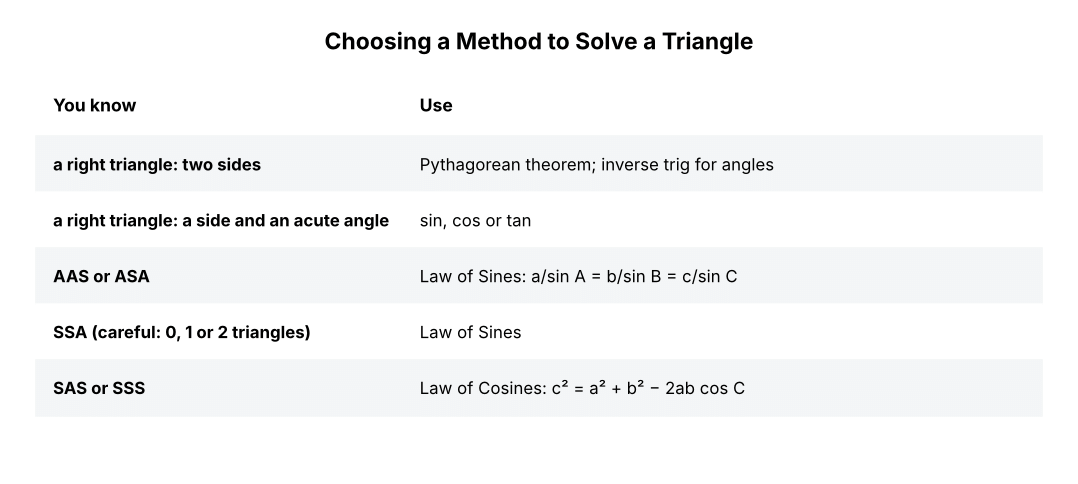
Worked example 1: A right triangle has legs of 9 and 14. Solve it.
- Hypotenuse: \(c=\sqrt{81+196}=\sqrt{277}\approx 16.64\).
- Angle opposite the side of 9: \(\theta=\tan^{-1}\left(\frac{9}{14}\right)\approx 32.7^{\circ}\).
- Other acute angle: \(90-32.7=57.3^{\circ}\).
Worked example 2: A right triangle has an acute angle of \(40^{\circ}\) and a hypotenuse of 15. Solve it.
- Other acute angle: \(90-40=50^{\circ}\).
- Side opposite \(40^{\circ}\): \(15\sin 40^{\circ}\approx 9.64\).
- Side adjacent to \(40^{\circ}\): \(15\cos 40^{\circ}\approx 11.49\).
- Check with the Pythagorean Theorem: \(9.64^{2}+11.49^{2}\approx 225=15^{2}\).
Why does this matter? Use the given values whenever possible rather than your rounded answers. Rounding errors grow with each step, so calculating each side directly from the original information gives more accurate results.
Angles of Elevation and Depression
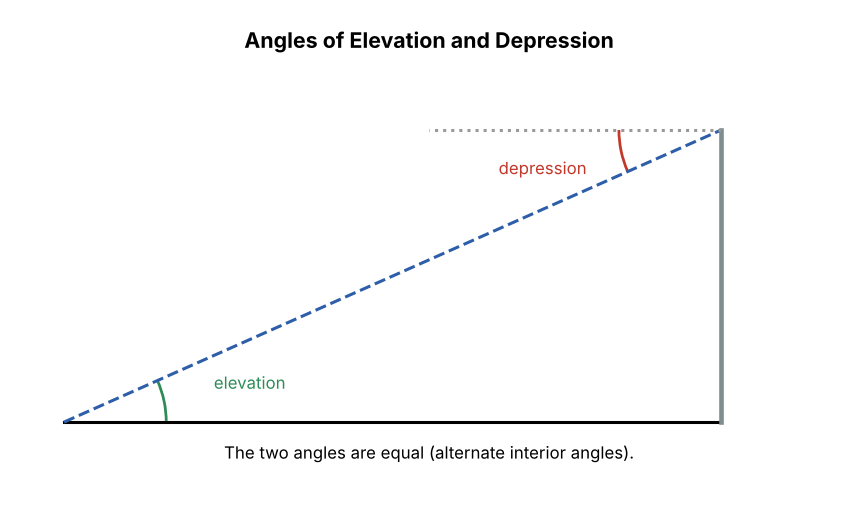
- An angle of elevation is measured upward from a horizontal line to an object above, such as looking up at the top of a building.
- An angle of depression is measured downward from a horizontal line to an object below, such as looking down from a lighthouse at a boat.
The angle of depression from point \(A\) to point \(B\) equals the angle of elevation from \(B\) to \(A\). The two horizontal lines are parallel, so these are alternate interior angles.
Worked example 3: From a point 50 meters from the base of a tower, the angle of elevation to the top is \(58^{\circ}\). How tall is the tower?
- The height is opposite the angle, and 50 meters is adjacent.
- Use tangent: \(\tan 58^{\circ}=\frac{h}{50}\).
- Solve: \(h=50\tan 58^{\circ}\approx 80.0\) meters.
Worked example 4: A pilot at 3,000 feet sees a runway at an angle of depression of \(9^{\circ}\). How far is the plane, along the ground, from the runway?
- The angle of elevation from the runway to the plane is also \(9^{\circ}\).
- Use tangent: \(\tan 9^{\circ}=\frac{3000}{d}\).
- Solve: \(d=\frac{3000}{\tan 9^{\circ}}\approx 18941\) feet, or about 3.6 miles.
Why does this matter? Depression problems are where most setup errors happen. The angle of depression sits between the horizontal line at the observer’s eye and the line of sight, not inside the triangle you would naturally draw. Transferring it to the bottom of the triangle as an angle of elevation puts it inside a right triangle, where SOH-CAH-TOA applies directly. Draw that transfer every time, and the rest of the problem becomes a routine tangent calculation.
Test-Taking Strategies
Mnemonic Devices and Memory Shortcuts
“Sides to angle, go inverse.” For depression angles, “the angle drops from the horizontal, never from the vertical.” SOH-CAH-TOA still chooses the ratio; the inverse just runs it backward.
Cross-Topic Connections
- The three ratios are defined in Topic 8.3: Sine, Cosine, and Tangent Ratios.
- The third side comes from Topic 8.1: The Pythagorean Theorem and Its Converse.
- Elevation equals depression because of Topic 3.1: Angles Formed by Parallel Lines and Transversals.
- Exact answers for special angles come from Topic 8.2: Special Right Triangles.
Common Question Formats
- Find an acute angle given two sides.
- Solve a right triangle completely.
- Find a height or distance using an angle of elevation or depression.
- Find the angle a ramp or ladder makes with the ground.
Frequent Student Mistakes
- Measuring an angle of depression from the vertical.
- Treating \(\sin^{-1}\) as a reciprocal.
- Rounding early and carrying the rounded value through later steps.
Test-Day Shortcuts
Sketch every word problem, mark the horizontal line, and place the angle carefully. Once the triangle is labeled, the ratio choice is automatic. For angles, check that your answer is between \(0^{\circ}\) and \(90^{\circ}\).
Time Management Tips
Inverse trig items on Geometry unit tests and end-of-course exams take about a minute. Elevation and depression problems take two to three minutes, mostly for the sketch. Solve-the-triangle problems take three to four minutes.