
When lines cross a circle, they create angles and segments with predictable relationships. A tangent meets a radius at a right angle. Two chords that cross inside a circle split each other in a fixed product. Lines that meet outside a circle form angles equal to half the difference of the arcs they cut off. This topic gathers those rules into a set of formulas that cover nearly every circle diagram you will see.
This article covers Topic 9.4: Tangents, Secants, and Chords in Unit 9, Circles. The topic asks you to apply tangent properties, find angle measures formed by chords, secants, and tangents, and find segment lengths using the segment product theorems.
By the end, you should be able to:
- Use the facts that a tangent is perpendicular to a radius and that two tangents from a point are congruent.
- Find angles formed by lines that meet inside, on, or outside a circle.
- Apply the Chord-Chord, Secant-Secant, and Secant-Tangent product theorems.
- Choose the correct rule based on where the lines meet.
Tangent Properties
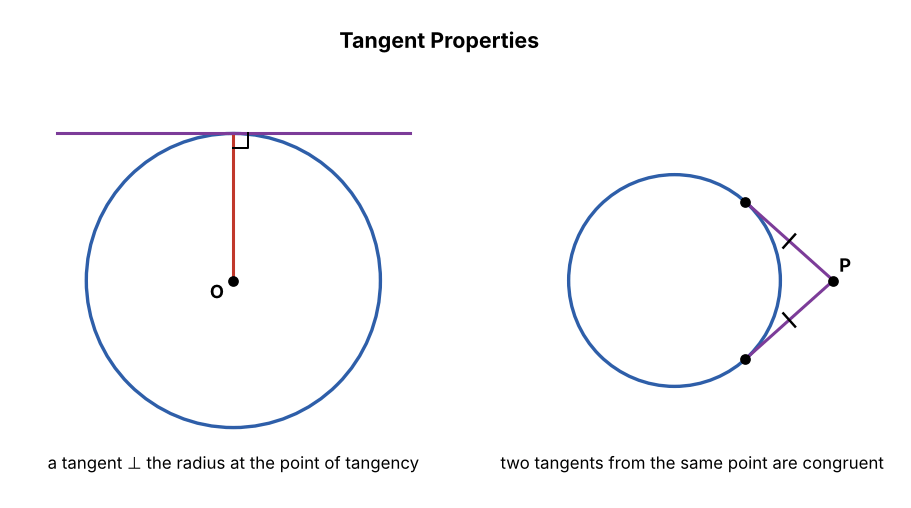
- A tangent is perpendicular to the radius at the point of tangency. This creates a right angle you can use with the Pythagorean Theorem.
- Two tangent segments from the same outside point are congruent. Think of an ice cream cone: both sides from the tip to the scoop are the same length.
The converse is also useful: if a line is perpendicular to a radius at its endpoint on the circle, the line is tangent.
Worked example 1: A tangent segment from point \(P\) touches \(\odot O\) at \(T\). The radius is 9 and \(OP=15\). Find \(PT\).
- \(\angle OTP\) is a right angle.
- Use the Pythagorean Theorem: \(PT^{2}+9^{2}=15^{2}\).
- Solve: \(PT^{2}=144\), so \(PT=12\).
Angle Relationships
The rule for an angle depends on where its vertex sits relative to the circle.
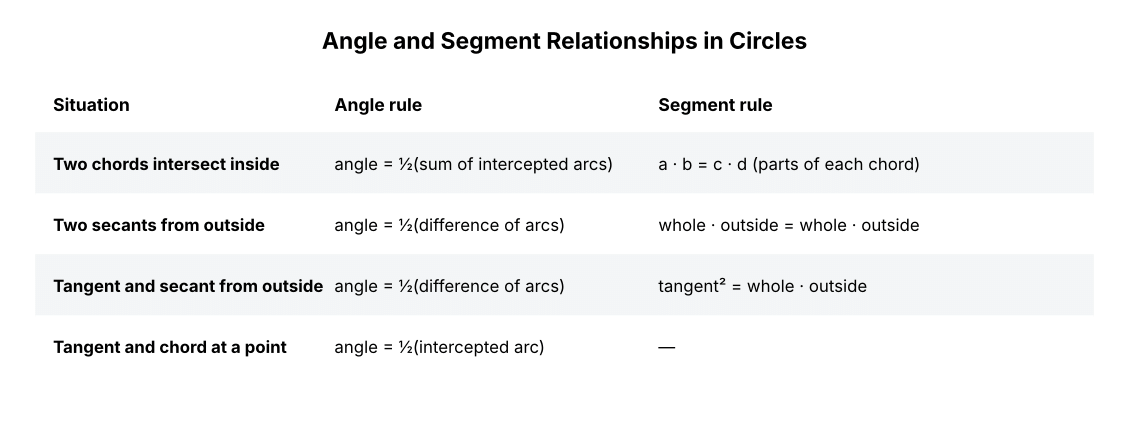
| Vertex Location | Formed By | Angle Measure |
|---|---|---|
| At the center | Two radii | Equal to the arc |
| On the circle | Two chords, or a chord and a tangent | Half the intercepted arc |
| Inside the circle | Two chords crossing | Half the sum of the two intercepted arcs |
| Outside the circle | Two secants, two tangents, or one of each | Half the difference of the two intercepted arcs |
Worked example 2: Two chords intersect inside a circle. The arcs intercepted by one pair of vertical angles measure \(80^{\circ}\) and \(50^{\circ}\). Find the angle. It equals \(\frac{1}{2}(80+50)=65^{\circ}\).
Worked example 3: Two secants meet outside a circle. The far arc measures \(130^{\circ}\) and the near arc measures \(40^{\circ}\). Find the angle. It equals \(\frac{1}{2}(130-40)=45^{\circ}\).
Why does this matter? The pattern follows distance from the center. At the center, the angle equals the arc. Moving to the edge halves it. Inside, you average two arcs. Outside, the angle shrinks further, so you subtract. Remembering this progression lets you rebuild the formulas instead of memorizing them separately.
Segment Relationships
| Theorem | Situation | Equation |
|---|---|---|
| Chord-Chord | Two chords cross inside | \(a\cdot b=c\cdot d\), the products of the pieces |
| Secant-Secant | Two secants from one outside point | outside piece times whole secant, for each |
| Secant-Tangent | A secant and a tangent from one outside point | tangent squared equals outside piece times whole secant |
Worked example 4: Two chords cross. One is split into pieces of 6 and 4. The other is split into 3 and \(x\). Then \(6\cdot 4=3x\), so \(x=8\).
Worked example 5: From point \(P\), a secant passes through the circle with an outside piece of 4 and an inside piece of 5. A tangent from \(P\) has length \(t\). Find \(t\).
- The whole secant is \(4+5=9\).
- Apply the theorem: \(t^{2}=4\cdot 9=36\).
- Solve: \(t=6\).
Why does this matter? In the secant theorems, students often multiply the outside piece by the inside piece. The rule uses the whole secant, from the outside point all the way through to the far side. Writing “outside times whole” next to the diagram prevents this error.
Test-Taking Strategies
Mnemonic Devices and Memory Shortcuts
For angles: “Inside, add the arcs; outside, subtract; then halve.” For segments: “Part times part” inside, and “outside times whole” outside. Tangents meet radii at right angles: “tangent to radius, 90.”
Cross-Topic Connections
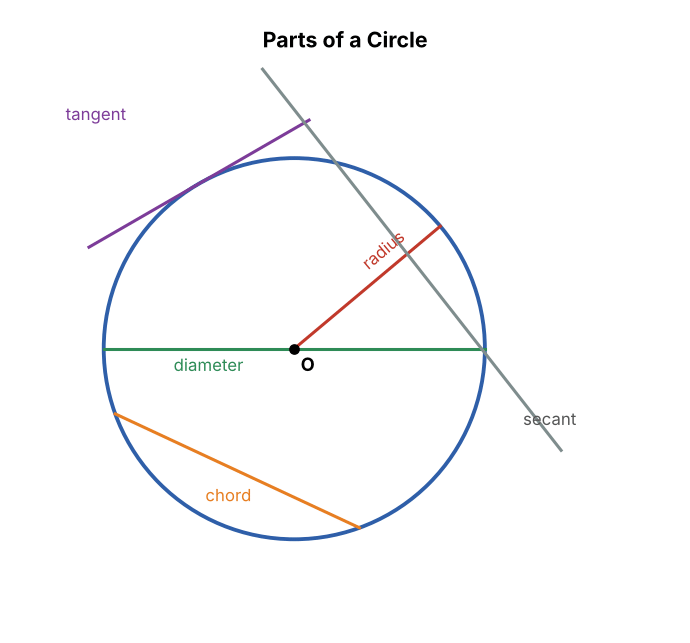
- Tangent and secant definitions are in Topic 9.1: Parts of a Circle.
- Angles on the circle follow Topic 9.3: Inscribed Angles.
- Tangent-radius right triangles use Topic 8.1: The Pythagorean Theorem and Its Converse.
- The product theorems come from similar triangles in Topic 7.2: Proving Triangles Similar.
Common Question Formats
- Find a tangent length using the Pythagorean Theorem.
- Find an angle formed by chords, secants, or tangents.
- Find a missing segment using a product theorem.
- Find perimeter of a polygon whose sides are tangent to a circle.
Frequent Student Mistakes
- Adding arcs for an outside angle instead of subtracting.
- Using the inside piece instead of the whole secant.
- Forgetting the right angle where a tangent meets a radius.
Test-Day Shortcuts
Locate the vertex first: center, on, inside, or outside. That single observation picks the formula. For segments, check whether the lines meet inside or outside before deciding between “part times part” and “outside times whole.”
Time Management Tips
Tangent, secant, and chord items on Geometry unit tests and end-of-course exams take one to three minutes. Label every arc and segment on the diagram before choosing a formula.