
Stand anywhere on the edge of a circular stage and look at the two ends of the front edge. The angle your eyes make is an inscribed angle, and it measures exactly half the arc it opens onto. That halving rule is the single most important fact about angles in circles, and it leads to several surprising results, including why every angle drawn in a semicircle is a right angle.
This article covers Topic 9.3: Inscribed Angles in Unit 9, Circles. The topic asks you to apply the Inscribed Angle Theorem, recognize its corollaries, and use the properties of quadrilaterals inscribed in circles.
By the end, you should be able to:
- Identify an inscribed angle and its intercepted arc.
- Apply the Inscribed Angle Theorem to find angle and arc measures.
- Use the fact that an angle inscribed in a semicircle is a right angle.
- Apply the opposite-angle property of inscribed quadrilaterals.
Inscribed Angles and Intercepted Arcs
An inscribed angle has its vertex on the circle, and its sides are chords. The arc that lies in the interior of the angle, between its sides, is its intercepted arc.
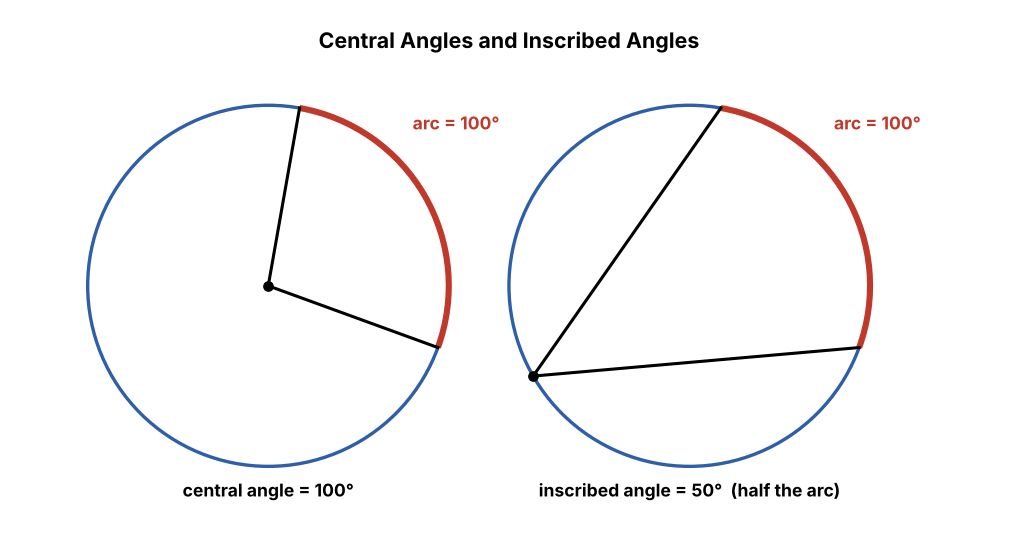
Compare inscribed angles with central angles:
| Angle Type | Vertex Location | Measure |
|---|---|---|
| Central angle | At the center | Equal to its arc |
| Inscribed angle | On the circle | Half its intercepted arc |
The Inscribed Angle Theorem
The Inscribed Angle Theorem states that the measure of an inscribed angle is half the measure of its intercepted arc:
\(m\angle ABC=\frac{1}{2}m\overset{\frown}{AC}\)
Worked example 1: An inscribed angle intercepts an arc of \(110^{\circ}\). The angle measures \(\frac{1}{2}(110)=55^{\circ}\).
Worked example 2: An inscribed angle measures \(38^{\circ}\). Its intercepted arc measures \(2(38)=76^{\circ}\).
Why does this matter? Students often confuse the two directions. If you know the arc, halve it to get the angle. If you know the angle, double it to get the arc. The arc is always the bigger number.
The proof places the center on one side of the inscribed angle. Two radii form an isosceles triangle, and the Exterior Angle Theorem shows the central angle is twice the inscribed angle. Other cases split into two pieces of this same situation.
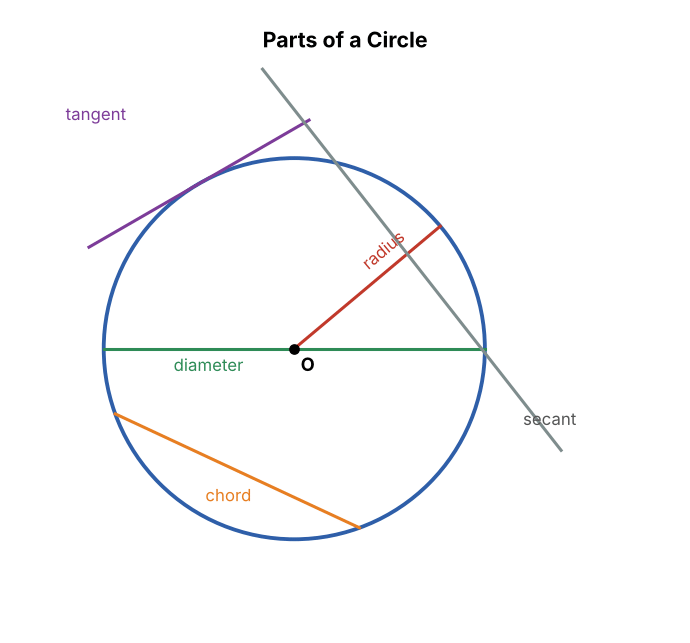
Corollaries
Three useful results follow directly from the theorem.
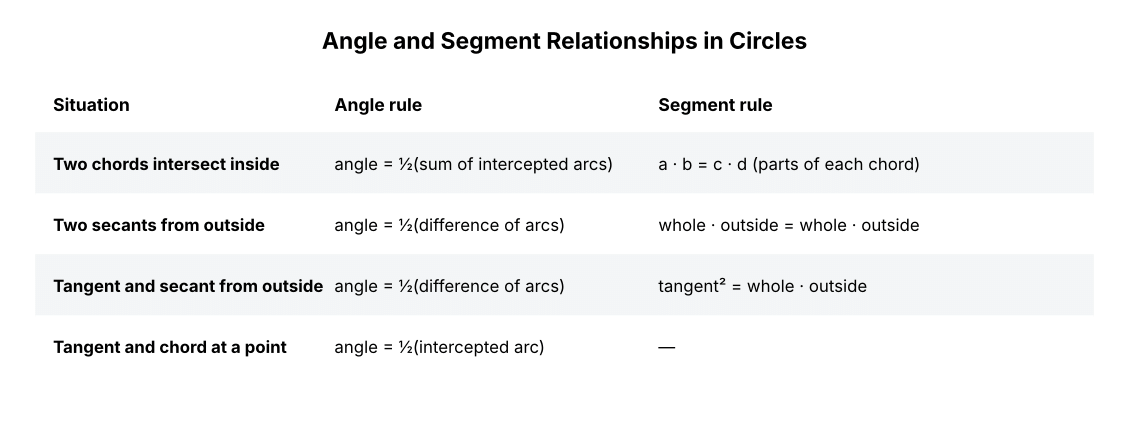
- Inscribed angles that intercept the same arc are congruent. Any two angles opening onto the same arc measure half of it, so they must be equal. This creates congruent angles you can use to prove triangles similar.
- An angle inscribed in a semicircle is a right angle. A semicircle measures \(180^{\circ}\), so the inscribed angle measures \(90^{\circ}\). Equivalently, if an inscribed angle is right, the chord it opens onto is a diameter.
- Opposite angles of an inscribed quadrilateral are supplementary. A quadrilateral with all four vertices on a circle has opposite angles that sum to \(180^{\circ}\), because their intercepted arcs together make the full \(360^{\circ}\) circle.
Worked example 3: \(\triangle ABC\) is inscribed in a circle with \(\overline{AC}\) as a diameter. If \(m\angle A=34^{\circ}\), find \(m\angle C\).
- \(\angle B\) is inscribed in a semicircle, so \(m\angle B=90^{\circ}\).
- Use the Triangle Sum Theorem: \(m\angle C=180-90-34=56^{\circ}\).
Worked example 4: Quadrilateral \(PQRS\) is inscribed in a circle. \(m\angle P=(3x+5)^{\circ}\) and \(m\angle R=(2x+25)^{\circ}\). Find each angle.
- Opposite angles are supplementary: \((3x+5)+(2x+25)=180\).
- Solve: \(5x+30=180\), so \(x=30\).
- \(m\angle P=95^{\circ}\) and \(m\angle R=85^{\circ}\).
Why does this matter? The semicircle corollary is how carpenters find the center of a round tabletop. They place the corner of a square on the edge and mark where its sides cross the circle. Those two points are the ends of a diameter. Repeating the process gives a second diameter, and the center is where they cross.
Combining With Central Angles
Many diagrams show a central angle and an inscribed angle that intercept the same arc. The central angle is always twice the inscribed one. If central angle \(\angle AOC\) measures \(124^{\circ}\), then any inscribed angle intercepting \(\overset{\frown}{AC}\) measures \(62^{\circ}\).
Test-Taking Strategies
Mnemonic Devices and Memory Shortcuts
“Center equals, edge halves.” A central angle equals its arc; an inscribed angle is half. For semicircles, “diameter in, right angle out.” For inscribed quadrilaterals, “opposites add to 180.”
Cross-Topic Connections
- Arc measures and central angles come from Topic 9.2: Arcs and Central Angles.
- The proof uses isosceles triangles from Topic 5.4: Isosceles and Equilateral Triangles.
- Finding the third angle uses Topic 5.1: Classifying Triangles and the Triangle Sum Theorem.
- Congruent inscribed angles help prove similarity, as in Topic 7.2: Proving Triangles Similar.
Common Question Formats
- Find an inscribed angle from its arc, or an arc from its inscribed angle.
- Find angles in a triangle inscribed in a semicircle.
- Solve for \(x\) in an inscribed quadrilateral.
- Compare a central angle and an inscribed angle that share an arc.
Frequent Student Mistakes
- Setting an inscribed angle equal to its arc.
- Making adjacent angles of an inscribed quadrilateral supplementary instead of opposite angles.
- Reading the wrong intercepted arc when the angle’s sides cross other chords.
Test-Day Shortcuts
Trace each side of an inscribed angle out to the circle. The arc between those two endpoints, on the far side from the vertex, is the intercepted arc. Shade it lightly before calculating.
Time Management Tips
Inscribed angle items on Geometry unit tests and end-of-course exams take about a minute. Multi-step diagrams with several chords take two to three minutes, so label each arc as you find it.