
A slice of pizza is a perfect picture of this topic. The angle at the tip of the slice is a central angle, and the curved crust is an arc. Their measures are linked directly: the arc measures exactly as many degrees as the angle that cuts it off. That simple rule, plus arc addition, unlocks most circle angle problems.
This article covers Topic 9.2: Arcs and Central Angles in Unit 9, Circles. The topic asks you to classify and name arcs, find arc measures from central angles, use the Arc Addition Postulate, and connect congruent chords to congruent arcs.
By the end, you should be able to:
- Identify central angles and classify arcs as minor arcs, major arcs, or semicircles.
- Name arcs correctly using two or three letters.
- Find arc measures using central angles and the Arc Addition Postulate.
- Use the relationship between congruent chords and congruent arcs.
Central Angles and Arcs
A central angle has its vertex at the center of a circle. Its sides are radii. The part of the circle between the sides is an arc.
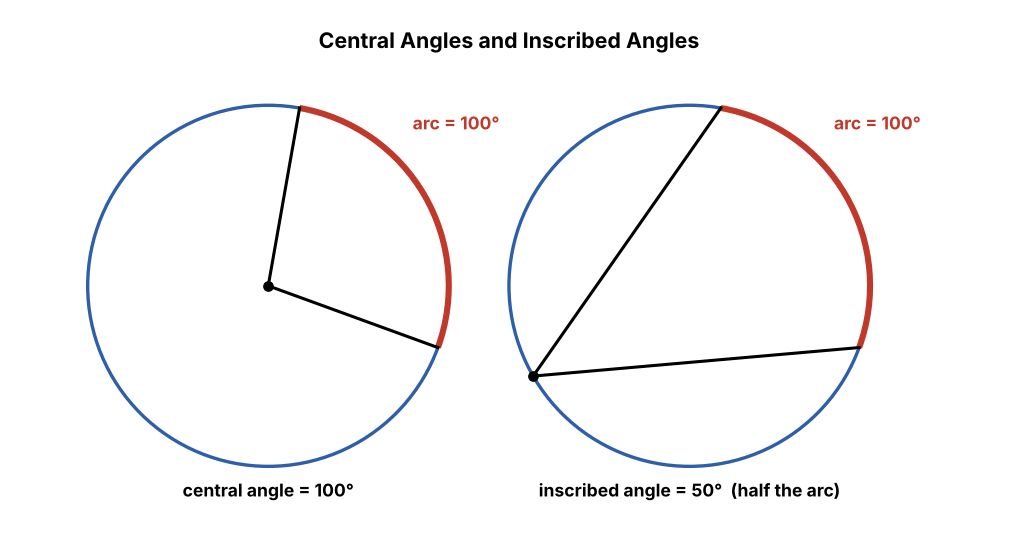
| Arc Type | Measure | How to Name It |
|---|---|---|
| Minor arc | Less than \(180^{\circ}\). Equals its central angle. | Two letters: \(\overset{\frown}{AB}\) |
| Semicircle | Exactly \(180^{\circ}\). Cut off by a diameter. | Three letters: \(\overset{\frown}{ACB}\) |
| Major arc | Greater than \(180^{\circ}\). Equals \(360^{\circ}\) minus the minor arc. | Three letters: \(\overset{\frown}{ADB}\) |
If central angle \(\angle AOB\) measures \(70^{\circ}\), then \(m\overset{\frown}{AB}=70^{\circ}\) and the major arc measures \(360-70=290^{\circ}\).
Why does this matter? Major arcs need three letters because two letters always name the shorter path. The middle letter tells the reader which way around the circle to travel. Writing a major arc with two letters names the wrong arc.
The Arc Addition Postulate
The measure of an arc formed by two adjacent arcs is the sum of their measures: \(m\overset{\frown}{ABC}=m\overset{\frown}{AB}+m\overset{\frown}{BC}\). This works just like segment and angle addition.
Worked example 1: In \(\odot O\), \(\overline{AC}\) is a diameter. \(m\angle AOB=(4x+10)^{\circ}\) and \(m\angle BOC=(2x+26)^{\circ}\). Find \(m\overset{\frown}{AB}\).
- A diameter makes a semicircle, so the two arcs sum to \(180^{\circ}\): \((4x+10)+(2x+26)=180\).
- Solve: \(6x+36=180\), so \(x=24\).
- Substitute: \(m\overset{\frown}{AB}=4(24)+10=106^{\circ}\).
Worked example 2: A circle graph shows four categories with central angles of \(90^{\circ}\), \(120^{\circ}\), \(x^{\circ}\), and \(2x^{\circ}\). Find \(x\).
- All central angles around a point sum to \(360^{\circ}\): \(90+120+x+2x=360\).
- Solve: \(3x=150\), so \(x=50\).
Congruent Arcs and Chords
Two arcs are congruent if they have the same measure and are in the same circle or congruent circles. Arcs in circles of different sizes can have equal measures without being congruent, since one is longer than the other.
In the same circle or in congruent circles:
- Congruent central angles cut off congruent arcs, and the reverse is also true.
- Congruent chords cut off congruent arcs, and the reverse is also true.
- Chords that are the same distance from the center are congruent.
- A diameter perpendicular to a chord bisects the chord and its arc.
Worked example 3: In \(\odot P\), chords \(\overline{RS}\) and \(\overline{TU}\) are congruent, and \(m\overset{\frown}{RS}=(5y-12)^{\circ}\) while \(m\overset{\frown}{TU}=(3y+20)^{\circ}\). Find \(y\). Congruent chords mean congruent arcs: \(5y-12=3y+20\), so \(y=16\) and each arc measures \(68^{\circ}\).
Why does this matter? The perpendicular diameter fact is the key to many chord-length problems. It creates right triangles with a radius as the hypotenuse, so the Pythagorean Theorem finds the distance from the center to a chord.
Arc Measure Versus Arc Length
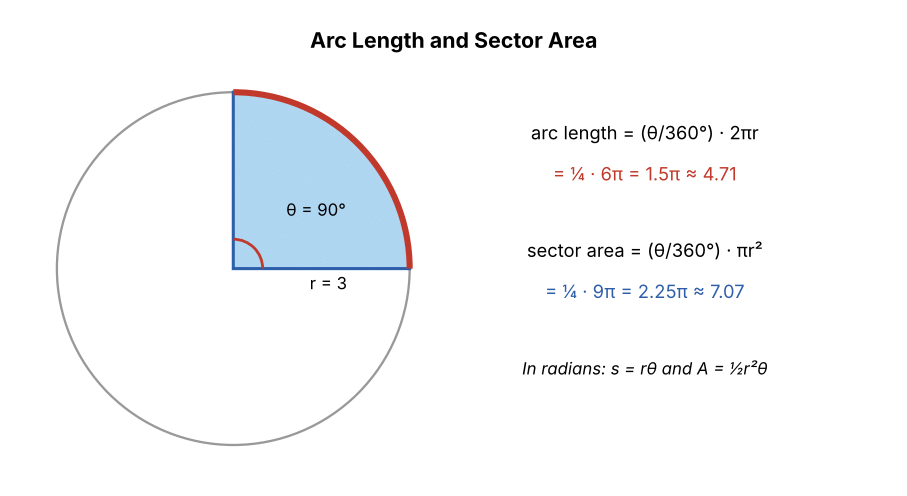
Arc measure is in degrees and depends only on the central angle. Arc length is a distance, in units like centimeters, and depends on both the angle and the radius. A \(60^{\circ}\) arc on a small coin and a \(60^{\circ}\) arc on a bicycle wheel have the same measure but very different lengths. You will compute arc length later in this unit, using the arc measure as a fraction of the full circle.
Test-Taking Strategies
Mnemonic Devices and Memory Shortcuts
“Central angle equals its arc.” For major arcs, “three letters, take the long way.” Around a full circle, everything adds to \(360^{\circ}\).
Cross-Topic Connections
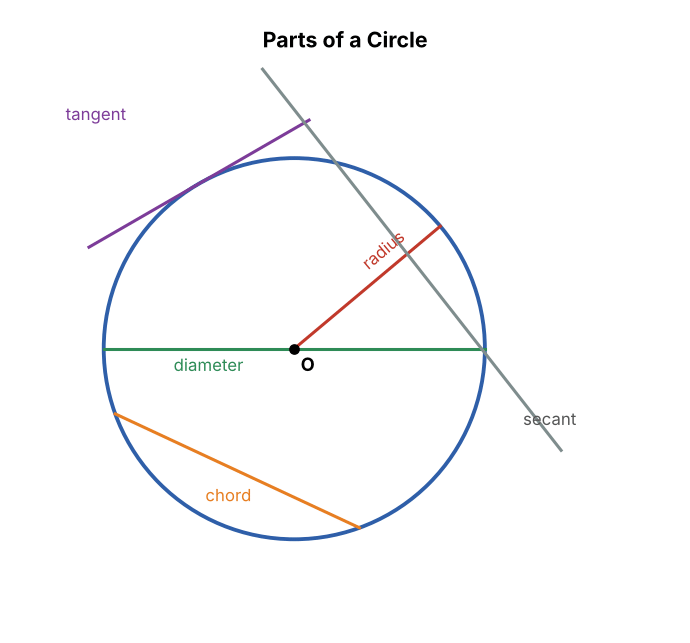
- Circle vocabulary comes from Topic 9.1: Parts of a Circle.
- Arc addition mirrors angle addition in Topic 1.4: Measuring and Classifying Angles.
- Perpendicular-diameter problems use Topic 8.1: The Pythagorean Theorem and Its Converse.
- Equal central angles in regular polygons connect to Topic 6.1: Angles of Polygons.
Common Question Formats
- Find the measure of a minor or major arc from a central angle.
- Use arc addition with a diameter or full circle to solve for \(x\).
- Name an arc correctly with two or three letters.
- Use congruent chords to find an arc measure.
Frequent Student Mistakes
- Naming a major arc with only two letters.
- Confusing arc measure with arc length.
- Calling arcs congruent when they are in circles of different sizes.
Test-Day Shortcuts
Write every arc measure directly on the diagram as you find it. Then use the \(360^{\circ}\) total or a semicircle’s \(180^{\circ}\) to fill in what remains. Most arc questions need only one or two subtractions.
Time Management Tips
Arc measure items on Geometry unit tests and end-of-course exams take about a minute. Problems with expressions take one to two minutes. Identify whether the arcs make a semicircle or a full circle before writing your equation.