
“Because I said so.” Parents use that line all the time, and in conversation everyone understands it. On a grammar test, though, it is not a sentence. It is a fragment, a piece of a sentence punctuated as if it were complete. Fragments are one of the most common errors in student writing, and they are easy to fix once you know what to look for.
This article covers Topic 5.4: Sentence Fragments in Unit 5, Sentence Structure. The topic asks you to identify the main kinds of fragments and repair them by adding missing parts or attaching them to nearby sentences.
By the end, you should be able to:
- State the three requirements of a complete sentence.
- Identify fragments missing a subject, a verb, or a complete thought.
- Repair fragments using at least two different methods.
- Recognize when writers use fragments on purpose.
What a Complete Sentence Needs
A complete sentence must have:
- A subject, who or what the sentence is about.
- A verb that can serve as the main verb of the sentence.
- A complete thought, meaning it does not leave the reader waiting for more.
A fragment is missing at least one of these. In imperative sentences like “Sit down,” the subject you is understood, so they are complete.
Four Common Types of Fragments
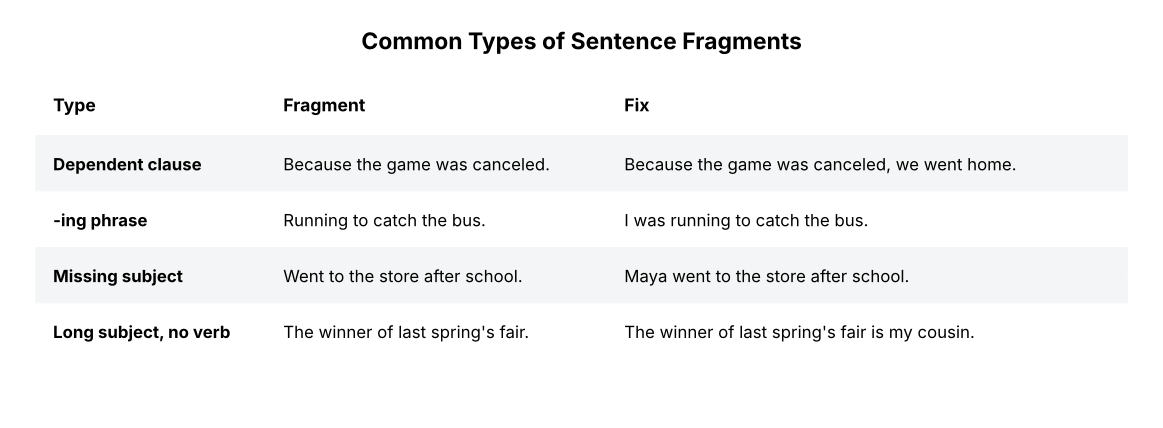
| Type | Fragment | What Is Missing |
|---|---|---|
| Missing subject | Ran to the store after school. | Who ran? |
| Missing verb | The tall girl in the red jacket. | What did she do? |
| Dependent clause | Because the bus was late. | The main idea; the clause leaves the thought unfinished |
| Phrase | Running down the hallway. | A subject and a main verb |
The -ing Trap
An -ing word cannot be the main verb by itself. “The dog barking at the mailman” has a subject and an -ing word, but it is still a fragment. Add a helping verb (“The dog was barking at the mailman”) or change the form (“The dog barked at the mailman”).
The same is true of infinitives. “To win the championship” is a phrase, not a sentence.
The Dependent Clause Trap
Dependent clause fragments are the hardest to spot because they contain a subject and a verb. The problem is the opening word. Because, although, when, if, since, while, which, and who turn a clause into a piece that depends on something else.
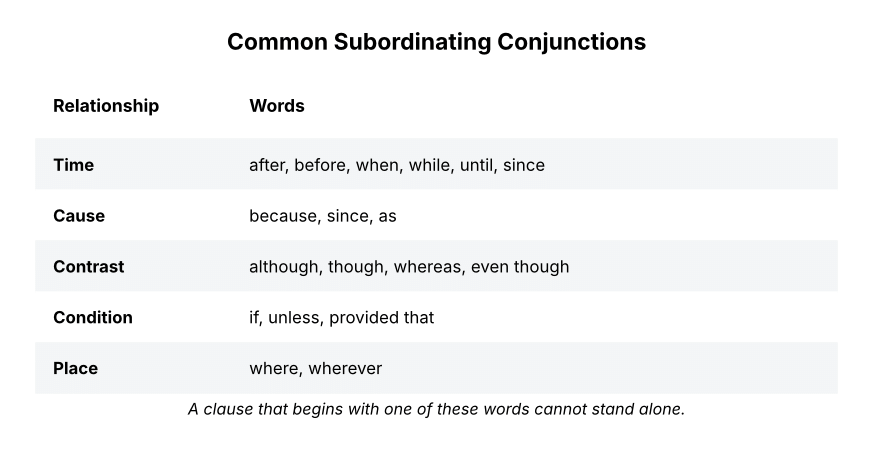
- Fragment: Although she studied all weekend.
- Fix by attaching: Although she studied all weekend, she still felt nervous.
- Fix by removing the subordinating word: She studied all weekend.
Why does this matter? Most fragments in student essays are pieces broken off from the sentence before or after them. Writers often put a period where a comma belongs: “I stayed home. Because I was sick.” Reading the two lines together shows the fix right away.
Three Ways to Fix a Fragment
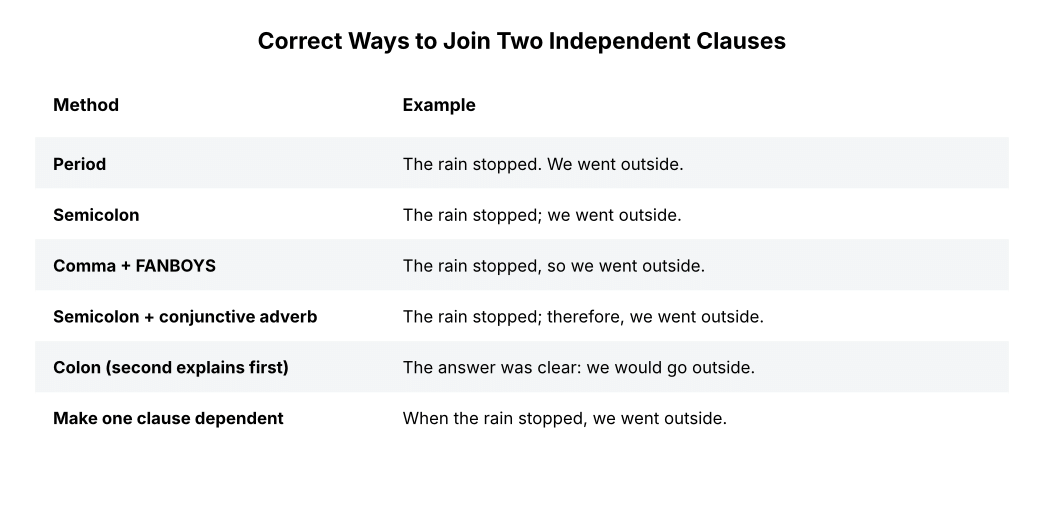
- Attach it to a neighboring sentence. “We went to the beach. With our cousins.” becomes “We went to the beach with our cousins.”
- Add the missing part. “Ran to the store” becomes “Leo ran to the store.”
- Rewrite it as an independent clause. “Because the bus was late” becomes “The bus was late.”
Worked example: Fix the fragments in this paragraph.
The museum has a new exhibit. Featuring dinosaur fossils from Montana. Which were discovered last year.
- “Featuring dinosaur fossils from Montana” is a phrase; attach it with a comma.
- “Which were discovered last year” is a dependent clause describing the fossils; attach it with a comma.
- Revised: The museum has a new exhibit featuring dinosaur fossils from Montana, which were discovered last year.
Fragments for Effect
Professional writers sometimes use fragments deliberately for emphasis or rhythm: “He opened the box. Empty.” Advertisements and dialogue also use them often. In academic writing and on grammar tests, however, treat every fragment as an error unless the question asks about style.
A Quick Test
Put the words “I realize that” in front of the word group. If the result makes sense as a complete statement, the original is probably a sentence. “I realize that the bus was late” works. “I realize that because the bus was late” does not, so “Because the bus was late” is a fragment.
Why does this matter? Fragments make readers stop and guess how ideas connect. On timed tests, editing questions often hide a fragment in a long phrase that looks complete at first glance, so a reliable test saves time and points.
Test-Taking Strategies
Mnemonic Devices and Memory Shortcuts
“Subject, verb, complete thought: miss one and it is caught.” Remember that -ing words and to verbs need help to be main verbs.
Cross-Topic Connections
- The subject requirement is explained in Topic 4.1: Subjects.
- The verb requirement is explained in Topic 4.2: Predicates.
- Clauses that cannot stand alone are in Topic 4.6: Dependent Clauses.
- Phrase fragments are reviewed in Topic 4.4: Phrases.
Common Question Formats
- Identify which word group is a fragment.
- Choose the revision that fixes a fragment.
- Decide whether a period or comma belongs between two word groups.
- Combine a fragment with a nearby sentence.
Frequent Student Mistakes
- Treating any long word group as a complete sentence.
- Missing dependent clause fragments that contain a subject and verb.
- Using an -ing word as the only verb.
Test-Day Shortcuts
When an answer choice uses a period, read the words after it alone. If they start with a subordinating word or an -ing verb, that choice is likely wrong.
Time Management Tips
Fragment items on English unit tests and standardized tests such as the SAT and ACT take 20 to 30 seconds. Read both sides of each punctuation mark before choosing.