
“Every student should bring their notebook.” Some teachers accept that sentence, and some mark it wrong. “The team celebrated their victory” causes a similar debate. These sentences test pronoun-antecedent agreement, the rule that a pronoun must match the word it replaces. The rule itself is simple, but tricky antecedents such as everyone, team, and neither make it one of the most tested topics in grammar.
This article covers Topic 6.2: Pronoun-Antecedent Agreement in Unit 6, Agreement and Usage. The topic asks you to match pronouns with their antecedents in number, person, and gender and to handle indefinite pronouns, collective nouns, and compound antecedents.
By the end, you should be able to:
- Match a pronoun to its antecedent in number, person, and gender.
- Choose correct pronouns for singular and plural indefinite pronouns.
- Handle compound antecedents joined by and, or, and nor.
- Fix vague or ambiguous pronoun references.
The Basic Rule
An antecedent is the noun or pronoun that a pronoun refers to. The pronoun must agree with it in:
- Number: singular or plural (the dog and its; the dogs and their).
- Person: first, second, or third (I, you, he).
- Gender: when known (Grandpa and his).
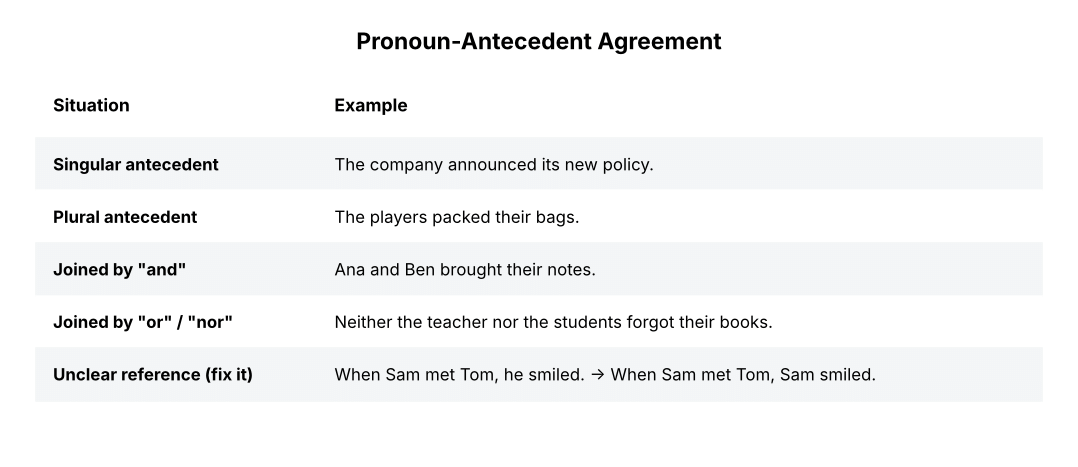
Example: The tigers paced in their enclosure. The tiger paced in its enclosure.
Indefinite Pronouns
Indefinite pronouns cause the most agreement errors because they do not refer to a specific person.
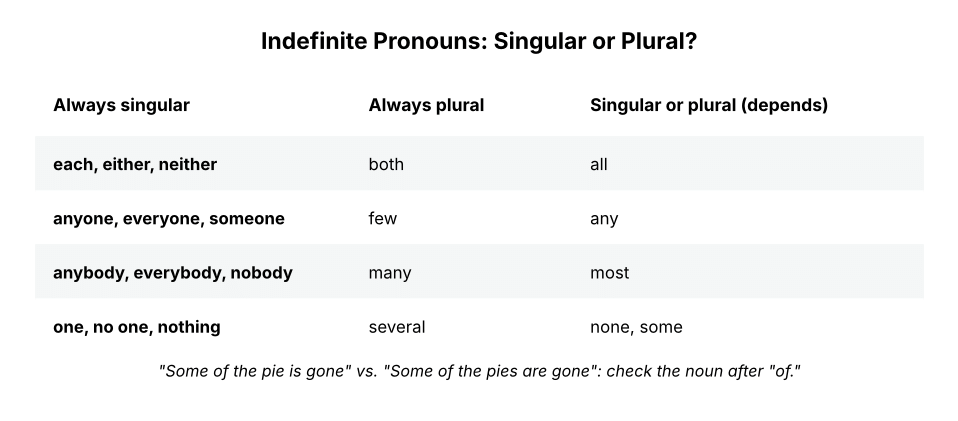
| Always Singular | Always Plural | Singular or Plural |
|---|---|---|
| anyone, anybody, anything, each, either, everyone, everybody, everything, neither, no one, nobody, one, someone, somebody | both, few, many, others, several | all, any, more, most, none, some |
- Each of the boys brought his own lunch.
- Several of the students forgot their calculators.
- Some of the cake lost its frosting. Some of the cookies lost their sprinkles.
For the “either way” group, look at the noun in the of phrase. A singular noun makes the pronoun singular; a plural noun makes it plural.
Singular They
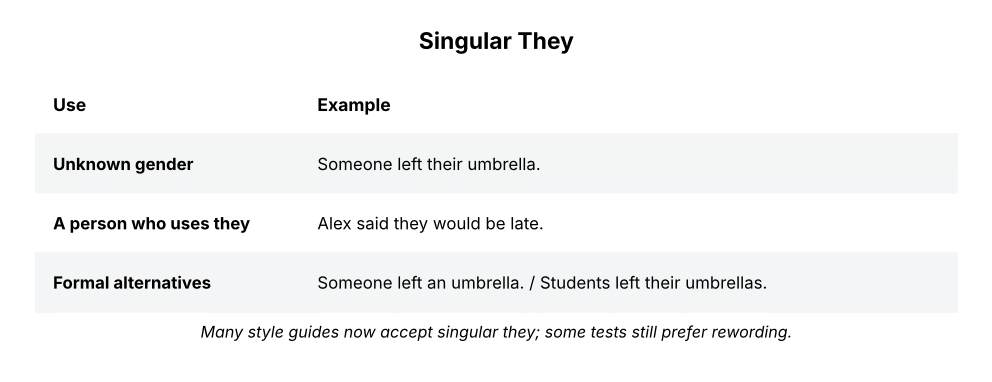
When a singular antecedent could be anyone, traditional grammar uses “his or her”: “Everyone should bring his or her notebook.” Many style guides, including APA and the Chicago Manual of Style, now accept the singular they in this situation: “Everyone should bring their notebook.” Some teachers and tests still prefer the traditional form, so the safest move is often to rewrite with a plural antecedent: “All students should bring their notebooks.”
Why does this matter? Knowing several correct options lets you meet the expectations of any teacher or test. Rewriting with a plural subject avoids both the awkward “his or her” and any debate about singular they.
Collective Nouns
A collective noun such as team, class, family, committee, or band usually acts as one unit in American English and takes a singular pronoun.
- The committee announced its decision.
If the members act individually, a plural pronoun can fit, though rewording is often clearer: “The committee members cast their votes.”
Compound Antecedents
- Joined by and: plural. “Lena and Omar finished their project.”
- Joined by or or nor: the pronoun agrees with the nearer antecedent. “Neither the coach nor the players forgot their jerseys.” “Neither the players nor the coach forgot his jersey.”
Putting the plural noun second usually produces the smoother sentence.
Clear Pronoun Reference
A pronoun must point to one clear antecedent.
- Ambiguous: When Kim talked to Jess, she was upset. (Who was upset?)
- Clear: Kim was upset when she talked to Jess.
- Vague: At the clinic, they told me to rest. (Who are they?)
- Clear: The doctor at the clinic told me to rest.
Also avoid shifts in person, such as “When one studies hard, you get good grades.” Pick one person and stay with it.
Why does this matter? Unclear pronouns force readers to guess. Standardized tests often reward the answer choice that replaces a vague pronoun with the specific noun it stands for.
Test-Taking Strategies
Mnemonic Devices and Memory Shortcuts
“Words with one, body, or thing are singular.” For or and nor, “the closer noun calls the shots.”
Cross-Topic Connections
- Antecedents are introduced in Topic 1.7: Pronoun Antecedents.
- Group nouns are explained in Topic 1.3: Collective Nouns.
- The same rules for verbs appear in Topic 6.1: Subject-Verb Agreement.
- Choosing the right pronoun form is covered in Topic 1.8: Pronoun Case.
Common Question Formats
- Choose the pronoun that agrees with its antecedent.
- Find the pronoun error in a sentence or passage.
- Revise a sentence with an ambiguous pronoun.
- Handle a compound antecedent joined by or or nor.
Frequent Student Mistakes
- Using their with it-type nouns such as companies and schools.
- Treating each and everyone as plural.
- Letting a pronoun refer to a noun that never appears.
Test-Day Shortcuts
Find the antecedent before reading the choices. Cross out any of phrase so it does not trick you into matching the wrong noun.
Time Management Tips
Agreement items on English unit tests and standardized tests such as the SAT and ACT take about 30 seconds. Ambiguous reference questions may need a reread of the previous sentence.