
“We toured the White House” and “We toured the white house” describe two very different trips. One visit was to the home of the U.S. president; the other could have been to any house painted white. In the same way, “Turkey” is a country while “turkey” is a bird. Capitalization tells readers which words are names, which begin sentences, and which are titles. The basic rules are learned early, but tests focus on the tricky cases: family titles, directions, seasons, school subjects, and titles of works.
This article covers Topic 7.7: Capitalization in Unit 7, Punctuation and Mechanics. The topic asks you to capitalize proper nouns, titles, and sentence beginnings correctly and to avoid capitalizing common nouns.
By the end, you should be able to:
- Capitalize the first word of sentences and quotations correctly.
- Distinguish proper nouns from common nouns.
- Apply rules for personal titles, family words, and directions.
- Capitalize the titles of books, articles, and other works.
Sentence Beginnings and Quotations
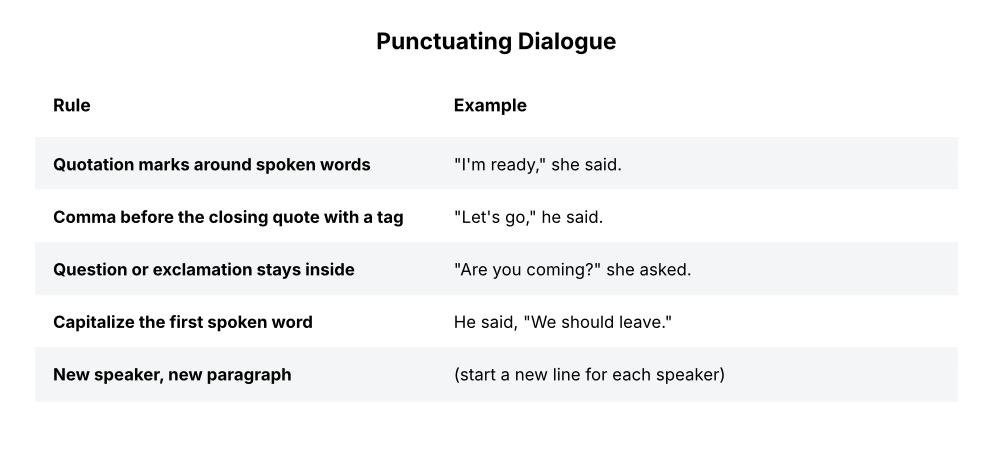
- Capitalize the first word of every sentence.
- Capitalize the first word of a direct quotation that is a complete sentence: She said, “We are leaving soon.”
- Do not capitalize a quotation that is a fragment blended into your sentence: He described the plan as “risky at best.”
- Always capitalize the pronoun I.
Proper Nouns Versus Common Nouns
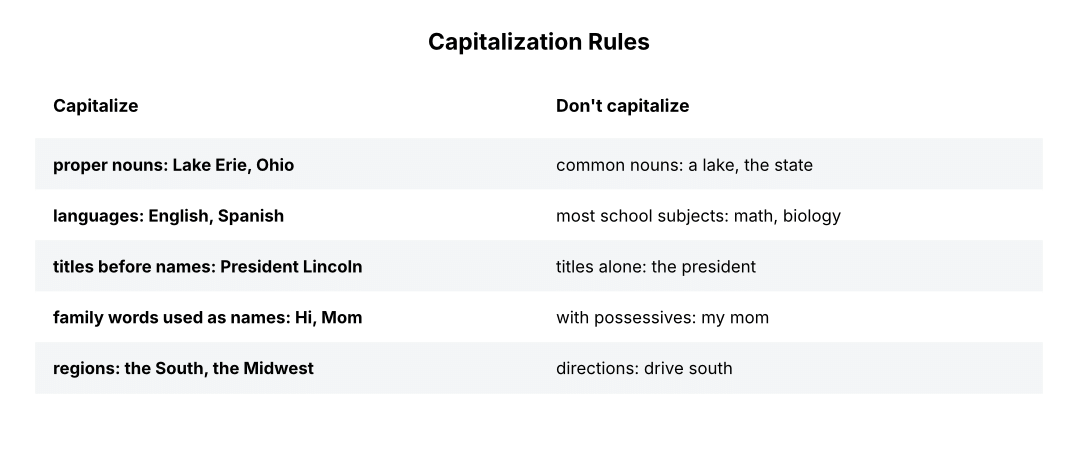
A proper noun names a specific person, place, thing, or idea and is capitalized. A common noun names a general category and is not.
| Category | Capitalize | Do Not Capitalize |
|---|---|---|
| People | Dr. Maria Lopez | a doctor |
| Places | Lake Michigan, Main Street | a lake, our street |
| Organizations | Red Cross, Lincoln High School | a charity, the high school |
| Days, months, holidays | Tuesday, March, Thanksgiving | spring, summer, fall, winter |
| Historical events and periods | World War II, the Renaissance | a war, the century |
| Languages and nationalities | Spanish, Japanese, Canadian | a language |
| Brand names | Nike, Google | sneakers, a search engine |
Seasons are not capitalized unless they begin a sentence or are part of a proper name, such as “Spring Festival.”
School Subjects
Capitalize languages and specific numbered courses, but not general subjects.
- I have English, math, and Biology 101 this semester.
- She is taking history and Spanish.
English and Spanish are capitalized because they come from proper nouns. Math and history are not.
Titles of People
Capitalize a title used directly before a name or as a direct address. Lowercase it when it stands alone or follows the name.
- Governor Ramirez spoke today. The governor spoke today.
- Jane Ortiz, president of the club, opened the meeting.
Family Words
Capitalize Mom, Dad, Grandma, and similar words when they are used as names. Do not capitalize them after a possessive word like my or her.
- I asked Mom for a ride. (Could replace with her name.)
- I asked my mom for a ride. (Possessive comes first.)
- We visited Aunt Rosa. We visited my aunt.
Why does this matter? The name-replacement test works every time. If you can swap in the person’s actual name, capitalize the word. If a possessive like my is in front, you cannot, so leave it lowercase.
Directions and Regions
Capitalize compass words when they name a region, not a direction.
- We drove north for two hours. (direction)
- She grew up in the South. (region)
- The Midwest is known for farming.
Religions, Deities, and Celestial Bodies
Capitalize the names of religions and their sacred texts, such as Islam, Judaism, the Bible, and the Quran. Capitalize planets and named stars, such as Mars, Jupiter, and Polaris. The words earth, sun, and moon are usually lowercase, except when Earth is named alongside other planets or used as the planet’s proper name: “Earth is the third planet from the sun.”
Titles of Works
In titles of books, articles, songs, and films, capitalize:
- The first and last words.
- All major words: nouns, pronouns, verbs, adjectives, and adverbs.
Lowercase articles (a, an, the), coordinating conjunctions, and short prepositions unless they come first or last. Example: The Old Man and the Sea, Of Mice and Men.
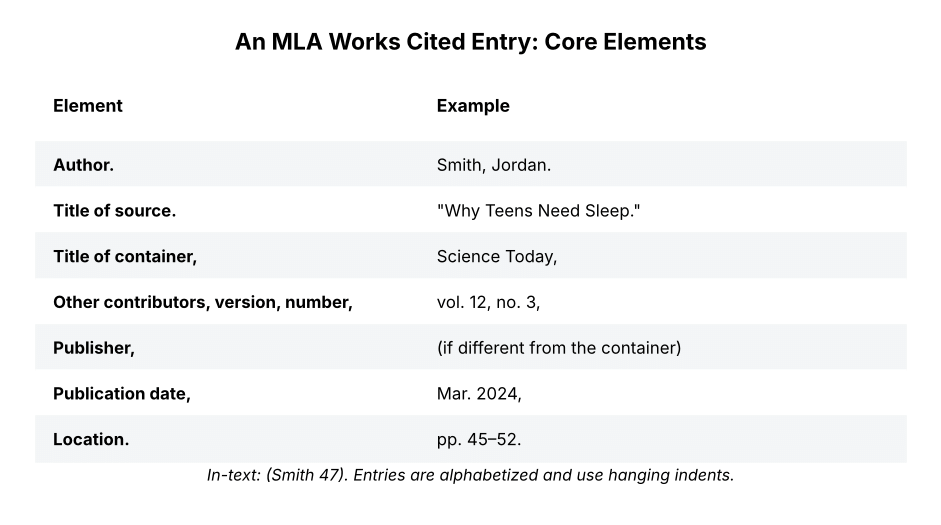
Why does this matter? Capitalization errors make writing look careless, and in titles and citations they can make a source harder to find. Research essays require consistent title capitalization in every citation.
Test-Taking Strategies
Mnemonic Devices and Memory Shortcuts
“Specific gets a capital; general stays small.” For family words, “If my is there, the capital is not.”
Cross-Topic Connections
- The foundation is Topic 1.1: Common and Proper Nouns.
- Capitals in dialogue follow Topic 7.5: Quotation Marks.
- Capitals after a colon are discussed in Topic 7.3: Semicolons and Colons.
- Words often confused in writing are in Topic 6.3: Commonly Confused Words.
Common Question Formats
- Identify the word that should or should not be capitalized.
- Correct capitalization in a title.
- Choose the correctly capitalized version of a sentence.
- Explain why a word is capitalized in one sentence but not another.
Frequent Student Mistakes
- Capitalizing seasons and general school subjects.
- Capitalizing mom after my.
- Capitalizing compass directions that are not regions.
Test-Day Shortcuts
For each capitalized word, ask, “Is this a specific name?” If not, and it does not start a sentence or title, it should be lowercase.
Time Management Tips
Capitalization items on English unit tests and standardized tests such as the SAT and ACT take 10 to 20 seconds. Spend the saved time on longer editing questions.