
When Robert Browning’s poem “My Last Duchess” begins, a duke is showing a visitor a portrait of his late wife. He speaks politely, even charmingly, yet by the end readers suspect he had something to do with her death. Browning never says so directly. Everything comes through the duke’s own voice. Understanding who is speaking in a poem, and how that voice sounds, is often the key to the whole work.
This article covers Topic 1.2: Speaker and Voice in Unit 1, Reading Poetry. The topic asks you to identify the speaker of a poem, distinguish the speaker from the poet, and analyze how voice shapes meaning.
By the end, you should be able to:
- Define the speaker and explain why the speaker is not always the poet.
- Identify clues about a speaker’s identity, situation, and attitude.
- Describe a speaker’s voice using precise adjectives.
- Recognize the audience a speaker addresses.
The Speaker Is Not the Poet
The speaker is the voice that talks in a poem. Some poems clearly reflect the poet’s own life, but many do not. Poets create characters, imagine situations, and write from points of view far from their own. Browning was not a murderous duke, and Edgar Allan Poe was not visited by a talking raven.
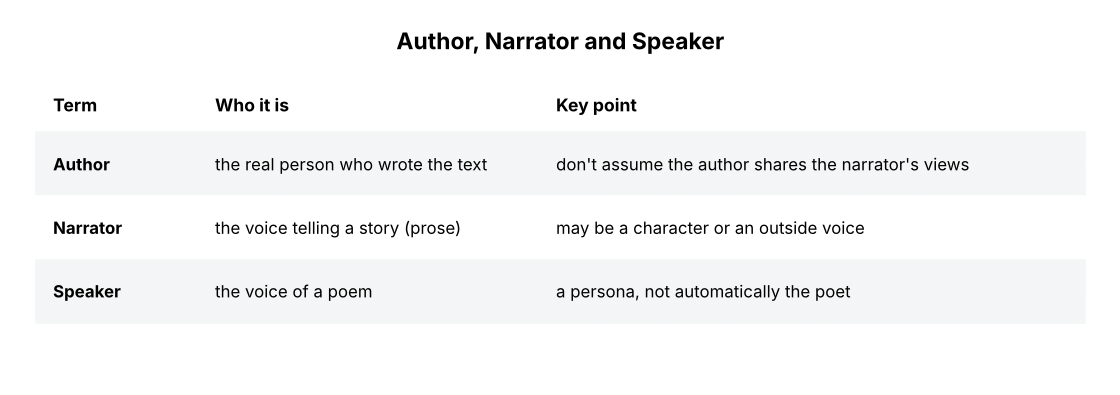
To stay accurate, write “the speaker” rather than the poet’s name when discussing what the poem says. Write “the poet” or the poet’s name only when discussing the choices made in writing the poem.
- Weak: Poe is grieving for Lenore.
- Strong: The speaker grieves for Lenore, and Poe uses repetition to show that grief turning into despair.
Clues About the Speaker
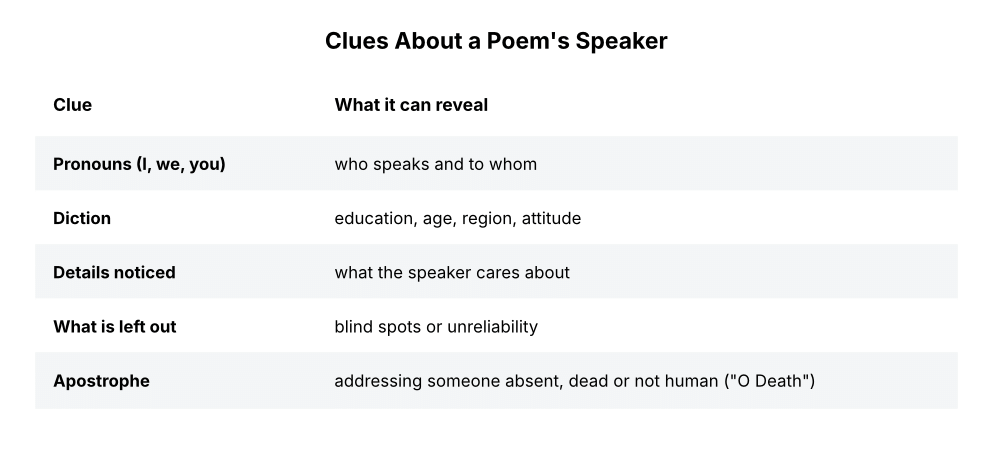
| Clue | What to Look For |
|---|---|
| Pronouns | I and we show a first-person speaker; you shows an addressee |
| Situation | Where the speaker is and what is happening |
| Word choice | Formal or casual, educated or plain, old-fashioned or modern |
| Details noticed | What the speaker pays attention to reveals values and feelings |
| Title | Often names the speaker or situation |
Voice
Voice is the distinctive personality or style of the speaker, created through word choice, sentence structure, rhythm, and attitude. Two speakers can describe the same event in completely different voices.
Emily Dickinson’s speaker in “Because I could not stop for Death” (published 1890) describes dying in a calm, almost polite voice:
Because I could not stop for Death,
He kindly stopped for me;
The word “kindly” is surprising. The speaker treats Death as a courteous gentleman caller rather than something terrifying. That calm voice shapes the poem’s meaning: death becomes a journey rather than an ending.
Useful words for describing voice include calm, bitter, playful, formal, urgent, nostalgic, defiant, ironic, tender, and detached.
Why does this matter? The speaker’s voice tells you how to read the poem’s content. A cheerful voice describing something tragic may signal irony. A calm voice describing death may suggest acceptance. Voice and meaning cannot be separated.
Types of Speakers
- Lyric speaker: expresses personal thoughts and feelings, often in the first person.
- Persona: a character clearly different from the poet, like Browning’s duke.
- Narrative speaker: tells a story, sometimes in third person.
- Collective speaker: uses we to speak for a group.
Audience and Apostrophe
Ask whom the speaker is addressing. It might be the reader, a specific person, a crowd, or even something that cannot answer. When a speaker addresses an absent person, an object, or an idea, it is called apostrophe. Blake’s “Tyger Tyger, burning bright” is an apostrophe to a tiger, and John Keats addresses a nightingale in “Ode to a Nightingale.”
Unreliable Speakers
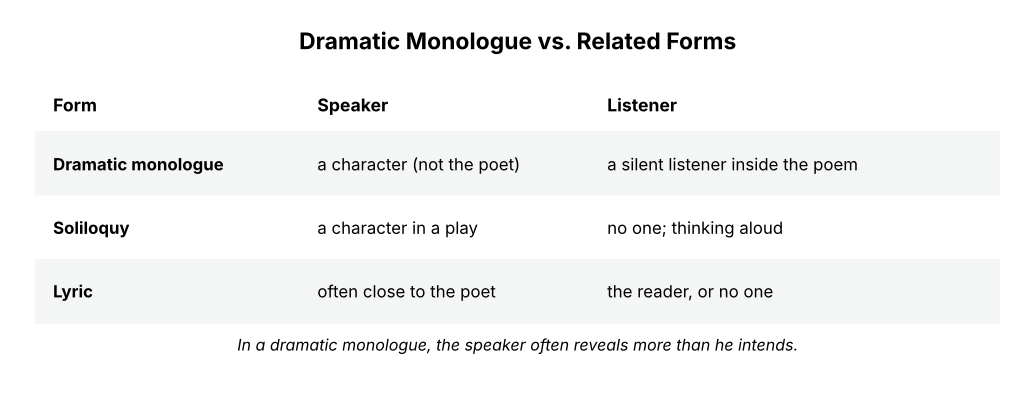
Sometimes a speaker reveals more than he or she intends. In dramatic monologues like “My Last Duchess,” readers piece together the truth from what the speaker lets slip. When the speaker’s view seems limited, biased, or self-serving, read between the lines.
Why does this matter? Test questions often ask what a speaker believes, values, or reveals. If you assume the speaker is honest and reliable, you may miss the irony that makes the poem work.
Test-Taking Strategies
Mnemonic Devices and Memory Shortcuts
“Speaker, not poet.” Before analyzing, ask the 3 W’s: Who is talking, to whom, and where?
Cross-Topic Connections
- A step-by-step analysis appears in Topic 1.5: Poetry Analysis Step by Step.
- Reading strategies are reviewed in Topic 1.1: How to Read a Poem.
- Voice connects closely to Reading Skills Topic 2.4: Identifying Author’s Tone.
- Perspective is examined in Reading Skills Topic 2.5: Analyzing Author’s Purpose and Point of View.
Common Question Formats
- Identify the speaker and the audience of a poem.
- Describe the speaker’s attitude toward the subject.
- Explain what a word choice reveals about the speaker.
- Explain how the speaker’s voice contributes to meaning.
Frequent Student Mistakes
- Treating the speaker as the poet in every poem.
- Using vague words like “sad” or “happy” to describe voice.
- Trusting a speaker who reveals bias or self-interest.
Test-Day Shortcuts
Circle every pronoun in the first stanza. Pronouns usually identify the speaker and audience faster than anything else.
Time Management Tips
Speaker questions on English unit tests and standardized reading tests such as the SAT and ACT take about 30 seconds after a careful first read.