
An old pond. A frog jumps in. The sound of water. That is nearly the whole of the most famous poem in Japanese literature, written by Matsuo Bashō in 1686. In just three short lines, it captures a single moment of stillness broken by sound. This tiny form, the haiku, shows how much a poem can do with very few words.
This article covers Topic 2.7: Haiku in Unit 2, Structure and Form. The topic asks you to identify the traditional features of haiku, explain how English haiku differ from Japanese originals, and analyze how haiku create meaning through images.
By the end, you should be able to:
- Describe the traditional structure of a haiku.
- Explain the roles of the season word and the cutting word.
- Explain why English haiku do not always follow a 5-7-5 syllable count.
- Analyze how a haiku uses imagery and juxtaposition.
Origins
The haiku developed in Japan from the opening verse, called the hokku, of longer linked poems. In the 1600s, Matsuo Bashō raised the hokku into a respected art form of its own. Later masters included Yosa Buson and Kobayashi Issa. The name haiku became common in the late 1800s through the poet and critic Masaoka Shiki.
Traditional Features
| Feature | Description |
|---|---|
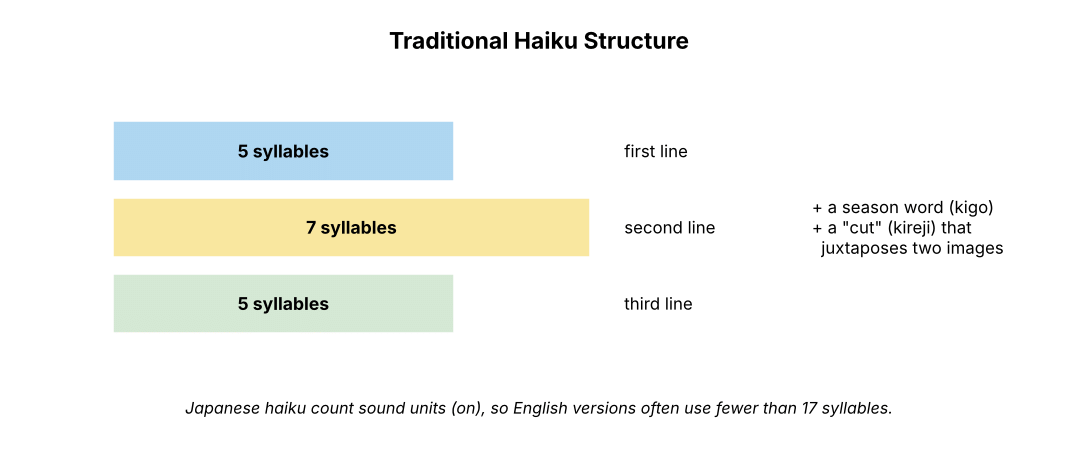
| Length | Three phrases, traditionally of 5, 7, and 5 sound units |
| Kigo (season word) | A word or image that signals a season, such as cherry blossoms for spring or snow for winter |
| Kireji (cutting word) | A word that creates a pause or break, dividing the poem into two parts |
| Subject | Usually nature or a single moment of everyday life |
| Style | Concrete images in the present, with little direct explanation of feelings |
The 5-7-5 Question
Japanese haiku count on, sound units that are shorter than English syllables. Bashō’s frog poem in Japanese is:
furuike ya
kawazu tobikomu
mizu no oto
That is 5, 7, and 5 sound units. A literal English version, “old pond / a frog jumps in / water’s sound,” has only 2, 4, and 3 syllables, yet it carries the same content. Because English syllables hold more sound, many English-language haiku poets write shorter poems than 5-7-5. Schools often teach 5-7-5 as a simple rule, and it is a fine starting point, but brevity, imagery, and a moment of insight matter more than the exact count.
Why does this matter? Test questions sometimes ask what defines a haiku. Answers focused only on syllables miss the deeper features: a seasonal reference, a cut between two images, and attention to a single moment.
Juxtaposition and the Cut
The cutting word splits a haiku into two parts, often placing two images side by side. In Bashō’s poem, ya after “old pond” acts like a spoken pause, separating the still pond from the sudden action. This side-by-side placement is called juxtaposition.
The reader’s mind fills the space between the two images. In the frog poem, the silence of the old pond makes the small splash seem louder and more meaningful. English haiku often show the cut with a dash, a colon, or a line break.
Worked Example
Analyze the frog haiku.
- Season word: the frog is a traditional sign of spring.
- Cut: after “old pond,” dividing stillness from motion.
- Images: an ancient, quiet pond; a small, sudden jump; a sound.
- Insight: a brief moment of sound reveals how deep the surrounding silence is. The poem invites readers to notice small events in nature.
Haiku and Imagism
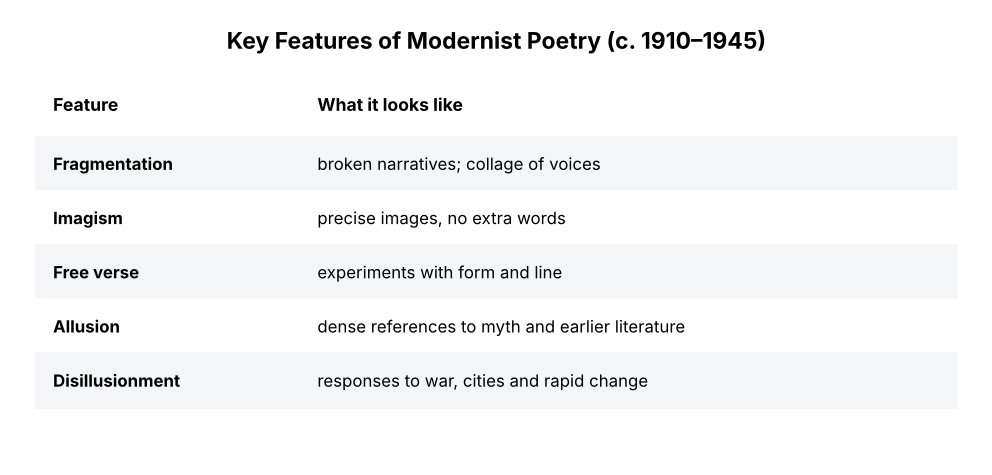
In the early 1900s, Western poets discovered haiku and were inspired by their precision. The Imagist movement, led by Ezra Pound, valued clear, concrete images and economy of language. Pound’s two-line “In a Station of the Metro” (1913) places a crowd’s faces beside petals on a wet, black bough, using juxtaposition much as a haiku does.
Why does this matter? Haiku teach a skill every poet and reader needs: noticing exactly. Writing and reading haiku trains you to focus on precise sensory details instead of general statements.
Related Forms
Senryu use the same short form but focus on human nature, often with humor, instead of the natural world. Tanka are longer Japanese poems of five lines, traditionally 5-7-5-7-7 sound units, that often include personal emotion.
Test-Taking Strategies
Mnemonic Devices and Memory Shortcuts
“Three lines, one season, one cut, one moment.” Remember kigo as “key season” and kireji as the “cut.”
Cross-Topic Connections
- Haiku depend on Topic 3.1: Imagery.
- Short lines and white space are explained in Topic 2.1: Lines and Stanzas.
- Imagist poets also shaped Topic 2.5: Free Verse.
- Poetic traditions around the world are surveyed in Topic 4.1: Poetry Through the Ages.
Common Question Formats
- Identify the features that make a poem a haiku.
- Identify the season word in a haiku.
- Explain the effect of two juxtaposed images.
- Compare a haiku with a senryu or tanka.
Frequent Student Mistakes
- Defining a haiku only by its syllable count.
- Explaining feelings directly instead of showing them through images.
- Missing the cut between the two parts of the poem.
Test-Day Shortcuts
Find the line break or punctuation that divides the poem. Compare the images on each side; the meaning lives in their relationship.
Time Management Tips
Haiku questions on English unit tests and standardized reading tests such as the SAT and ACT take about 30 seconds. Short poems still deserve two careful reads.