
Some poems tell you what happened: a midnight ride, a shipwreck, a hero’s journey. Others tell you how it felt to stand in a field of daffodils or to lose someone you loved. These two impulses, telling a story and expressing a feeling, divide most poetry into two broad categories: narrative and lyric. Knowing the difference helps you decide what to look for as soon as you begin reading.
This article covers Topic 2.12: Narrative and Lyric Poetry in Unit 2, Structure and Form. The topic asks you to distinguish narrative from lyric poetry, identify their subtypes, and analyze how each type creates meaning.
By the end, you should be able to:
- Define narrative poetry and lyric poetry.
- Identify the main forms within each category.
- Analyze plot, character, and conflict in a narrative poem.
- Analyze emotion, voice, and imagery in a lyric poem.
The Two Categories
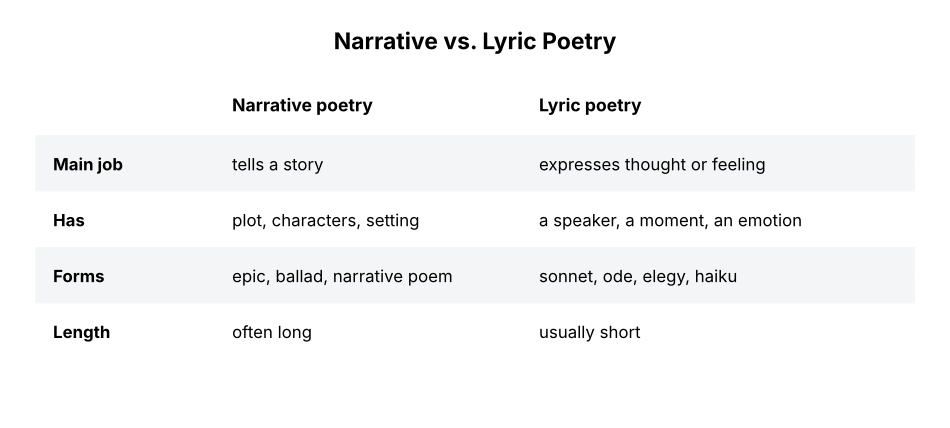
| Feature | Narrative Poetry | Lyric Poetry |
|---|---|---|
| Main purpose | Tells a story | Expresses thoughts and feelings |
| Elements | Plot, characters, setting, conflict | Speaker, emotion, imagery, reflection |
| Speaker | Often a narrator, sometimes third person | Usually a first-person “I” |
| Length | Often long | Usually short |
| Forms | Epic, ballad, verse narrative | Sonnet, ode, elegy, haiku, many free verse poems |
Narrative Poetry
A narrative poem tells a story with a beginning, middle, and end. Like a short story, it has characters, a setting, and a conflict that builds to a climax.
- Epic: a long narrative about a hero’s deeds, often involving gods, journeys, and the fate of a people. Examples include Homer’s Iliad and Odyssey and the Old English Beowulf.
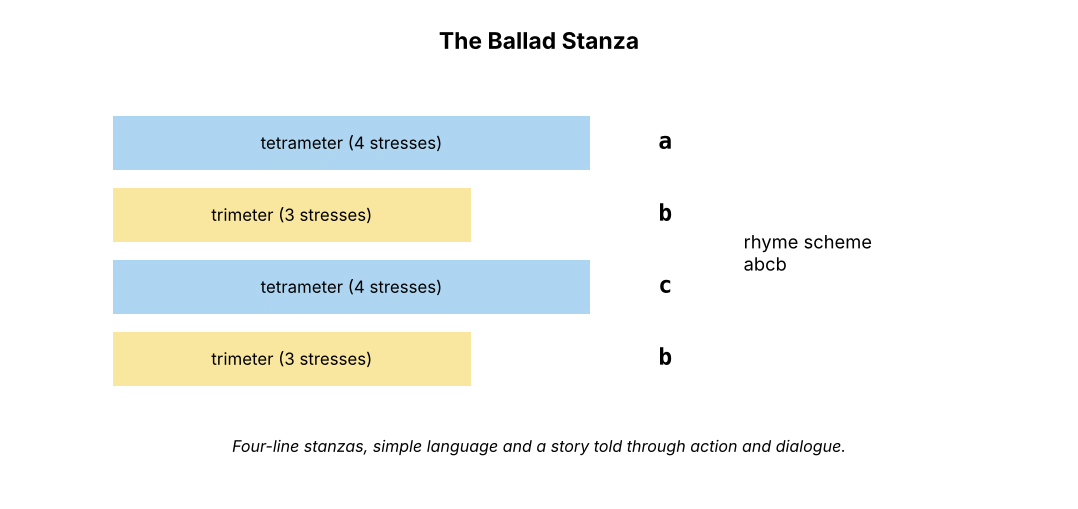
- Ballad: a shorter, songlike story, often tragic, told in simple stanzas.
- Verse narrative: a story told in poetry, such as Henry Wadsworth Longfellow’s “Paul Revere’s Ride” (published 1861).
Longfellow’s poem opens like a storyteller gathering an audience:
Listen, my children, and you shall hear
Of the midnight ride of Paul Revere,
The narrator promises a story, sets the time, and names the hero in just two lines. The galloping rhythm matches the ride itself.
Why does this matter? When you read a narrative poem, you can use the same tools you use for fiction: identify the conflict, track the plot, and analyze how characters change. Then add poetic tools such as rhythm and rhyme to explain how the telling shapes the story.
Lyric Poetry
A lyric poem expresses a speaker’s personal emotions or thoughts, often about a single moment, object, or experience. The word comes from the lyre, a stringed instrument that accompanied song in ancient Greece.
William Wordsworth’s lyric “I Wandered Lonely as a Cloud” (1807) begins:
I wandered lonely as a cloud
That floats on high o’er vales and hills,
- Speaker: a first-person “I.”
- Feeling: loneliness at first, then joy at the sight of daffodils.
- Imagery: a floating cloud, then a crowd of golden flowers dancing in the breeze.
- Reflection: by the end, the speaker explains that the memory of the daffodils fills his heart with pleasure whenever he recalls it.
There is a small event, seeing flowers, but the poem’s focus is the emotion and its lasting effect, not a plot.
Where the Categories Overlap
Many poems mix both modes. A ballad tells a story but may pause for emotional reflection. A lyric poem may describe a brief event. The dramatic monologue uses a single speaker, like a lyric, but reveals a story and a character, like a narrative. When a poem blends both, ask which purpose dominates.
Why does this matter? Identifying the main mode guides your analysis. For a narrative poem, questions often focus on events and character. For a lyric, they focus on the speaker’s feelings, tone, and imagery.
Other Categories You May See
Some textbooks add a third category, dramatic poetry, for poems written as speeches by characters, such as verse plays and dramatic monologues. Others mention didactic poetry, which aims mainly to teach a lesson. These labels overlap with narrative and lyric, but they can be useful when a poem’s main purpose is performance or instruction rather than storytelling or personal feeling.
Analyzing Each Type
- Narrative questions: What is the conflict? Where is the climax? How does the narrator’s voice shape the story? What theme does the outcome suggest?
- Lyric questions: Who is speaking? What emotion dominates? What images express that emotion? Does the feeling change?
Test-Taking Strategies
Mnemonic Devices and Memory Shortcuts
“Narrative narrates; lyric lingers.” A narrative asks “What happened?” A lyric asks “How does it feel?”
Cross-Topic Connections
- Story ballads are explained in Topic 2.10: Ballads.
- Lyric forms include Topic 2.8: The Ode.
- The lyric “I” is examined in Topic 1.2: Speaker and Voice.
- Plot analysis skills appear in Reading Skills Topic 1.7: Tracking Character and Plot Development.
Common Question Formats
- Classify a poem as narrative or lyric and explain why.
- Identify the conflict in a narrative poem.
- Describe the dominant emotion in a lyric poem.
- Explain how a poem blends narrative and lyric elements.
Frequent Student Mistakes
- Calling any poem with an event a narrative poem.
- Calling only rhyming poems lyric poems.
- Ignoring the narrator’s voice in a narrative poem.
Test-Day Shortcuts
Check the pronouns and verbs. A string of past-tense actions suggests a narrative; a focus on “I” and feelings suggests a lyric.
Time Management Tips
Classification questions on English unit tests and standardized reading tests such as the SAT and ACT take about 30 seconds. Use extra time on how-and-why questions.