
If someone says a gift turned out to be “a Trojan horse,” you know it hid a danger, even though no wooden horse or ancient city is involved. If a friend calls a task “my Achilles’ heel,” you know it is their weak spot. These phrases are allusions, brief references to well-known stories, people, or events. Poets use allusions to pack an entire story into a word or two, trusting readers to recognize the reference and bring its meaning into the poem.
This article covers Topic 3.5: Allusion in Unit 3, Figurative Language and Sound. The topic asks you to identify allusions, recognize their common sources, and explain how an allusion adds meaning to a poem.
By the end, you should be able to:
- Define allusion and distinguish it from a direct quotation or explanation.
- Identify common sources of allusions.
- Research an unfamiliar allusion efficiently.
- Explain how an allusion contributes to tone and theme.
What an Allusion Is
An allusion is an indirect or brief reference to a person, place, event, or work outside the poem. The poet does not explain it; the reader is expected to recognize it. When the reader does, the reference brings a whole set of associations into the poem.
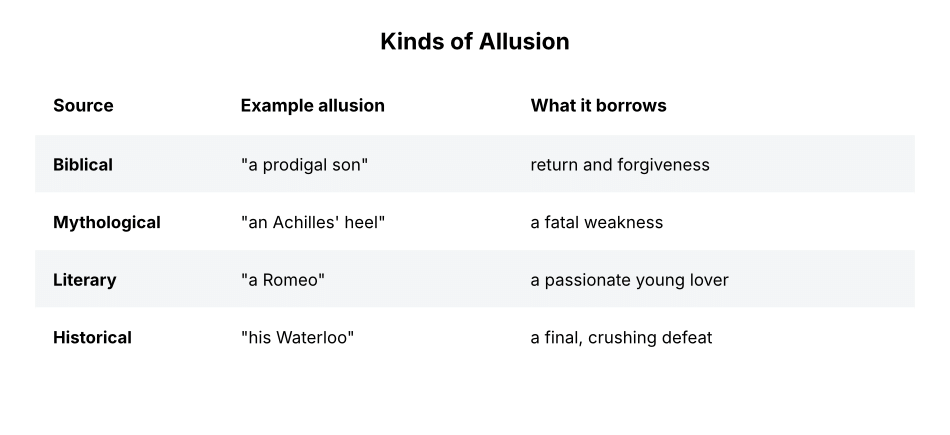
Allusions are efficient. A single word like “Eden” calls up the story of paradise, innocence, temptation, and loss, all without further explanation.
Common Sources of Allusions
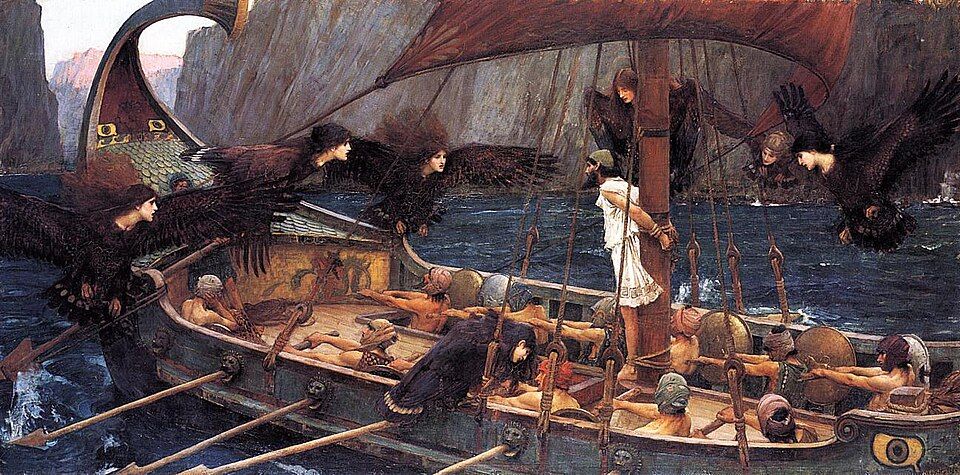
| Source | Examples | Typical Meaning |
|---|---|---|
| Religious texts | Eden, Noah’s flood, David and Goliath | Innocence lost, renewal, an underdog’s victory |
| Greek and Roman myth | Icarus, Pandora, Narcissus, Odysseus | Overreaching ambition, unleashed troubles, vanity, a long journey home |
| History | Waterloo, Rubicon, Cortez | Final defeat, a point of no return, discovery |
| Literature | Romeo, Hamlet, Scrooge | Young love, indecision, stinginess |
| Popular culture | Famous films, songs, and characters | Shared modern references |
Worked Example: “Nothing Gold Can Stay”
Robert Frost’s eight-line poem “Nothing Gold Can Stay” (1923) describes how the first gold-tinged leaves of spring quickly turn green, and how dawn gives way to day. In its sixth line, Frost writes:
So Eden sank to grief,
- Allusion: Eden, the garden in the Book of Genesis, lost when Adam and Eve disobeyed.
- Associations: a perfect beginning, innocence, and its inevitable loss.
- Connection: the poem compares the brief gold of early spring to humanity’s lost paradise.
- Effect: the allusion expands a small observation about leaves into a statement about all beginnings: every perfect moment fades.
Why does this matter? Without recognizing the allusion, a reader might see only a poem about plants. With it, the poem becomes a meditation on innocence and loss. Allusions often unlock a poem’s theme.
Worked Example: Keats and Cortez
In “On First Looking into Chapman’s Homer” (1816), John Keats compares his excitement at reading a new translation of Homer to an explorer’s first sight of the Pacific Ocean. He names “stout Cortez” staring at the Pacific with his men silent around him. The historical allusion conveys awe and discovery. (Historians note that it was actually Balboa, not Cortez, who first saw the Pacific from Panama, a famous slip in an otherwise celebrated poem.)
Allusion Versus Reference
An allusion is brief and indirect. If a poem retells a myth at length, it is adapting or retelling the story, not merely alluding to it. If it quotes a line directly, that is a quotation or epigraph. Allusions trust the reader to supply the meaning.
How to Handle Unfamiliar Allusions
- Notice capitalized names or unusual phrases that seem to point outside the poem.
- Check footnotes, which textbooks often provide.
- Look up the name or phrase and read a short summary of the original story.
- Ask which details of the original story connect to the poem’s situation.
- Explain how those details change or deepen the poem’s meaning.
Why does this matter? Many students skip allusions they do not recognize. On tests, allusions are usually explained in a footnote or made clear by context. Reading footnotes carefully can turn a confusing line into an easy point.
Allusion and Tone
Allusions can be serious or ironic. Comparing a high school football game to the Battle of Troy might create a mock-heroic tone, making a small event seem humorously grand. Comparing a lost love to Eden creates a solemn, mournful tone. Always ask whether the allusion elevates the subject or pokes fun at it.
Test-Taking Strategies
Mnemonic Devices and Memory Shortcuts
“An allusion alludes; it does not explain.” Think of allusions as “shortcuts to stories.”
Cross-Topic Connections
- Allusions often work as symbols, as in Topic 3.4: Symbolism.
- Knowing a poem’s era helps, as in Topic 4.1: Poetry Through the Ages.
- Allusions build Topic 1.4: Theme in Poetry.
- Allusion is a rhetorical tool in Reading Skills Topic 2.9: Analyzing Rhetorical Devices.
Common Question Formats
- Identify the allusion in a line.
- Identify the source of an allusion.
- Explain how an allusion contributes to meaning or tone.
- Choose the best interpretation of a line that contains an allusion.
Frequent Student Mistakes
- Skipping footnotes that explain allusions.
- Identifying the source without explaining the connection.
- Missing irony when an allusion is used humorously.
Test-Day Shortcuts
Find what the original story and the poem’s situation have in common. The correct answer almost always names that shared quality.
Time Management Tips
Allusion questions on English unit tests and standardized reading tests such as the SAT and ACT take 30 to 45 seconds. Read any footnote before the question.