
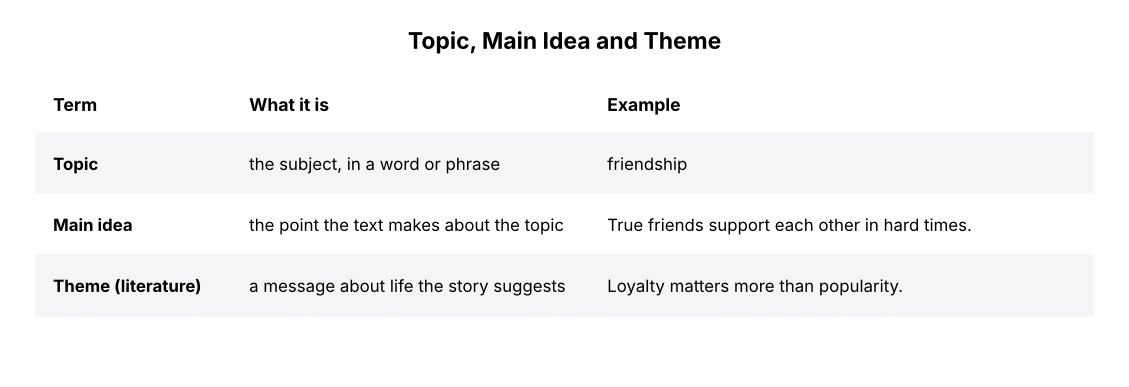
A story about a boy who lies about seeing a wolf is not really about wolves. Aesop’s fable “The Boy Who Cried Wolf” is about trust: people who lie lose the ability to be believed, even when they tell the truth. That lesson, the message that reaches beyond the specific characters and events, is the story’s theme. Identifying theme is one of the most important reading skills, and it appears on nearly every reading test.
This article covers Topic 1.3: Determining Theme in Unit 1, Key Ideas and Details. The topic asks you to identify a text’s theme, state it as a complete idea, and trace how it develops through characters, conflict, and details.
By the end, you should be able to:
- Distinguish theme from topic, plot, and moral.
- State a theme as a complete, universal sentence.
- Use characters, conflict, and resolution to determine theme.
- Trace how a theme develops over the course of a text.
Theme Versus Related Terms
| Term | Definition | Example |
|---|---|---|
| Topic | The general subject, usually a word or phrase | honesty |
| Plot | What happens in the story | A shepherd boy falsely cries “wolf,” and later no one believes him. |
| Theme | The insight about life the text conveys | Dishonesty destroys trust, even when the liar later tells the truth. |
| Moral | A lesson stated directly, often at the end of a fable | “Nobody believes a liar, even when he speaks the truth.” |
Most literature does not state its theme. Readers must infer it from evidence. A moral is a theme that the author spells out.
Writing a Theme Statement
A strong theme statement:
- Is a complete sentence, not a single word.
- Is universal; it does not mention specific characters.
- Is insightful, not an obvious cliché.
- Avoids commands such as “You should always be honest.”
- Avoids absolutes like “always” and “never” unless the text supports them.
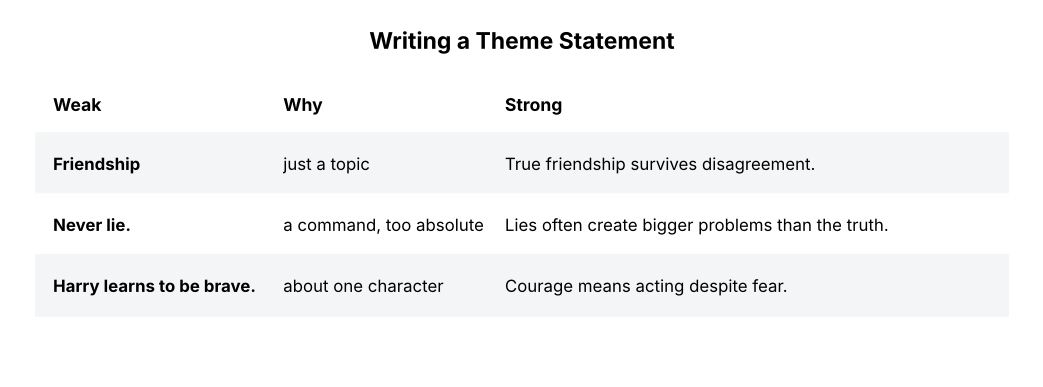
Formula: Topic + what the text suggests about it = Theme. For example, “friendship” plus what a story shows becomes “True friendship sometimes requires telling a friend something painful.”
Where to Look for Theme
- The title: often hints at the central idea.
- The main conflict: what struggle drives the story?
- Character change: what does the main character learn or fail to learn?
- The resolution: how is the conflict resolved, and what are the consequences?
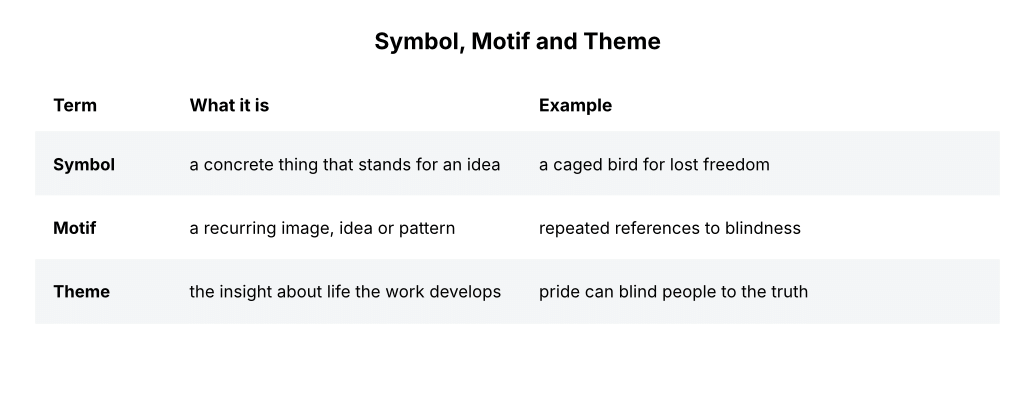
- Repeated images, symbols, or ideas: patterns reveal emphasis.
- Key statements: sometimes a character or narrator voices the idea.
Why does this matter? Theme connects a story to readers’ own lives. Identifying it shows that you understand not just what happened, but why the story was worth telling.
Worked Example
Read this short passage:
Maya practiced her violin solo every night for a month, but at the recital her bow slipped and she missed three notes. Afterward, she expected her teacher to be disappointed. Instead, Mr. Ortiz smiled. “You kept playing,” he said. “That is what musicians do.” Walking home, Maya realized she could not remember the missed notes anymore, only the applause at the end.
- Topic: mistakes and perseverance.
- Conflict: Maya fears her mistake defines her performance.
- Change: she shifts from dread to a new perspective.
- Key statement: “You kept playing. That is what musicians do.”
- Theme: Persevering through mistakes matters more than achieving perfection.
How Themes Develop
A theme rarely appears all at once. It builds through the text:
- Early details introduce the idea, often through a problem or a character’s belief.
- Rising action tests the idea through conflict.
- The climax and resolution confirm or complicate it.
Tests often ask how a theme is developed. A strong answer points to evidence from more than one part of the text: beginning, middle, and end.
Why does this matter? Theme questions are frequently paired with evidence questions on standardized tests. Once you identify the theme, you must find the line that best supports it, so tracing development saves time.
Multiple Themes
Longer works often have several themes. A novel might explore friendship, prejudice, and courage all at once. Choose the theme that best fits the evidence the question focuses on, and be ready to support any theme you name.
Test-Taking Strategies
Mnemonic Devices and Memory Shortcuts
“Topic is a word; theme is a sentence.” Ask, “What did the character learn, and what should the reader learn?”
Cross-Topic Connections
- Theme is related to Topic 1.2: Finding the Central Idea.
- Character change drives theme, as in Topic 1.7: Tracking Character and Plot Development.
- Supporting a theme uses Topic 1.6: Using Textual Evidence to Support Claims.
- Themes in poems are covered in Poetry Topic 1.4: Theme in Poetry.
Common Question Formats
- Choose the statement that best expresses the theme.
- Select the evidence that best supports a theme.
- Explain how a theme develops over the text.
- Compare themes in two passages.
Frequent Student Mistakes
- Naming a topic instead of a theme.
- Summarizing the plot as the theme.
- Choosing a theme based on a single detail.
Test-Day Shortcuts
Eliminate answer choices that mention specific characters, that are too narrow, or that do not match the story’s ending. The best theme fits the whole passage.
Time Management Tips
Theme questions on English unit tests and standardized reading tests such as the SAT and ACT take 45 seconds to a minute. Answer detail questions first; they often reveal the theme.