
Imagine the same birthday party described three ways. In one, the birthday girl tells it: “I blew out the candles and wished nobody had noticed my red face.” In another, a narrator follows only her brother: “Sam watched his sister blush.” In a third, the narrator knows what everyone is thinking. The events are identical, but each telling gives readers different information and a different feeling. That is the power of narrative point of view.
This article covers Topic 2.8: Narrative Point of View in Unit 2, Craft and Structure. The topic asks you to identify first-, second-, and third-person narration, distinguish types of third-person narrators, and analyze how point of view shapes what readers know and feel.
By the end, you should be able to:
- Identify first-, second-, and third-person point of view.
- Distinguish third-person limited, omniscient, and objective narrators.
- Recognize unreliable narrators.
- Explain how point of view creates effects such as suspense, irony, and sympathy.
The Main Points of View
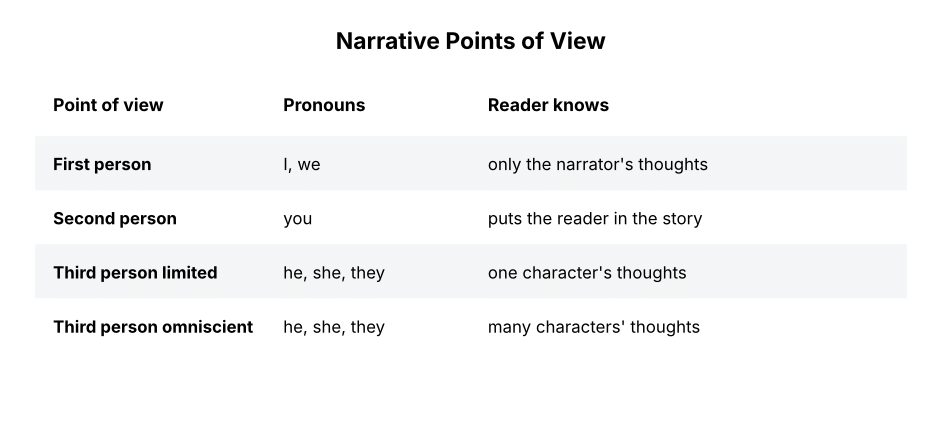
| Point of View | Narrator | Pronoun Clues | What Readers Know |
|---|---|---|---|
| First person | A character in the story | I, me, my, we | Only what the narrator knows, thinks, and chooses to share |
| Second person | Addresses the reader as a character | you, your | Varies; puts the reader inside the action |
| Third-person limited | Outside the story, following one character | he, she, they | One character’s thoughts and feelings |
| Third-person omniscient | Outside the story, all-knowing | he, she, they | Any character’s thoughts, plus past and future events |
| Third-person objective | Outside the story, like a camera | he, she, they | Only actions and dialogue, no thoughts |
First-Person Narration
In first person, a character tells the story. Mark Twain’s Adventures of Huckleberry Finn (1884) begins with Huck speaking directly to the reader in his own informal voice. First person creates intimacy and a strong voice, but readers see only what the narrator sees and must remember that the narrator’s view may be limited or biased.
Watch for dialogue: a story full of “I said” may still be third person if the “I” appears only inside quotation marks. Check the narration outside the dialogue.
Third-Person Narration
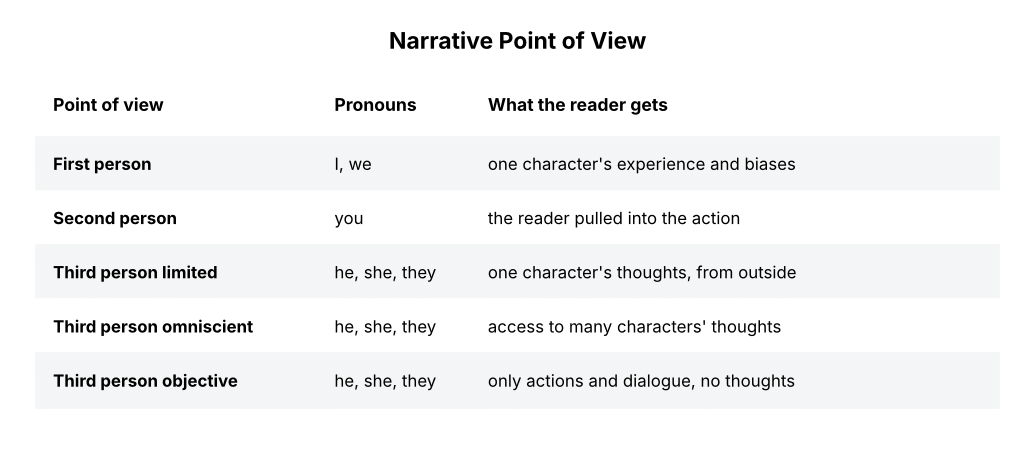
- Limited: the narrator stays close to one character. Readers experience the story through that character’s perceptions, which can create suspense because other characters’ thoughts remain hidden.
- Omniscient: the narrator moves freely among characters’ minds and may comment on events. This allows a wide view and can create dramatic irony, when readers know something a character does not.
- Objective: the narrator reports only what can be seen and heard. Readers must infer characters’ feelings from actions and dialogue.
Second-Person Narration
Second person is rare in fiction. “You walk into the room. You notice the window is open.” It makes readers feel like participants and is common in choose-your-own-adventure books and some experimental stories. Do not confuse it with a first-person narrator who occasionally addresses “you, the reader.”
Why does this matter? Point of view controls information. Every choice about who tells the story decides what readers learn, when they learn it, and whose feelings they share. Changing the narrator can change the entire meaning of a story.
Unreliable Narrators
An unreliable narrator cannot be fully trusted, because of limited knowledge, bias, self-deception, or dishonesty. In Edgar Allan Poe’s “The Tell-Tale Heart” (1843), the narrator insists he is not mad while describing a murder in chilling detail. His frantic denials reveal the opposite of what he claims.
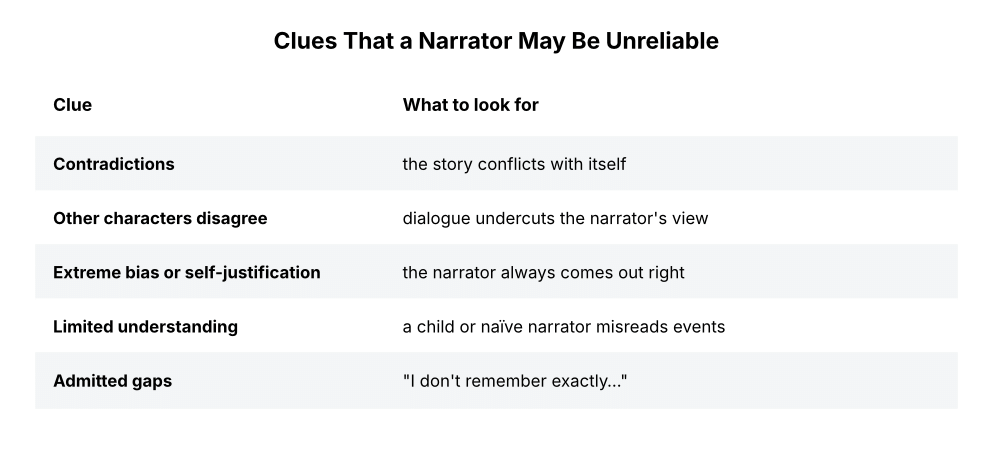
Clues that a narrator may be unreliable:
- Contradictions between what the narrator says and what happens.
- Other characters reacting in ways that challenge the narrator’s version.
- Extreme defensiveness or obvious self-interest.
- A child narrator who does not fully understand adult situations.
Worked Example
Everyone at the table laughed at Dad’s joke except Mira, who stared at her plate. Dad didn’t notice. He was already reaching for the potatoes, pleased with himself.
- Pronouns: third person (she, he).
- Access to thoughts: the narrator knows Dad is “pleased with himself” and notes what he does not notice.
- Conclusion: the narrator reports details about more than one character and knows Dad’s inner feeling, suggesting omniscient narration.
- Effect: readers see a gap between Dad’s satisfaction and Mira’s discomfort, creating dramatic irony and sympathy for Mira.
Why does this matter? Test questions often ask how point of view affects a passage. Strong answers explain what the narrator reveals or hides and how that shapes readers’ understanding.
Test-Taking Strategies
Mnemonic Devices and Memory Shortcuts
“First is I, second is you, third is they.” For third person, think “limited sees one mind, omniscient sees all minds, objective sees no minds.”
Cross-Topic Connections
- Authors’ perspectives are covered in Topic 2.5: Analyzing Author’s Purpose and Point of View.
- Narrator voice connects to Topic 2.4: Identifying Author’s Tone.
- Reading past a narrator’s claims uses Topic 1.5: Making Inferences.
- Poetic speakers are discussed in Poetry Topic 1.2: Speaker and Voice.
Common Question Formats
- Identify the point of view of a passage.
- Explain how point of view creates suspense or irony.
- Determine whether a narrator is reliable.
- Describe how a passage would change with a different narrator.
Frequent Student Mistakes
- Using pronouns inside dialogue to determine point of view.
- Confusing third-person limited with omniscient.
- Trusting every first-person narrator completely.
Test-Day Shortcuts
Check whose thoughts appear in the narration. Thoughts from one character mean limited; thoughts from several mean omniscient; none means objective.
Time Management Tips
Point of view questions on English unit tests and standardized reading tests such as the SAT and ACT take about 30 seconds. Effect questions take closer to a minute.