
When you read a science article, you look for facts. When you read a short story, you look for something different: what characters want, why they act as they do, and what the story suggests about life. Literary texts, including stories, novels, plays, and poems, use invented worlds to explore real human experiences. Reading them well means paying attention not only to what happens but to how the author tells it.
This article covers Topic 4.4: Reading Literary Texts in Unit 4, Reading Strategies. The topic asks you to identify the elements of fiction, track characters and plot, analyze the author’s craft, and connect details to theme.
By the end, you should be able to:
- Identify the main genres and elements of literary texts.
- Track characterization and conflict as you read.
- Notice how authors use craft choices such as point of view, setting, and figurative language.
- Connect specific details to a text’s theme.
Literary Versus Informational Texts
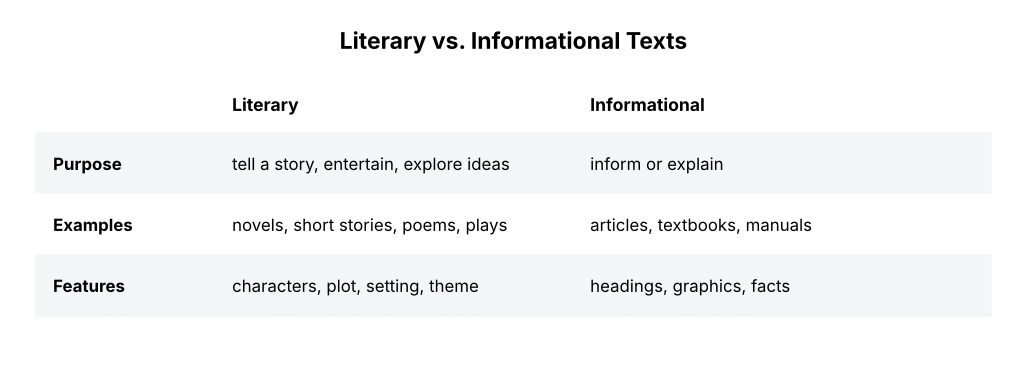
| Feature | Literary Texts | Informational Texts |
|---|---|---|
| Purpose | Entertain, explore human experience, express ideas | Inform, explain, persuade |
| Structure | Plot, stanzas, scenes | Headings, paragraphs organized by idea |
| Language | Often figurative and descriptive | Usually direct and precise |
| Meaning | Often implied; readers infer theme | Usually stated; central idea is clear |
Elements of Fiction
- Character: the people (or animals or beings) in the story. Protagonists drive the story; antagonists oppose them.
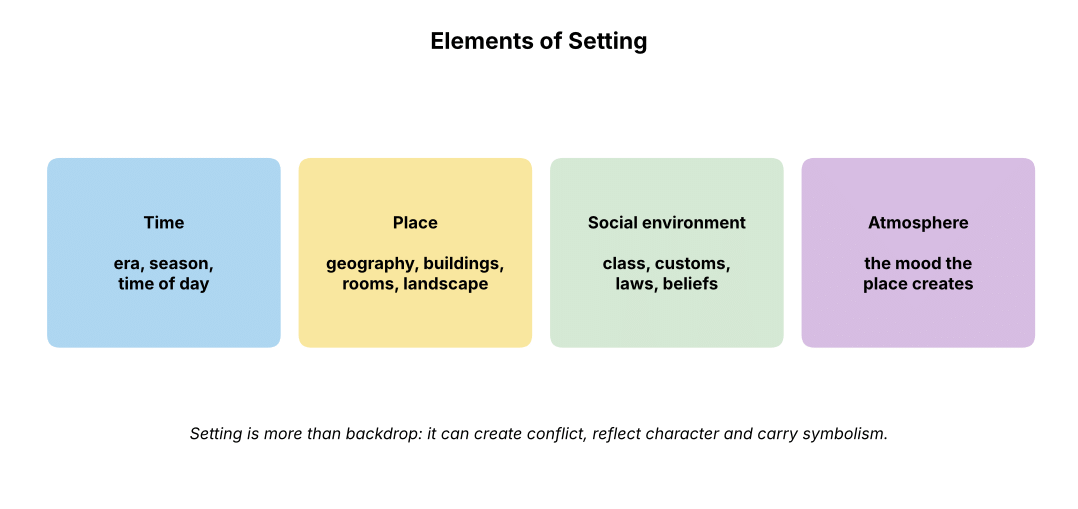
- Setting: time and place, which can shape mood and conflict.
- Plot: the sequence of events, usually built around a conflict.
- Conflict: the central struggle, internal or external.
- Point of view: who tells the story and how much they know.
- Theme: the insight about life the story conveys.
Tracking Characters
Authors reveal characters through direct characterization (stating traits) and indirect characterization (showing traits). A helpful way to remember indirect methods is STEAL:
- Speech: what the character says.
- Thoughts: what the character thinks.
- Effect on others: how others react to the character.
- Actions: what the character does.
- Looks: how the character appears.
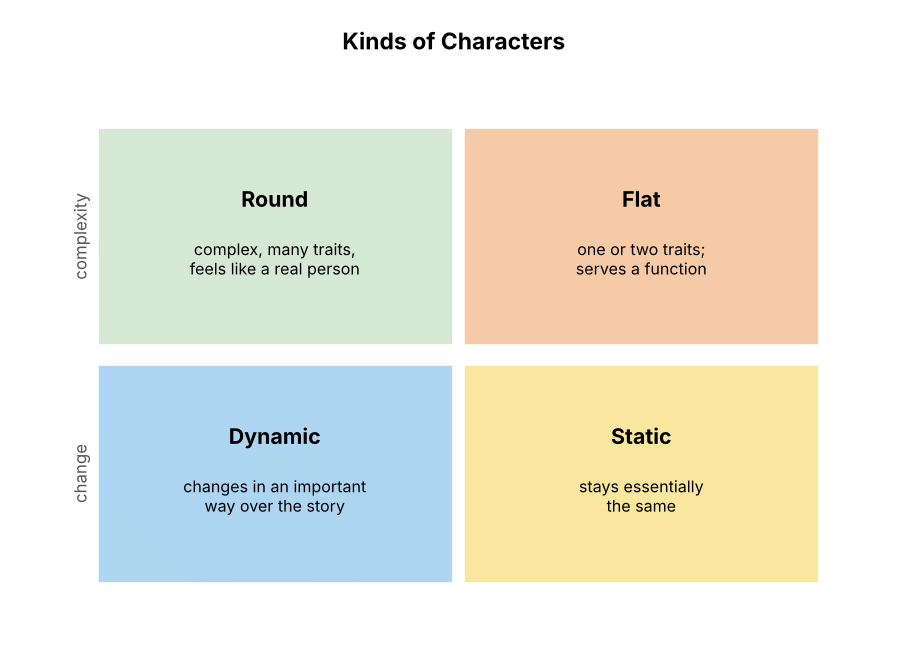
As you read, note how characters change. A dynamic character changes in an important way; a static character stays the same. The change in a dynamic character often reveals the theme.
Why does this matter? Characters’ choices drive both plot and meaning. Test questions frequently ask why a character acts a certain way or how a character changes, and the answers depend on tracking evidence throughout the text.
Noticing the Author’s Craft
Literary reading means asking not just “What happens?” but “How and why did the author present it this way?” Watch for:
- Word choice that creates tone or mood.
- Figurative language such as metaphors and symbols.
- Structure, including flashbacks, foreshadowing, and the placement of key scenes.
- Dialogue that reveals relationships and conflict.
- Setting details that reflect characters’ feelings.
Worked Example
The house on Maple Street had been empty since spring. Weeds pushed through the cracks in the walkway, and one shutter hung by a single hinge. Every afternoon, Theo slowed his bike as he passed, staring at the dark upstairs window where his grandmother used to wave.
- Setting: an abandoned, neglected house; the details suggest loss and decay.
- Indirect characterization: Theo slows down and stares, showing that he still feels connected to the house.
- Inference: his grandmother has died or moved away, and he misses her.
- Craft: the “dark” window replaces the image of his grandmother waving, contrasting past warmth with present emptiness.
- Possible theme: places can hold memories of the people we have lost.
Why does this matter? The passage never says “Theo is grieving.” Literary texts trust readers to build meaning from details, and the ability to do that is exactly what reading tests measure.
Drama and Poetry
Literary texts also include plays and poems. When reading drama, pay attention to stage directions, which describe setting, movement, and tone, and remember that the story is told almost entirely through dialogue. When reading poetry, read slowly and aloud if possible, follow punctuation rather than line breaks, and notice how sound and form add to meaning. The same core questions apply to every genre: who is involved, what conflict or feeling drives the text, and what idea about life emerges.
Reading Strategies for Literature
- Read the introduction or blurb on a test passage carefully; it often gives key context.
- Pause after major scenes to summarize what changed.
- Mark moments of conflict, decision, and change.
- Ask what the ending suggests about the characters and the theme.
Test-Taking Strategies
Mnemonic Devices and Memory Shortcuts
Use STEAL for characterization. For any scene, ask “What happened, how was it told, and why does it matter?”
Cross-Topic Connections
- Character arcs are tracked in Topic 1.7: Tracking Character and Plot Development.
- Who tells the story is covered in Topic 2.8: Narrative Point of View.
- Finding the story’s message uses Topic 1.3: Determining Theme.
- Reading between the lines uses Topic 1.5: Making Inferences.
Common Question Formats
- Infer a character’s motivation or feelings.
- Explain how setting contributes to mood.
- Identify how a character changes.
- Explain how a detail develops the theme.
Frequent Student Mistakes
- Reading for plot only and ignoring craft.
- Making inferences without textual evidence.
- Skipping the introductory blurb on test passages.
Test-Day Shortcuts
For character questions, find the moment the character makes a choice. Choices reveal motives more clearly than descriptions do.
Time Management Tips
Literary passages on English unit tests and standardized reading tests such as the SAT and ACT reward a careful first read. Spend about three to four minutes reading before answering.