
Maximize your score with these resources:
- Albert.io Digital SAT® Reading and Writing question banks
- Free Digital SAT® Reading and Writing cheat sheets
Some Digital SAT questions do not ask for the big picture. Instead, they ask about one specific fact: what a character noticed, why a researcher changed her method, or what a scientist found about a particular species. These are Key Details questions. The answer is always stated or clearly paraphrased in the passage, which makes them some of the most winnable questions on the test, as long as you resist the urge to rely on memory or outside knowledge.
This article covers Topic 1.2: Key Details in Unit 1, Information and Ideas. The topic asks you to locate and interpret specific information stated in a short passage and to choose the answer that accurately restates it.
By the end, you should be able to:
- Recognize the wording of Key Details questions.
- Locate the exact sentence in a passage that answers the question.
- Match a detail to an accurate paraphrase in the answer choices.
- Eliminate choices that distort, exaggerate, or go beyond the text.
What Key Details Questions Look Like
Each Digital SAT Reading and Writing question uses a short passage, usually between about 25 and 150 words, followed by one question. Key Details questions often use stems like these:
- “According to the text, what is true about…?”
- “Based on the text, why did the researchers…?”
- “Which choice best describes what happens in the text?”
- “According to the text, what did the narrator notice about…?”
The words “according to the text” are a signal. The answer is in the passage, not in your head.
A Four-Step Method
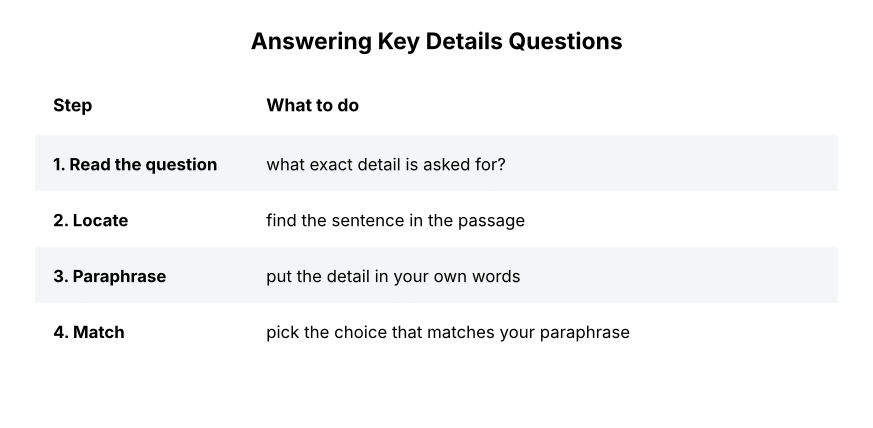
- Read the question first. Identify exactly what detail is being asked about.
- Read the passage with purpose. Look for the sentence that addresses that detail.
- Predict an answer in your own words before looking at the choices.
- Match your prediction to the choice that restates the passage most accurately.
Worked Example
Marine biologist Ana Ruiz studied coral reefs off the coast of Belize for six years. She expected that reefs closest to the shore would show the most damage from rising water temperatures. Instead, she found that some near-shore reefs recovered faster than offshore reefs, possibly because nearby mangrove forests filtered sediment and shaded the shallow water.
According to the text, what did Ruiz find about some near-shore reefs?
- Locate the detail: the last sentence says some near-shore reefs “recovered faster than offshore reefs.”
- Prediction: they bounced back more quickly than reefs farther out.
- Correct choice: “They recovered more quickly than some reefs located farther from shore.”
- Trap choices might say near-shore reefs were “undamaged,” that mangroves “caused” all recovery, or that Ruiz’s expectation was confirmed. None matches the text.
The fictional researcher in this example is invented for practice, but SAT passages use the same structure: an expectation, followed by a surprising detail.
Why does this matter? SAT passages often include a contrast word like “instead,” “however,” or “but.” The detail that follows it is very frequently what the question asks about. Training your eye to stop at those words saves time.
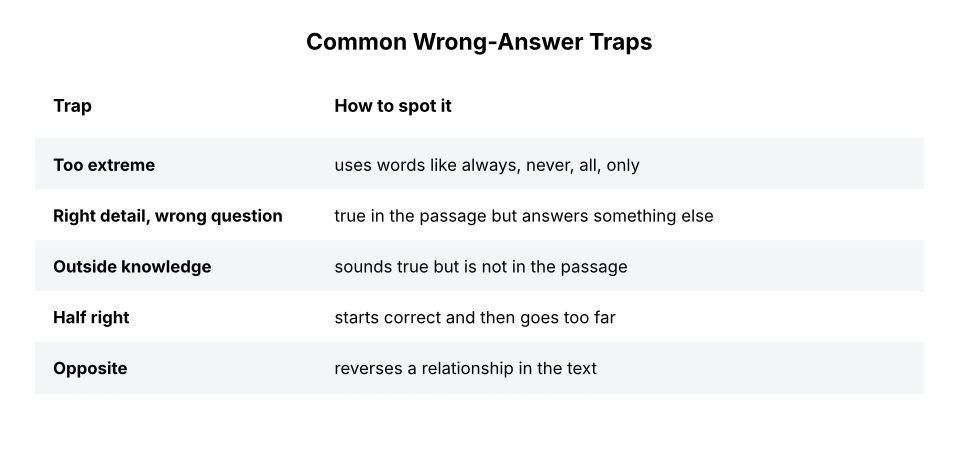
Common Wrong-Answer Traps
| Trap | What It Does | How to Spot It |
|---|---|---|
| Extreme language | Overstates the passage | Words like “always,” “never,” “all,” “completely” |
| Wrong detail | Accurately states a different fact from the passage | True, but answers a different question |
| Distortion | Mixes up who did what or reverses a relationship | Compare subjects and verbs carefully |
| Outside information | Adds a claim the passage never makes | Sounds reasonable but has no support in the text |
| Word echo | Repeats passage words in a misleading way | Familiar vocabulary with a changed meaning |
The word echo trap is especially sneaky. A wrong answer may reuse “mangrove,” “sediment,” and “shallow” while describing something the passage never said. The correct answer often uses different words with the same meaning.
Paraphrase Is the Key
Correct answers on Key Details questions are usually paraphrases rather than direct quotes. Practice translating sentences into simpler language. If the passage says the author “found the proposal unpersuasive,” a correct answer might say she “was not convinced by the plan.” If a passage says a species “thrives only in cold, fast-moving streams,” a correct answer might say it “requires cold water with strong currents.”
Why does this matter? Students who look only for matching words often fall for word echo traps. Students who look for matching meaning choose correctly, even when the vocabulary changes.
Key Details in Literary Passages
Literary passages, including excerpts from novels and poems, also produce Key Details questions. These might ask what a character does, what a narrator observes, or how a setting is described. Stay literal. If the narrator says a room was “dim and smelled of cedar,” the correct answer will describe the room’s lighting or scent, not invent the narrator’s mood.
Test-Taking Strategies
Mnemonic Devices and Memory Shortcuts
“Find it, then pick it.” If you cannot point to the line that supports an answer, do not choose it. Remember “same meaning, different words.”
Cross-Topic Connections
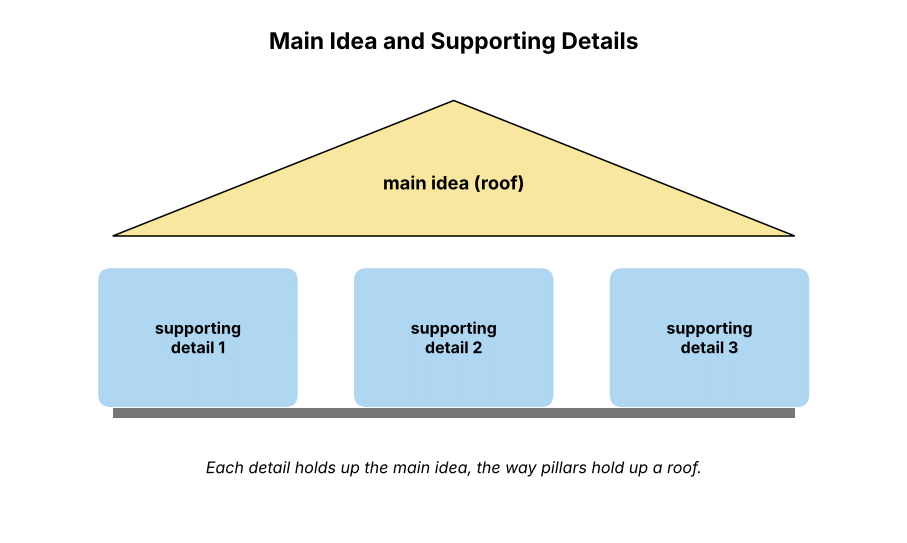
- Details support the main point in Topic 1.1: Central Idea.
- Choosing supporting quotations is practiced in Topic 1.3: Textual Evidence.
- Going one step beyond stated details is covered in Topic 1.5: Inferences.
- Careful reading habits are reviewed in Reading Skills Topic 1.1: Close Reading for Key Ideas and Details.
Common Question Formats
- Identify what the text states about a person, place, or finding.
- Explain why a person in the text took a specific action.
- Describe what happens in a literary excerpt.
- Identify an accurate paraphrase of a sentence.
Frequent Student Mistakes
- Choosing an answer that is true in real life but not stated in the passage.
- Picking a choice because it repeats passage vocabulary.
- Missing a contrast word that changes the meaning of the detail.
Test-Day Shortcuts
Use the elimination tool on the Digital SAT to cross out choices with extreme language first. You will often be left with two choices, and the passage settles the rest.
Time Management Tips
The Digital SAT Reading and Writing section gives about 71 seconds per question. Key Details questions often take 45 seconds, leaving extra time for harder questions later in the module.