
Maximize your score with these resources:
- Albert.io Digital SAT® Reading and Writing question banks
- Free Digital SAT® Reading and Writing cheat sheets
Where does one sentence end and the next begin? That simple question drives more Digital SAT grammar questions than any other topic. Sentence boundary questions ask you to choose the punctuation that correctly joins or separates parts of a sentence. Choose a comma where a period belongs, and you create a comma splice. Choose a period where nothing belongs, and you create a fragment. Mastering a handful of rules turns these questions into reliable points.
This article covers Topic 4.1: Sentence Boundaries in Unit 4, Standard English Conventions. The topic asks you to identify complete sentences and choose punctuation that correctly links or separates independent clauses, dependent clauses, and phrases.
By the end, you should be able to:
- Distinguish independent clauses, dependent clauses, and phrases.
- Recognize run-ons, comma splices, and fragments.
- Choose correct punctuation between two independent clauses.
- Handle transition words and introductory elements correctly.
The Building Blocks
| Unit | Definition | Example |
|---|---|---|
| Independent clause | Subject and verb; can stand alone | the experiment failed |
| Dependent clause | Subject and verb, but begins with a subordinating word | because the sample was contaminated |
| Phrase | Lacks a subject, a verb, or both | after weeks of careful preparation |
Joining Two Independent Clauses
When both sides of a punctuation mark are complete sentences, only these options are correct:
- Period: The experiment failed. The sample was contaminated.
- Semicolon: The experiment failed; the sample was contaminated.
- Comma plus coordinating conjunction (for, and, nor, but, or, yet, so): The experiment failed, so the team started over.
- Colon, when the second clause explains the first: The experiment failed for one reason: the sample was contaminated.
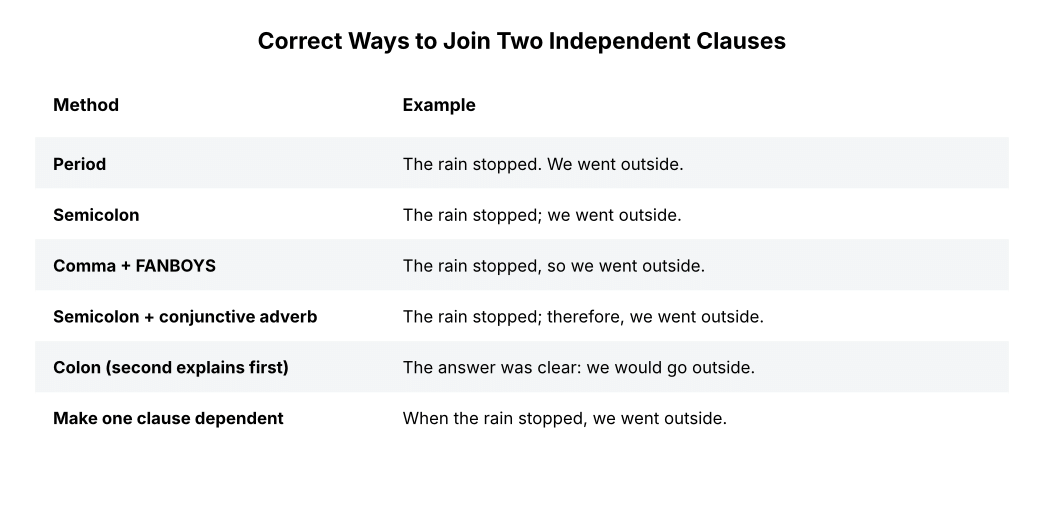
A comma alone between two independent clauses is a comma splice. No punctuation at all is a fused sentence, or run-on. Both are always wrong on the SAT.
Why does this matter? Many answer choices on the SAT differ only by punctuation. If you can quickly decide whether each side of the boundary is independent, you can eliminate most choices without reading them closely.
The Cover-Up Test
Cover everything after the punctuation mark and ask whether the first part is a complete sentence. Then cover everything before it and ask the same about the second part.
Worked example 1:
The Atacama Desert in Chile is one of the driest places on Earth some weather stations there have recorded almost no rainfall for years.
- Left side: “The Atacama Desert in Chile is one of the driest places on Earth” is independent.
- Right side: “some weather stations there have recorded almost no rainfall for years” is independent.
- Correct options: “Earth; some” or “Earth. Some.” Incorrect: “Earth, some” (comma splice) or “Earth some” (run-on).
Transition Words
Conjunctive adverbs and transitional phrases, such as however, therefore, moreover, consequently, for example, and in fact, are not conjunctions. They cannot join two independent clauses with only a comma.
- Incorrect: The forecast predicted rain, however, the sky stayed clear.
- Correct: The forecast predicted rain; however, the sky stayed clear.
- Correct: The forecast predicted rain. However, the sky stayed clear.
When a transition word interrupts a single clause, commas on both sides are fine: “The forecast, however, was wrong.”
Fragments and Dependent Clauses
A period or semicolon cannot separate a dependent clause or phrase from the sentence it belongs to.
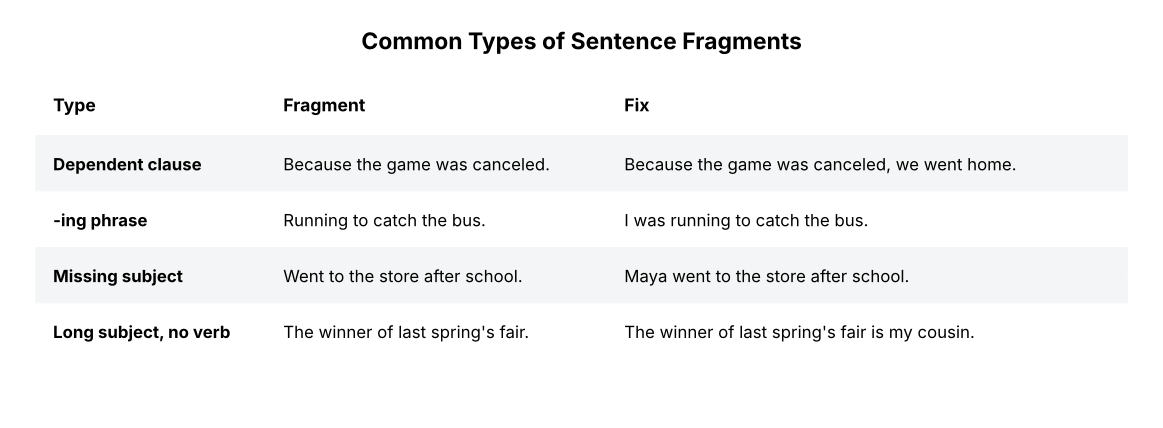
Worked example 2:
Although the novel sold poorly when it was first published. It later became a classic.
- “Although the novel sold poorly when it was first published” begins with “although,” so it is dependent.
- A period after it leaves a fragment.
- Correct: “published, it later became a classic.”
Semicolons follow the same rule as periods. If you would not put a period there, do not put a semicolon there.
Introductory Elements and Interrupters
Introductory phrases and dependent clauses are followed by a comma: “After the long winter, the river flooded.” Nonessential interrupters, such as appositives and relative clauses, are set off by matching punctuation on both sides, either two commas, two dashes, or two parentheses. Mixing them, as in a comma on one side and a dash on the other, is always incorrect.
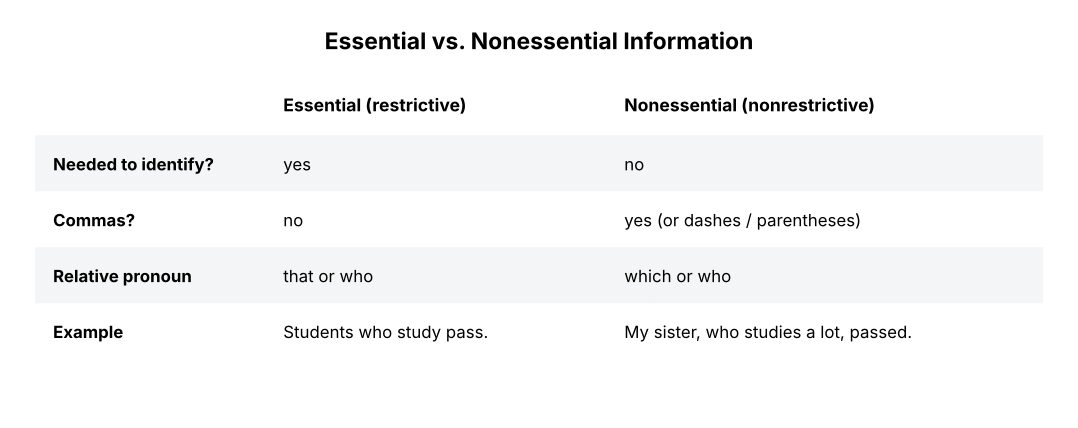
Why does this matter? The SAT often hides a boundary error inside a long sentence with several interrupting phrases. Identifying the core subject and verb first lets you see the real structure underneath.
Questions and Quotations
Some boundary questions involve direct questions and quotations. A direct question ends with a question mark (“Why did the bridge collapse?”), while an indirect question ends with a period (“The engineers asked why the bridge collapsed.”).
Test-Taking Strategies
Mnemonic Devices and Memory Shortcuts
“Period equals semicolon.” Between two complete sentences, a comma needs a FANBOYS partner: for, and, nor, but, or, yet, so.
Cross-Topic Connections
- Detailed comma, semicolon, and colon rules appear in Topic 4.2: Punctuation Rules.
- All tested grammar rules are summarized in Topic 4.8: Grammar Rules Overview.
- Comma splices are explained in depth in Grammar Topic 5.5: Run-On Sentences and Comma Splices.
- Incomplete sentences are covered in Grammar Topic 5.4: Sentence Fragments.
Common Question Formats
- Choose the punctuation that correctly joins two clauses.
- Fix a comma splice or run-on.
- Choose punctuation around a transition word.
- Correct a fragment created by misplaced end punctuation.
Frequent Student Mistakes
- Using a comma before “however” to join two sentences.
- Putting a semicolon after a dependent clause.
- Assuming long sentences must be run-ons.
Test-Day Shortcuts
If two answer choices are a period and a semicolon in the same spot, and nothing else differs, neither can be the only right answer; look for the choice that differs in another way.
Time Management Tips
The Digital SAT Reading and Writing section gives about 71 seconds per question. Boundary questions usually take 20 to 40 seconds, so bank that time for reading questions.