
Maximize your score with these resources:
- Albert.io Digital SAT® Reading and Writing question banks
- Free Digital SAT® Reading and Writing cheat sheets
“The collection of rare coins are valuable.” That sentence sounds almost right, because the word “coins” sits right before the verb. But the subject is “collection,” which is singular, so the verb must be “is.” Subject-verb agreement questions on the Digital SAT are built around exactly this kind of distraction. The rule is simple; the traps are what make these questions challenging.
This article covers Topic 4.3: Subject-Verb Agreement in Unit 4, Standard English Conventions. The topic asks you to ensure that verbs agree in number with their subjects, even when the subject is separated from the verb or hard to identify.
By the end, you should be able to:
- Identify the true subject of a verb, even in long sentences.
- Ignore prepositional phrases and other interrupters between subject and verb.
- Apply agreement rules for compound subjects, collective nouns, and indefinite pronouns.
- Handle inverted sentences that place the verb before the subject.
The Basic Rule
A singular subject takes a singular verb; a plural subject takes a plural verb.
- The scientist studies glaciers. (singular)
- The scientists study glaciers. (plural)
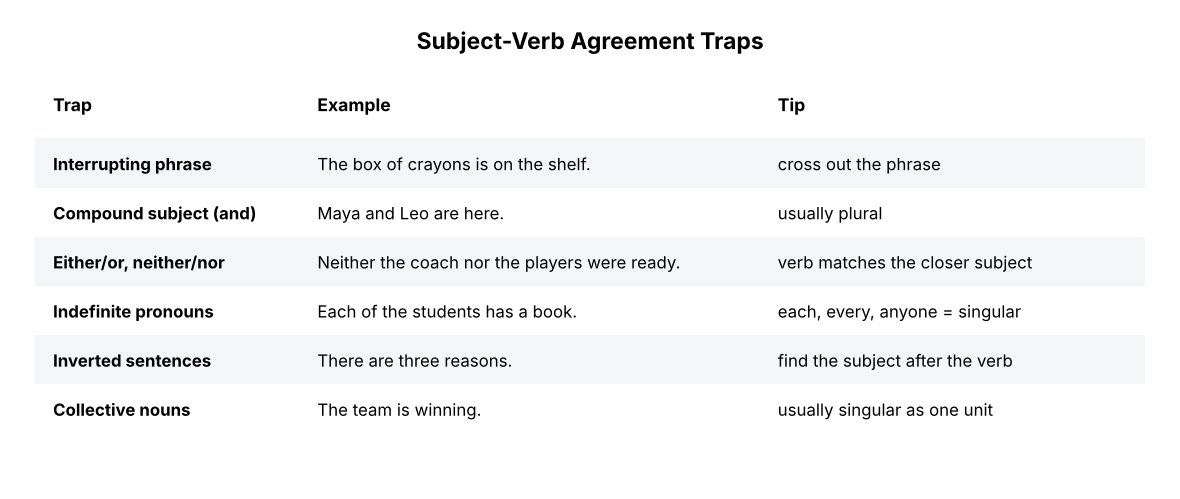
Remember that in the present tense, singular verbs usually end in -s, while plural nouns usually end in -s. That is the opposite pattern, which is why errors feel natural.
Trap 1: Interrupting Phrases
The SAT often places a long phrase between the subject and the verb. Cross out prepositional phrases and other interrupters to find the true subject.
Worked example 1:
The results of the study, which involved more than 3,000 participants across twelve countries, suggests / suggest that sleep affects memory.
- Cross out “of the study” and the “which” clause.
- The subject is “results,” which is plural.
- Correct verb: “suggest.”
Phrases like “along with,” “as well as,” and “in addition to” do not make a subject plural: “The coach, along with the players, was celebrating.”
Trap 2: Compound Subjects
- Subjects joined by and are plural: “The map and the compass are in the pack.”
- Subjects joined by or or nor: the verb agrees with the closer subject. “Neither the teacher nor the students were ready.” “Neither the students nor the teacher was ready.”
Trap 3: Collective Nouns and Tricky Singulars
Collective nouns such as team, committee, jury, audience, and family usually take singular verbs on the SAT when the group acts as one unit: “The committee has approved the plan.”
Other nouns look plural but are singular: news, physics, mathematics, and titles of works such as The Grapes of Wrath. Amounts treated as a single quantity are also singular: “Ten dollars is a fair price.”
Trap 4: Indefinite Pronouns
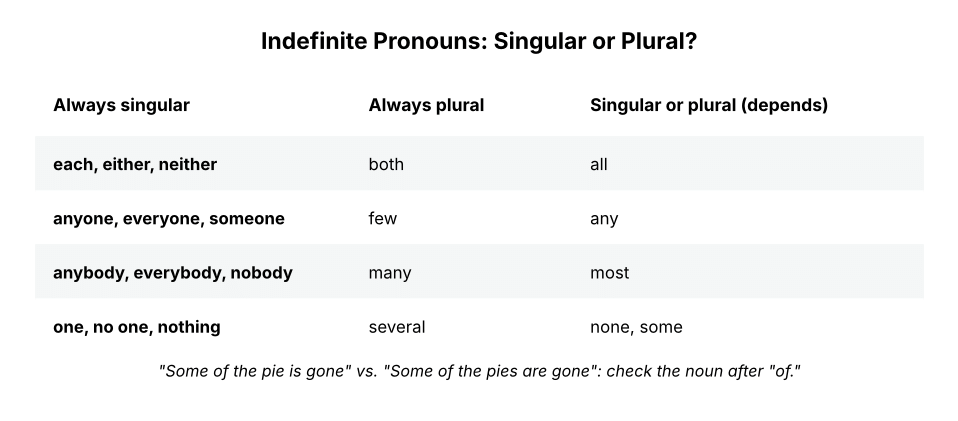
| Always Singular | Always Plural | Depends on Context |
|---|---|---|
| each, either, neither, everyone, someone, anybody, nobody | both, few, many, several | all, any, most, none, some |
“Each of the paintings is signed.” “Most of the water is frozen.” “Most of the lakes are frozen.” For the context group, check the noun in the “of” phrase.
Why does this matter? SAT test writers know which words students misjudge. “Each” and “neither” look like they refer to many things, so they are frequent traps. Memorizing the singular list removes the guesswork.
Trap 5: Inverted Sentences
When a sentence begins with “there,” “here,” or a prepositional phrase, the subject often comes after the verb.
Worked example 2:
Beneath the ancient city lies / lie a network of tunnels and chambers.
- Rearrange: “A network of tunnels and chambers lies beneath the ancient city.”
- The subject is “network,” which is singular.
- Correct verb: “lies.”
Similarly, “There are several reasons” uses a plural verb because the subject is “reasons.”
Relative Clauses
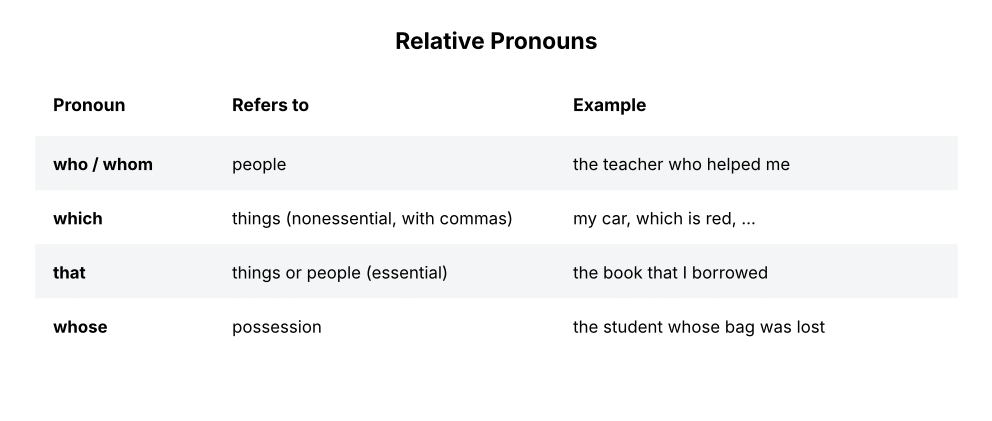
In a clause beginning with who, which, or that, the verb agrees with the noun the pronoun refers to: “She is one of the researchers who study coral reefs.” Here “who” refers to “researchers,” so the verb is plural.
Why does this matter? Agreement errors are some of the easiest to fix once spotted, but the SAT hides them in long, information-packed sentences. Practicing the cross-out method trains your eye to find the subject in seconds.
Test-Taking Strategies
Mnemonic Devices and Memory Shortcuts
“Cross out the middle, match the ends.” For “or” and “nor,” “the closer subject calls the shots.”
Cross-Topic Connections
- All tested rules are summarized in Topic 4.8: Grammar Rules Overview.
- The full set of agreement rules appears in Grammar Topic 6.1: Subject-Verb Agreement.
- Group nouns are explained in Grammar Topic 1.3: Collective Nouns.
- Finding the subject draws on Grammar Topic 4.1: Subjects.
Common Question Formats
- Choose the verb form that agrees with a distant subject.
- Choose agreement for compound subjects joined by “or” or “nor.”
- Choose a verb for an indefinite pronoun subject.
- Choose a verb in an inverted sentence.
Frequent Student Mistakes
- Matching the verb to the nearest noun instead of the subject.
- Treating “each” or “neither” as plural.
- Making “along with” phrases part of the subject.
Test-Day Shortcuts
If the answer choices differ only by singular versus plural verb forms, the question is about agreement. Go straight to finding the subject.
Time Management Tips
The Digital SAT Reading and Writing section gives about 71 seconds per question. Agreement questions usually take about 30 seconds once you identify the subject.