
Maximize your score with these resources:
- Albert.io Digital SAT® Reading and Writing question banks
- Free Digital SAT® Reading and Writing cheat sheets
One small mark separates “the scientist’s notes” from “the scientists’ notes” and from “the scientists notes.” The first refers to notes belonging to one scientist, the second to notes belonging to several scientists, and the third is simply incorrect. Plurals and possessives questions on the Digital SAT test whether you can place apostrophes precisely, and they often combine both ideas in one choice.
This article covers Topic 4.6: Plurals and Possessives in Unit 4, Standard English Conventions. The topic asks you to distinguish plural nouns from possessive nouns and to form singular and plural possessives correctly.
By the end, you should be able to:
- Distinguish plural nouns from possessive nouns.
- Form singular and plural possessives correctly.
- Handle irregular plurals and possessive pronouns.
- Decide quickly whether a word needs an apostrophe at all.
Plural Versus Possessive
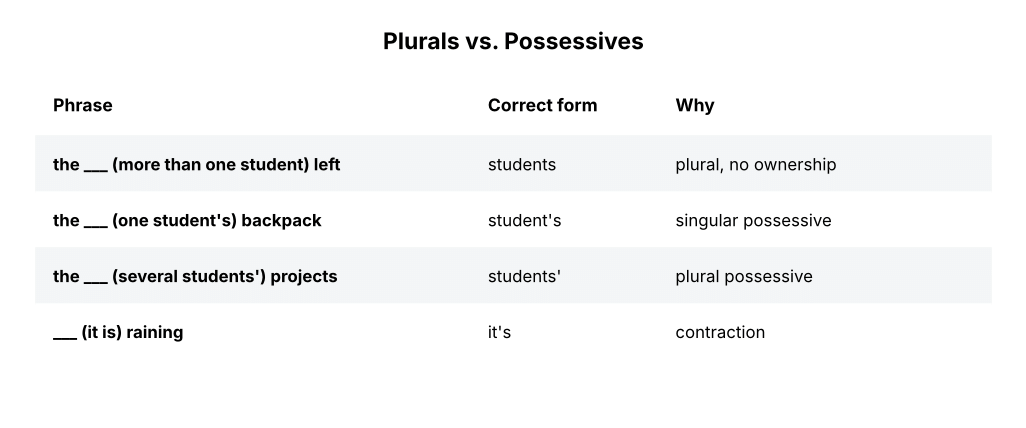
- A plural noun means more than one: volcanoes, researchers, cities. No apostrophe.
- A possessive noun shows ownership or a relationship: the volcano’s crater, the city’s mayor. Uses an apostrophe.
Ask: does the word own or have something that follows it? If yes, it is possessive. If it is simply more than one, it is plural.
Forming Possessives
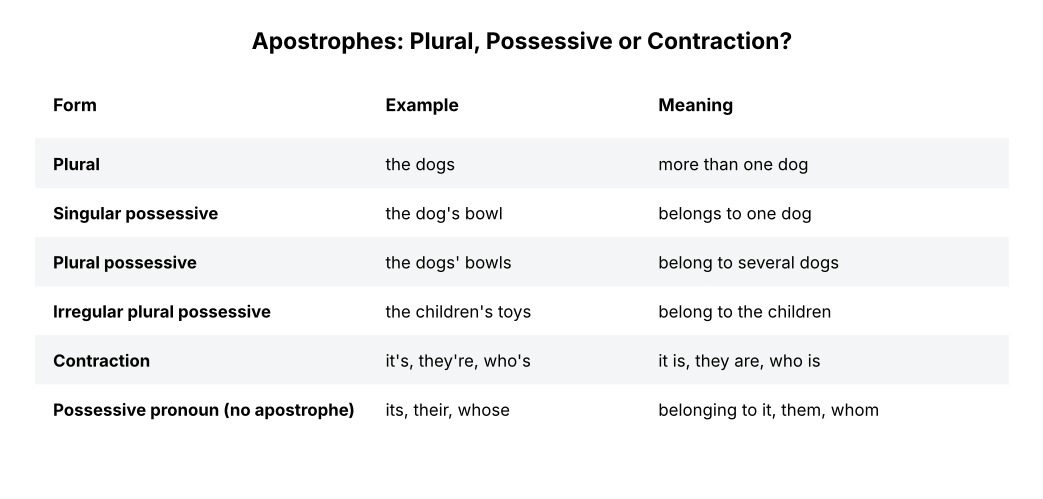
| Noun Type | Rule | Example |
|---|---|---|
| Singular noun | Add ‘s | the river’s source, the bus’s route |
| Plural noun ending in s | Add only ‘ | the rivers’ sources, the students’ projects |
| Irregular plural not ending in s | Add ‘s | the children’s books, the women’s team |
The three-step method:
- Decide whether the noun is singular or plural.
- Write the correct form of the noun (singular, or its plural).
- Add the apostrophe: ‘s if the word does not end in s, or just ‘ if it is a plural ending in s.
Worked Examples
Example 1:
The museums / museum’s / museums’ newest exhibit features artifacts from ancient Egypt.
- The exhibit belongs to the museum, so the word is possessive.
- “The” and the singular sense of the sentence point to one museum.
- Correct: “museum’s.”
Example 2:
Several farmers / farmer’s / farmers’ reported that early frost damaged their crops.
- “Several” means more than one, and the farmers do not own anything in this phrase; “reported” is their action.
- The word is plural, not possessive.
- Correct: “farmers.”
Example 3:
The two companies / company’s / companies’ profits rose during the same quarter.
- “Two” means plural, and the profits belong to the companies.
- Plural “companies” ends in s, so add only an apostrophe.
- Correct: “companies’.”
Why does this matter? SAT answer choices often include all three versions of a word. Asking two questions, “how many?” and “does it own something?”, eliminates the wrong versions in seconds.
Combined Questions
Many SAT questions underline two nouns at once, such as “the researchers findings.” You must decide on each word separately. The first might be a plural possessive, “researchers’,” and the second a plain plural, “findings.” Work word by word rather than choosing the answer that looks most balanced.
Reading the Whole Phrase
Context words often reveal whether a noun is singular or plural. Words such as “several,” “many,” “both,” and “two” signal plural nouns, while “a,” “one,” “each,” and “the only” signal singular nouns. Look for these clues before you decide where the apostrophe belongs. If a sentence says “each of the team’s members,” the team is singular; if it says “both teams’ coaches,” the possessive belongs to two teams.
Also watch the verb that follows the noun. A plural possessive such as “the scientists’ theory” can still take a singular verb, because the subject is “theory,” not “scientists.” Separating the owner from the thing owned keeps both agreement and apostrophes straight.
Possessive Pronouns
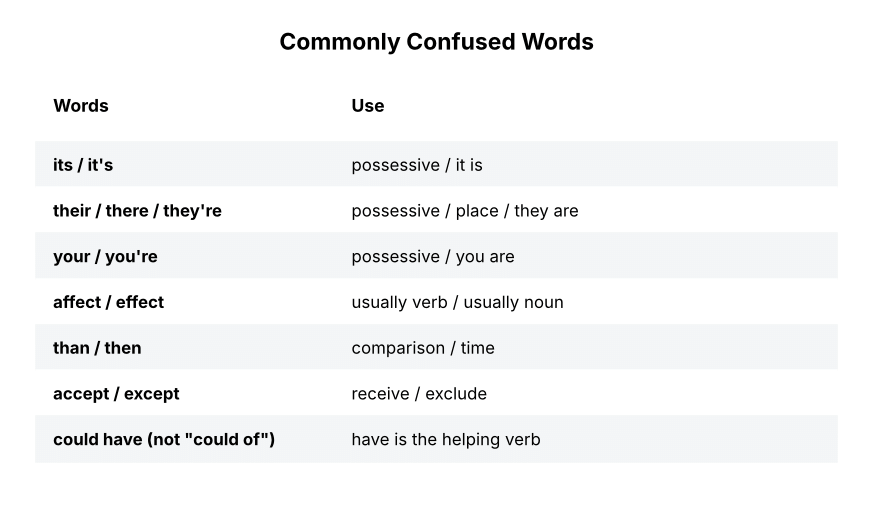
Possessive pronouns never take apostrophes: its, their, whose, yours, ours, hers. Words like “it’s” and “who’s” are contractions meaning “it is” and “who is.” If you can replace the word with “it is,” use “it’s”; otherwise use “its.”
Common Pitfalls
- Apostrophes in ordinary plurals: “The 1990s” and “three DVDs” need no apostrophe.
- Compound nouns: add the possessive to the last word: “my sister-in-law’s car.”
- Joint ownership: “Lewis and Clark’s expedition” (one shared expedition) versus “Maria’s and Jorge’s projects” (separate projects).
- Singular nouns ending in s: most style guides, and the SAT, accept “James’s” or “the bus’s.”
Why does this matter? Apostrophe errors change meaning. “The teacher’s comments” and “the teachers’ comments” describe different situations, and careful readers notice.
Test-Taking Strategies
Mnemonic Devices and Memory Shortcuts
“Plural first, apostrophe second.” For pronouns, “pronouns own without apostrophes.”
Cross-Topic Connections
- All tested rules are summarized in Topic 4.8: Grammar Rules Overview.
- Pronoun possessives are tested in Topic 4.4: Pronoun-Antecedent Agreement.
- Full apostrophe rules appear in Grammar Topic 7.4: Apostrophes and Possessives.
- Irregular plurals are reviewed in Grammar Topic 1.4: Irregular Plural Nouns.
Common Question Formats
- Choose among plural, singular possessive, and plural possessive forms.
- Correct two underlined nouns in one phrase.
- Choose between “its” and “it’s.”
- Form the possessive of an irregular plural.
Frequent Student Mistakes
- Adding apostrophes to simple plurals.
- Placing the apostrophe before the s in plural possessives.
- Using “it’s” to show possession.
Test-Day Shortcuts
Look at the word right after the underlined noun. If it is a noun being owned, you need a possessive; if it is a verb, you usually need a plain plural.
Time Management Tips
The Digital SAT Reading and Writing section gives about 71 seconds per question. Apostrophe questions usually take 20 to 30 seconds.