
Maximize your score with these resources:
- Albert.io Digital SAT® Reading and Writing question banks
- Free Digital SAT® Reading and Writing cheat sheets
“Having studied the data for months, the conclusion seemed obvious.” Who studied the data? Not the conclusion. That sentence contains a dangling modifier: the opening phrase describes someone who never appears. Modifier placement questions on the Digital SAT usually look exactly like this, with a descriptive phrase at the start of a sentence and four answer choices that differ in what comes right after the comma.
This article covers Topic 4.7: Modifier Placement in Unit 4, Standard English Conventions. The topic asks you to place modifiers next to the words they describe and to avoid dangling and misplaced modifiers.
By the end, you should be able to:
- Identify modifying phrases, especially introductory ones.
- Recognize dangling and misplaced modifiers.
- Choose the answer that places the correct noun right after an introductory modifier.
- Place limiting words such as “only” precisely.
The Core Rule
A modifier is a word, phrase, or clause that describes something else. It must sit as close as possible to the word it describes. When a sentence begins with a descriptive phrase followed by a comma, the noun or pronoun immediately after the comma must be the thing that phrase describes.
Dangling Modifiers
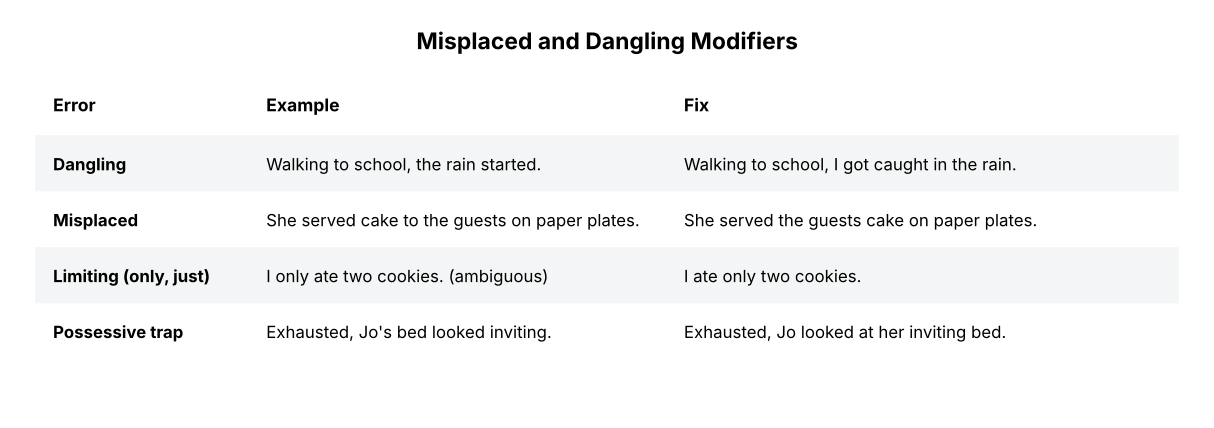
A dangling modifier describes something that does not appear in the sentence, or that appears in the wrong place.
Worked example 1:
Born in a small village in Kenya, ______ became the first African woman to win the Nobel Peace Prize.
- Ask: who was born in a small village in Kenya? A person.
- Wrong choices begin with something else, such as “the Nobel Peace Prize was awarded to Wangari Maathai” or “Wangari Maathai’s work.”
- Correct: “Wangari Maathai became the first African woman to win the Nobel Peace Prize.”
Maathai, an environmental activist who founded the Green Belt Movement, received the prize in 2004. The sentence is correct only when her name comes right after the comma.
Common Types of Introductory Modifiers
| Type | Example Opening |
|---|---|
| Present participle phrase | Analyzing the samples, … |
| Past participle phrase | Built in the twelfth century, … |
| Appositive phrase | A pioneer of modern dance, … |
| Prepositional phrase describing a person | As a young engineer, … |
| Adjective phrase | Eager to begin the experiment, … |
Each of these must be followed immediately by the person or thing it describes.
Why does this matter? On the SAT, every answer choice may be grammatically complete. Only one will put the right noun next to the modifier. Knowing this rule lets you answer by reading just the first few words of each choice.
Possessive Traps
A common trick puts a possessive noun after the comma: “A brilliant mathematician, Katherine Johnson’s calculations guided early spaceflights.” The modifier describes a mathematician, but the subject after the comma is “calculations.” The correct version is “A brilliant mathematician, Katherine Johnson calculated trajectories that guided early spaceflights.”
Worked example 2:
Originally designed as a temporary structure for the 1889 World’s Fair, ______
- What was designed as a temporary structure? The Eiffel Tower.
- Wrong: “Gustave Eiffel’s company built the tower…” (the company was not the structure).
- Correct: “the Eiffel Tower became a permanent symbol of Paris.”
Misplaced Modifiers
A misplaced modifier describes a word in the sentence, but it sits next to the wrong one.
- Misplaced: The researcher described the fossil to the reporters found in Montana.
- Correct: The researcher described the fossil found in Montana to the reporters.
Modifiers at the End of a Sentence
Modifiers can also dangle at the end of a sentence. In “The final report was submitted, exhausted after weeks of work,” the phrase “exhausted after weeks of work” seems to describe the report. A better version names the person: “Exhausted after weeks of work, the team submitted the final report.” When a descriptive phrase appears at the end, check that it sits right beside the noun it describes.
Limiting Modifiers
Words such as only, just, almost, and nearly modify the word immediately after them. “She only tested three samples” and “She tested only three samples” can mean different things. On the SAT, place the limiting word directly before the word it limits.
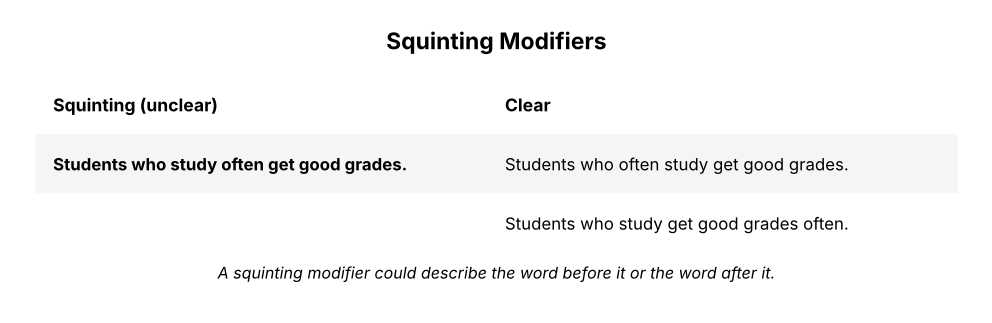
Why does this matter? Modifier errors can make sentences unintentionally funny or confusing. In scientific and historical writing, a misplaced phrase can attach a finding or an action to the wrong person or object.
Test-Taking Strategies
Mnemonic Devices and Memory Shortcuts
“Who or what did it? Put it after the comma.” Think of the comma as a doorway: the modifier must open onto the right person.
Cross-Topic Connections
- All tested rules are summarized in Topic 4.8: Grammar Rules Overview.
- Commas after introductory phrases are covered in Topic 4.2: Punctuation Rules.
- More examples appear in Grammar Topic 5.7: Misplaced and Dangling Modifiers.
- Phrase types are explained in Grammar Topic 4.4: Phrases.
Common Question Formats
- Complete a sentence that begins with an introductory modifier.
- Choose the version with no dangling modifier.
- Fix a sentence where a possessive follows the modifier.
- Place a limiting word correctly.
Frequent Student Mistakes
- Choosing a possessive noun right after the comma.
- Selecting the longest or most formal-sounding choice instead of checking the subject.
- Ignoring where “only” sits in a sentence.
Test-Day Shortcuts
Read only the modifier and the first two words of each answer choice. Usually just one choice begins with the correct doer.
Time Management Tips
The Digital SAT Reading and Writing section gives about 71 seconds per question. Modifier questions often take just 15 to 25 seconds with this shortcut.