
Maximize your score with these resources:
- Albert.io AP® Biology question banks
- Free AP® Biology study guides
- Free AP® Biology score calculator
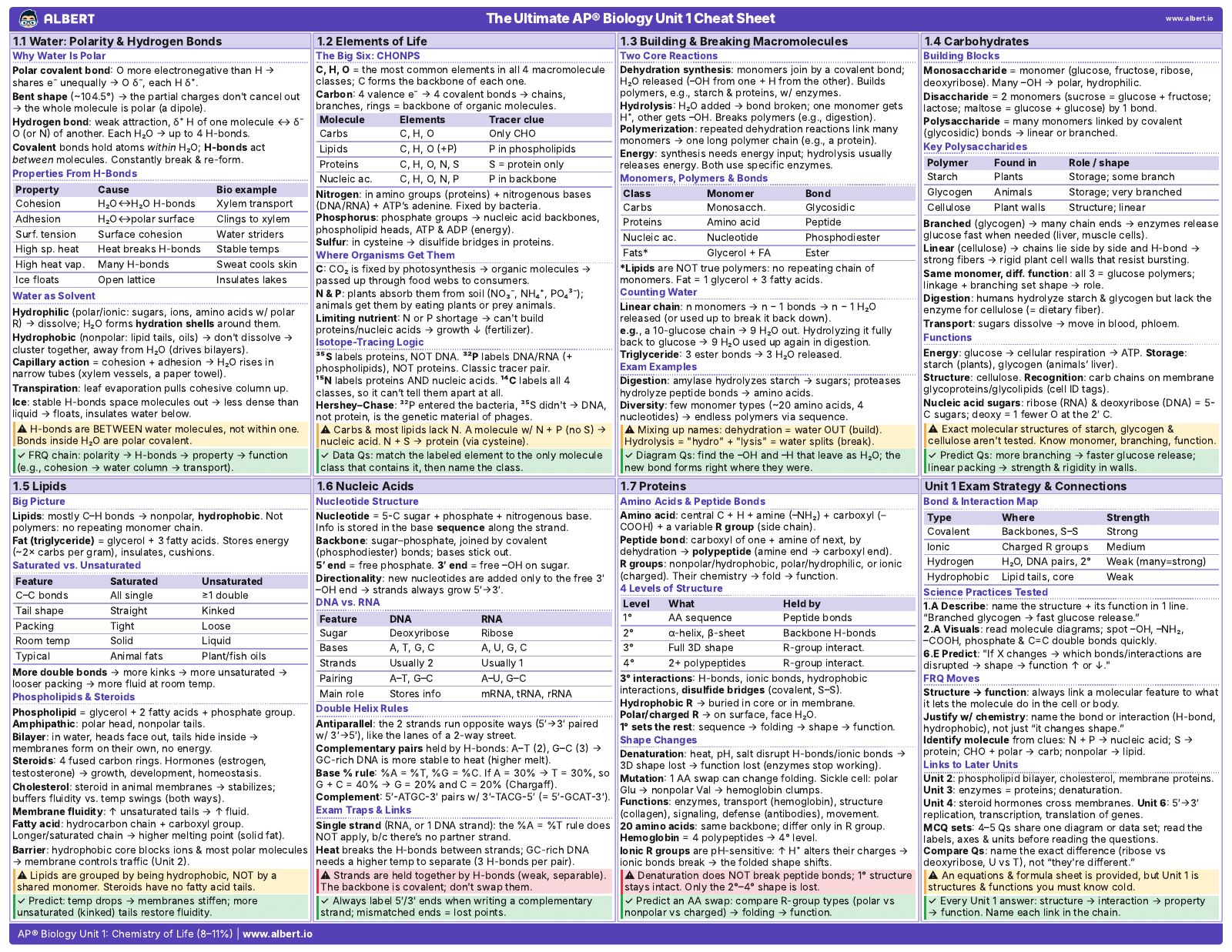
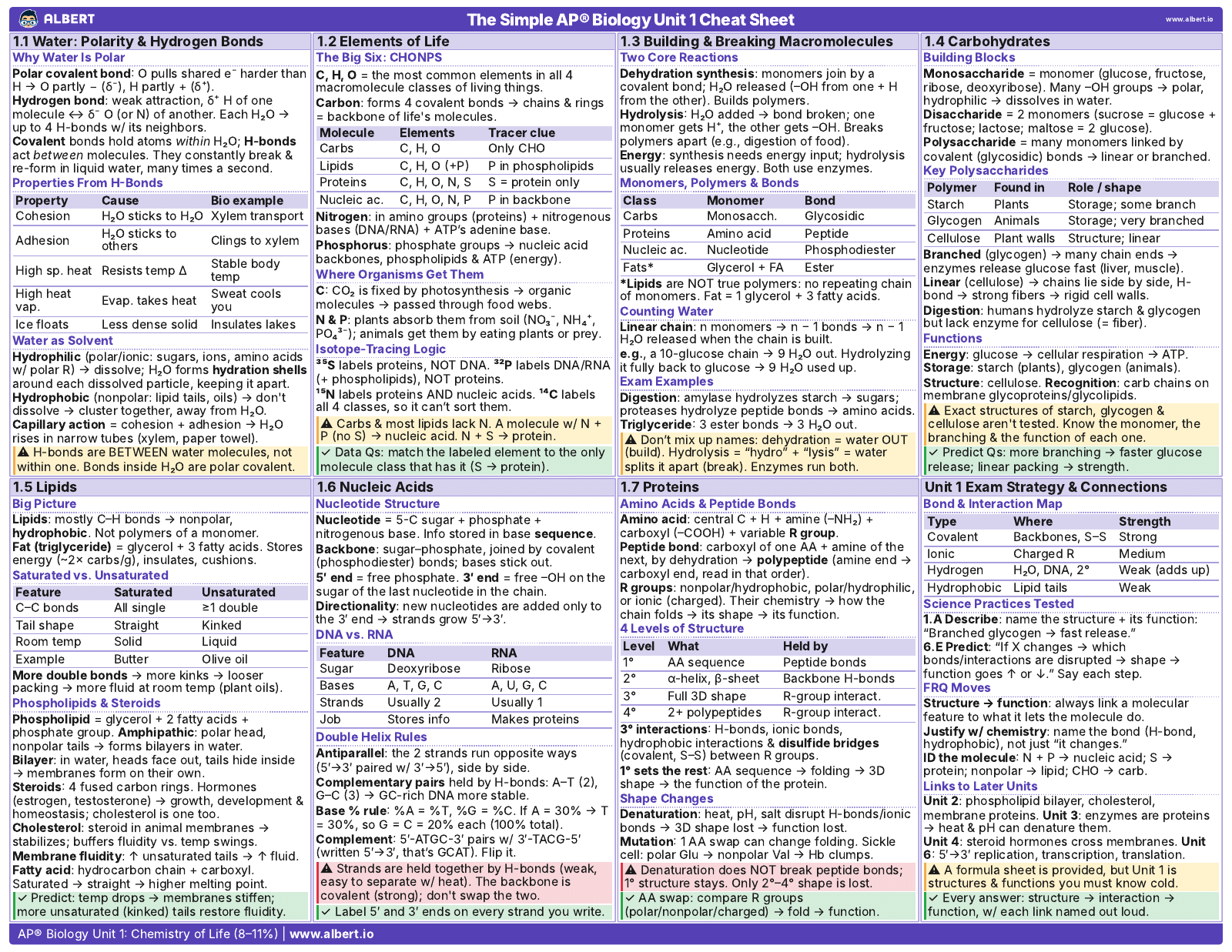
Chemistry of Life is where AP® Biology starts, and the AP Bio Unit 1 cheat sheet puts it on one page: water and hydrogen bonding, the elements organisms build with, and the four classes of macromolecules. Unit 1 is 8–11% of the exam, and every later unit leans on it. Use Simple for a fast first pass or Ultimate for full detail.
Practice AP® Biology Unit 1 questions on Albert
What’s on the AP Bio Unit 1 Cheat Sheet?
Both versions use the same eight cards: one for each topic in the current AP® Biology course framework (water, elements of life, building and breaking macromolecules, carbohydrates, lipids, nucleic acids, proteins) plus a strategy card that maps every bond type and links Unit 1 to later units.
Simple is for students meeting this material for the first time or reviewing the night before a quiz. It keeps the core definitions, one comparison table per card, and the single most common trap for each topic, with a few extra words of context on new terms.
Ultimate is for students who already know the basics and want everything in one place. It adds isotope-tracing logic, water-counting rules for polymers, R-group behavior in folding, membrane fluidity predictions, and extra exam traps. If you can explain every line on the Ultimate sheet out loud, you’re ready for Unit 1 questions on the exam.
AP® Biology Unit 1 at a Glance
The 2025 course framework splits Unit 1 into seven topics. Older study materials list six, with proteins folded into a general macromolecules topic, so check which version your class uses.
| Topic | Name | Focus |
|---|---|---|
| 1.1 | Structure of Water and Hydrogen Bonding | How polarity and hydrogen bonds give water its properties |
| 1.2 | Elements of Life | Which elements (C, H, O, N, P, S) appear in which macromolecules |
| 1.3 | Introduction to Macromolecules | Dehydration synthesis and hydrolysis |
| 1.4 | Carbohydrates | Monosaccharides, polysaccharides, branching and function |
| 1.5 | Lipids | Saturated vs. unsaturated fats, phospholipids, steroids |
| 1.6 | Nucleic Acids | Nucleotides, 5′ and 3′ ends, antiparallel base pairing |
| 1.7 | Proteins | Amino acids, peptide bonds, four levels of structure |
Exam weight: 8–11% of the multiple-choice score. That sounds small, but the ideas return constantly: enzymes in Unit 3 are proteins, membranes in Unit 2 are phospholipids, and gene expression in Unit 6 depends on 5′-to-3′ directionality. Treat this unit as a foundation, not a warm-up.
Key Concepts in Unit 1: Chemistry of Life
Water and Hydrogen Bonding (1.1)
Oxygen pulls shared electrons harder than hydrogen, so a water molecule has a partial negative charge near oxygen and partial positive charges near each hydrogen. Because the molecule is bent, those charges don’t cancel, and water is polar. The partially positive hydrogen of one molecule is attracted to the partially negative oxygen of another. That attraction is a hydrogen bond, and each water molecule can form up to four.
Almost every property you need to know comes from those hydrogen bonds. Cohesion (water sticking to water) and adhesion (water sticking to other polar surfaces) together pull water up through xylem. A high specific heat means water absorbs a lot of energy before its temperature rises, because that energy goes into breaking hydrogen bonds first. A high heat of vaporization is why sweating cools you.
Worked example: A question shows a leaf losing water through its stomata and asks why water keeps moving up from the roots. The answer chain is evaporation at the leaf, then cohesion between water molecules pulling the column upward, with adhesion to xylem walls helping hold it in place.
Exam tip: Hydrogen bonds form between water molecules. The bonds inside one water molecule are polar covalent. Mixing those up is one of the most common Unit 1 errors.
Elements of Life and Building Macromolecules (1.2–1.3)
Carbon, hydrogen, and oxygen are in all four macromolecule classes. The other elements are the clues: nitrogen shows up in proteins (amino groups) and nucleic acids (bases); phosphorus appears in nucleic acids, phospholipids, and ATP; sulfur shows up only in proteins, in amino acids like cysteine.
Monomers join through dehydration synthesis: one monomer gives up an –OH, the other gives up an H, and a water molecule leaves. Hydrolysis runs the other way: water is added across the bond and splits it, which is what happens during digestion.
Worked example: A linear chain of 10 glucose molecules has 9 bonds between them, so building it releases 9 water molecules, and fully hydrolyzing it uses 9. For any linear chain, n monomers means n − 1 water molecules.
Exam tip: For isotope questions, match the label to the only class that contains it. Radioactive sulfur labels protein but not DNA; radioactive phosphorus labels DNA but not protein. This is the logic of the Hershey–Chase experiment.
Carbohydrates and Lipids (1.4–1.5)
Starch, glycogen, and cellulose are all polymers of glucose, yet they do different jobs because of how the chains are linked and branched. Glycogen is highly branched, so enzymes can work on many chain ends at once and release glucose quickly. Cellulose is linear, so its chains line up side by side and hydrogen bond into strong fibers for plant cell walls. The exam won’t ask you to draw these molecules, but it will ask you to connect shape to function.
Lipids are grouped by being hydrophobic, not by a shared monomer. In a saturated fatty acid every carbon–carbon bond is single, the tail is straight, and the fats pack tightly and stay solid at room temperature. An unsaturated fatty acid has at least one double bond that puts a kink in the tail, so the molecules can’t pack tightly and the fat stays liquid. Phospholipids have a polar phosphate head and two nonpolar tails, so they form bilayers on their own in water. Steroids such as cholesterol and sex hormones are built from four fused rings.
Worked example: A fish moves into colder water. Predict a change in its membranes. Cold makes membranes stiffer, so cells that add more unsaturated (kinked) fatty acid tails keep their membranes fluid.
Exam tip: “Predict” questions about branching or saturation reward a full chain: structure, then packing, then the property, then the function.
Nucleic Acids (1.6)
A nucleotide has a five-carbon sugar, a phosphate group, and a nitrogenous base. Covalent bonds link the sugar of one nucleotide to the phosphate of the next, forming the sugar–phosphate backbone. Each strand has a 5′ end (free phosphate) and a 3′ end (free –OH), and new nucleotides are added only to the 3′ end.
DNA’s two strands are antiparallel and held together by hydrogen bonds between complementary bases: A with T, G with C. RNA uses ribose instead of deoxyribose, uracil instead of thymine, and is usually single-stranded.
Worked example: A DNA sample is 30% adenine. Because A pairs with T, thymine is also 30%. That leaves 40% for G and C combined, so each is 20%. To write the partner of 5′-ATGC-3′, pair each base and flip the direction: 3′-TACG-5′, which reads 5′-GCAT-3′.
Exam tip: Always label the 5′ and 3′ ends when you write a strand on a free-response question. The base-percentage rule only works for double-stranded DNA, never for RNA.
Proteins (1.7)
Every amino acid has the same backbone (a central carbon bonded to a hydrogen, an amine group, and a carboxyl group) plus a variable R group. Peptide bonds form by dehydration synthesis between the carboxyl group of one amino acid and the amine group of the next.
Structure builds in four levels. Primary is the amino acid sequence. Secondary structures (alpha helices and beta-pleated sheets) come from hydrogen bonds along the backbone. Tertiary structure is the full 3D shape, set by R-group interactions: hydrogen bonds, ionic bonds, hydrophobic interactions, and covalent disulfide bridges. Quaternary structure appears when two or more polypeptides combine, as in hemoglobin.
Worked example: In sickle cell disease, a polar amino acid (glutamic acid) in hemoglobin is replaced by a nonpolar one (valine). That nonpolar R group on the surface causes hemoglobin molecules to stick together, which distorts red blood cells. One change in primary structure changes shape and function.
Exam tip: Denaturation from heat or pH destroys secondary, tertiary, and quaternary structure, but the peptide bonds survive. The primary structure stays the same.
How Unit 1 Shows Up on the Exam
The exam is 60 multiple-choice questions and 6 free-response questions, each section 90 minutes and half the score. Many multiple-choice questions come in sets of four or five that share one diagram or data set, so Unit 1 often appears as a molecule drawing you have to read: find the functional groups, spot a double bond, or identify which molecule a diagram shows.
On the free-response section, Unit 1 rarely gets a question of its own. It shows up inside questions about enzymes, membranes, or genetics, where you explain why a change in structure changes function. The course framework highlights three skills for this unit: describing biological concepts, working with visual representations, and predicting the effects of a change to a system. Scorers reward answers that name the specific bond or interaction involved. “The protein’s shape changes” earns less than “the higher temperature disrupts hydrogen bonds and ionic interactions between R groups, changing the active site’s shape.” Calculators are allowed and a formula sheet is provided, but nothing on it replaces knowing these structures.
Common Mistakes in Unit 1
- Mistake: Saying hydrogen bonds hold the atoms of a water molecule together. Fix: Those are polar covalent bonds; hydrogen bonds act between molecules.
- Mistake: Swapping dehydration synthesis and hydrolysis. Fix: Dehydration builds and releases water; hydrolysis uses water to break.
- Mistake: Calling lipids polymers. Fix: Fats are glycerol plus three fatty acids, not a repeating chain of monomers.
- Mistake: Thinking denaturation breaks peptide bonds. Fix: Only the 3D shape is lost; the sequence stays intact.
- Mistake: Writing a complementary strand without flipping direction. Fix: Label 5′ and 3′ ends every time; the strands are antiparallel.
Frequently Asked Questions
Can I use this cheat sheet on the exam?
No. Students can’t bring notes into the AP exam. The AP Bio Unit 1 cheat sheet is a study tool for review and practice, not something to take into the testing room.
Should I start with the Simple or the Ultimate version?
Start with Simple if Unit 1 is new or if you are short on time. Move to Ultimate once the Simple sheet feels easy, since its extra traps and examples look more like real exam questions.
Why does my textbook list six Unit 1 topics instead of seven?
The course framework updated for 2025 gave proteins their own topic (1.7). Older materials cover the same content across six topics, so nothing important is missing either way.
How much do I need to memorize about molecular structures?
Less than you might think. The course framework says the exact structures of specific carbohydrate polymers, nucleotides, and amino acids are not tested. You do need to recognize functional groups, backbones, and double bonds, and explain how structure leads to function.
What’s the best AP Bio Unit 1 practice after reviewing the cheat sheet?
Work through Unit 1 practice questions that use diagrams and data, then explain each answer in one sentence that names the bond or interaction involved. That habit carries straight into the free-response section.