
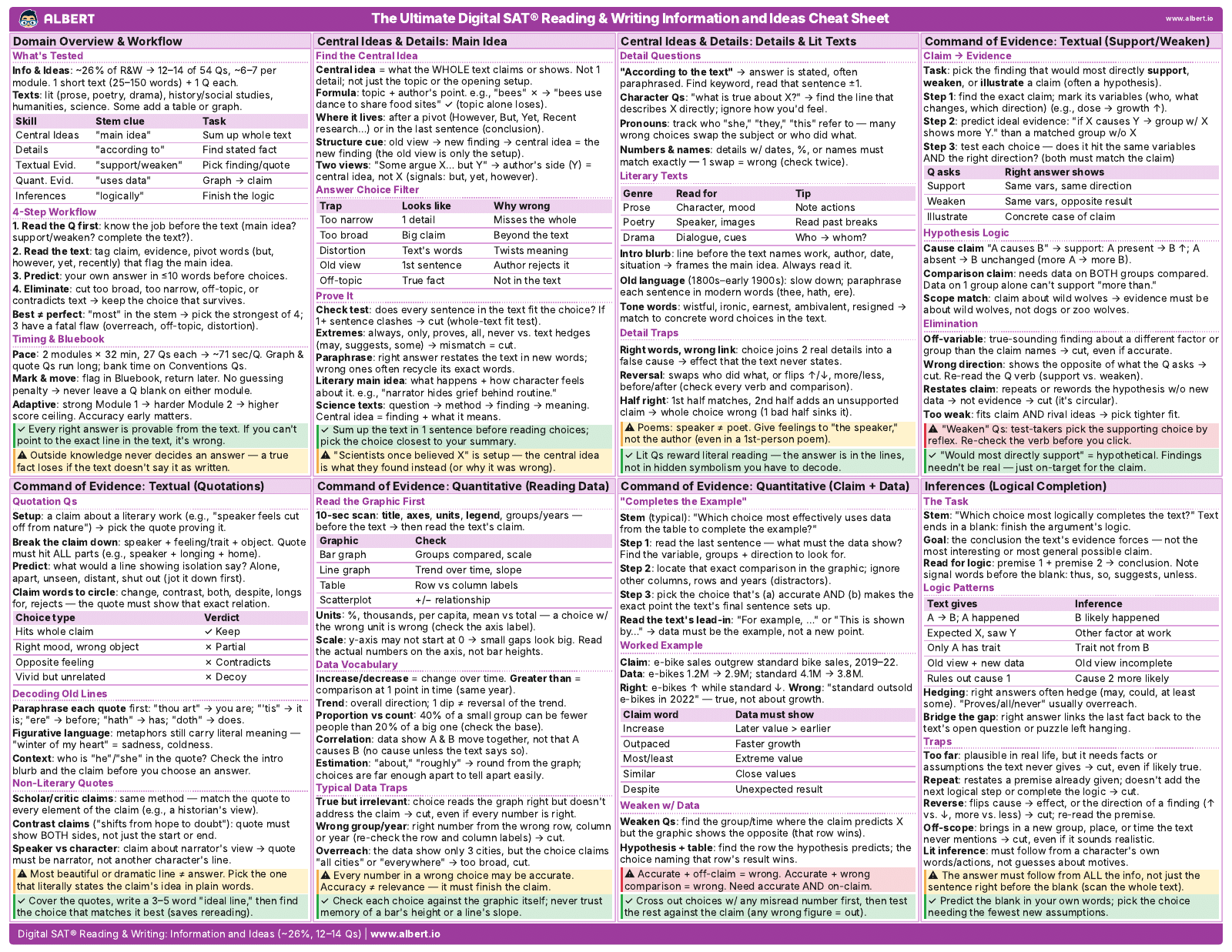
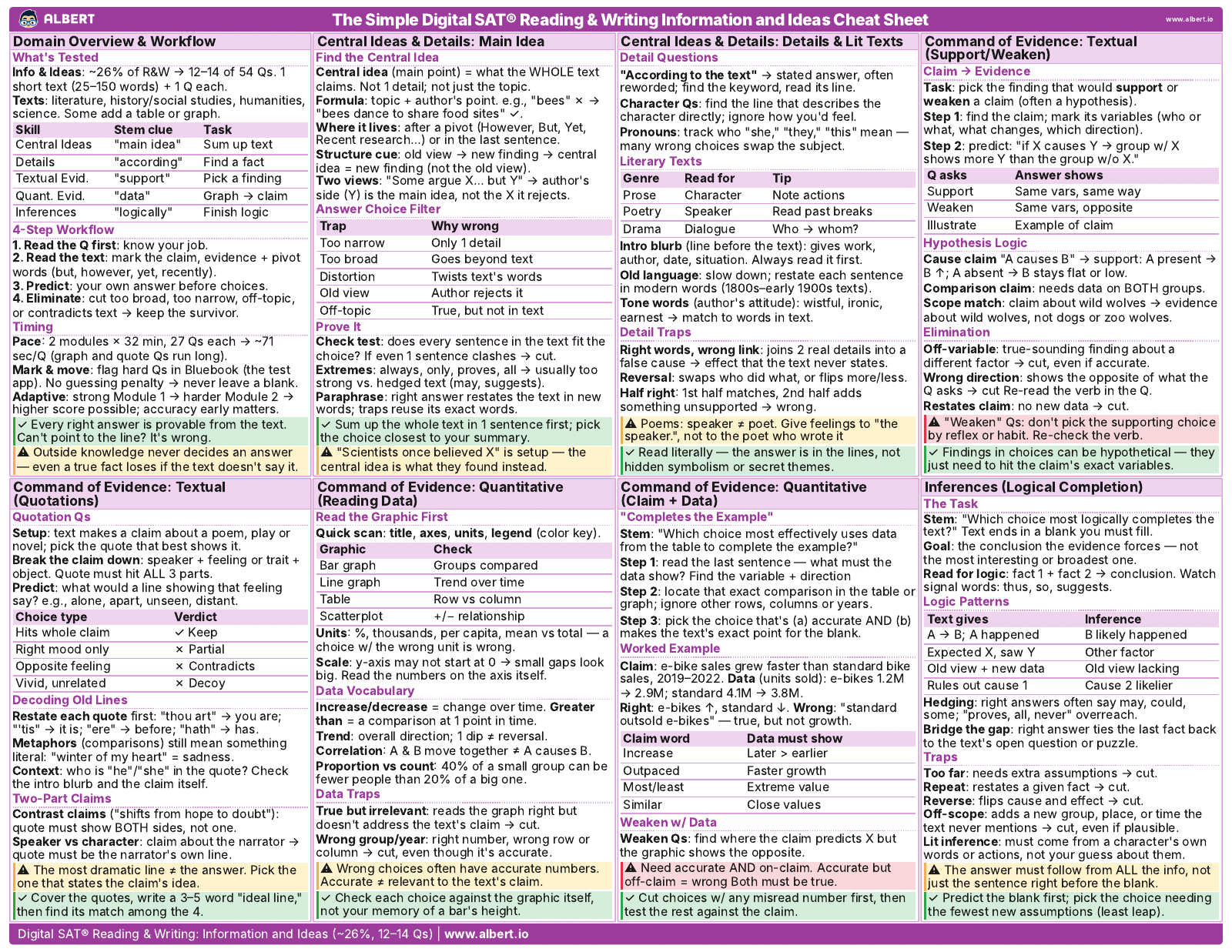
The SAT Information and Ideas cheat sheet covers the reading skills behind about 26% of the Digital SAT® Reading and Writing section: central ideas, details, textual and quantitative evidence, and inferences. That works out to 12 to 14 questions per test. Download it below in two versions: Simple for a first pass through the skills, and Ultimate for the full set of traps and strategies.
Practice Digital SAT® Reading & Writing questions on Albert
What’s on the SAT Information and Ideas Cheat Sheet?
Both versions of the SAT Information and Ideas cheat sheet use the same eight cards: a domain overview and workflow, two cards on central ideas and details, two on textual evidence, two on quantitative evidence, and one on inferences. Each card pairs the rule with the wrong-answer patterns that test writers lean on, because spotting the trap is usually faster than proving the right answer.
Simple is for students starting their review or coming back after a break. It keeps the core method for each question type, one or two traps per skill, and short notes that explain terms like hypothesis or legend the first time they appear.
Ultimate is for students already scoring in the mid-500s or higher who want every edge. It adds more trap types, decision tables for support versus weaken questions, extra data vocabulary, and the logic patterns that sit under the hardest inference questions. If you are aiming for a second module at the harder level, Ultimate is the one to print.
SAT Information and Ideas at a Glance
Information and Ideas is one of four content domains in the Reading and Writing section, and College Board lists it at about 26% of the section, or 12 to 14 of the 54 questions. Every question gives you one short text (25 to 150 words) and asks one question about it. Some texts come with a table, bar graph or line graph.
| Skill | Typical question | What you do |
|---|---|---|
| Central Ideas and Details | Which choice best states the main idea of the text? | Sum up the whole text or find a stated detail |
| Command of Evidence (Textual) | Which finding, if true, would most directly support the claim? | Match a finding or a quotation to a claim |
| Command of Evidence (Quantitative) | Which choice most effectively uses data from the graph to complete the example? | Pick the accurate data point that proves the text’s point |
| Inferences | Which choice most logically completes the text? | Finish the text’s reasoning |
Questions in each module are grouped by domain and run from easier to harder, so the Information and Ideas set arrives as a block. You can read the official domain descriptions on College Board’s Reading and Writing section page.
Key Concepts in Information and Ideas
Central Ideas and Details
A central idea question asks what the whole text is saying, not what it is about. “Coral reefs” is a topic. “Some corals survive heat waves by switching to heat-tolerant algae” is a central idea. The right answer covers every sentence in the text without adding a claim the text never makes.
Short science and history texts often follow the same shape: an old view, a pivot word such as however or recently, then a new finding. The new finding is almost always the central idea.
Worked example. A text says that historians long assumed medieval farmers rarely traveled, then reports that tax records show many farmers sold goods at markets more than 30 miles away, and ends by noting that these trips were common enough to be taxed separately. Choice A, “Medieval farmers rarely left their villages,” repeats the old view the text rejects. Choice B, “Tax records are the best source on medieval life,” goes beyond the text. Choice C, “Records suggest medieval farmers traveled more than historians once assumed,” covers the whole text and is correct.
Detail questions (“According to the text…”) point to something stated outright, usually in new words. Find the keyword, reread that sentence and the one around it, and check names, numbers and directions exactly.
Exam tip: say the main idea to yourself in one sentence before you look at the choices. The answer that matches your sentence is usually right, and the three traps (too narrow, too broad, twisted) become easy to spot.
Command of Evidence: Textual
These questions give you a claim, usually a researcher’s hypothesis, and ask which finding would support it, weaken it or illustrate it. Some versions instead give a claim about a poem or novel and ask which quotation shows it.
Start by naming the claim’s variables. If a researcher thinks that noise from ships makes whales call louder, the variables are ship noise and call volume, and the predicted direction is “more noise, louder calls.” Evidence that supports the claim has to involve both variables and move in that direction.
Worked example. The hypothesis is that bumblebees learn flower colors faster when the flowers also have a scent. A finding that bees visit scented flowers more often does not help, because it says nothing about learning speed. A finding that bees trained on scented, colored flowers picked the right color in fewer trials than bees trained on unscented, colored flowers matches both variables and the direction, so it most directly supports the claim. Flip that result and you have the answer to the “weaken” version.
For quotation questions, break the claim into parts (speaker, feeling, object) and make sure the line covers every part. A line with the right mood but the wrong object is a partial match, and partial matches are wrong.
Exam tip: reread the question’s verb before you click. Students who read “weaken” carefully still pick the supporting finding surprisingly often, because they spent the whole question thinking about the hypothesis.
Command of Evidence: Quantitative
Here a text makes a claim and a table or graph supplies the data. The question asks which choice uses the data to complete the text or support its point. Three of the four choices often describe the graphic accurately. Only one describes the comparison the text needs.
Read the graphic first: title, axis labels, units, legend and the groups or years shown. Then read the final sentence of the text and name exactly what the data must show, such as an increase, a difference between two groups, or the highest value.
Worked example. A text says a city’s new bike lanes were followed by a sharper rise in cycling than in a neighboring city without them. The table shows cyclists per day before and after: City A went from 1,200 to 2,100, City B from 1,100 to 1,250. The correct choice compares the change in both cities. “City A had 2,100 cyclists per day after the lanes opened” is accurate, but it says nothing about City B, so it can’t show a sharper rise.
Exam tip: treat every choice as two tests. Is it accurate to the graphic? Does it make the text’s point? A choice must pass both.
Inferences
Inference questions end with a blank and ask which choice most logically completes the text. The right answer is the conclusion the text’s facts force, not the most interesting idea and not the most general one.
Most inference texts follow a small set of patterns. A scientist expected one result and got another, so some other factor must be involved. Two possible causes are named and one is ruled out, so the other becomes more likely. A trait shows up only in one group, so it cannot come from something both groups share.
Worked example. A text explains that a species of lizard was thought to change color to control body temperature. Researchers then found that lizards in a heated lab kept constant at 30°C still changed color when another lizard was placed in view. The blank follows “This finding suggests that…” A strong answer is “color change in this species may also serve a social purpose.” An answer saying “temperature has no effect on color change” overreaches, because the study never tested different temperatures.
Exam tip: right answers to inference questions often hedge with words like may or at least some. Choices with proves, all or never usually need an assumption the text does not give you.
How Information and Ideas Shows Up on the Exam
Every Reading and Writing question is a four-choice multiple-choice question, and Information and Ideas is no exception. You’ll see about six or seven of these questions in each of the two 32-minute modules. The texts are drawn from literature, history and social studies, the humanities and science, and literary texts can be prose, poetry or drama, sometimes from the 1800s or early 1900s.
Because the test is adaptive by module, your accuracy in Module 1 decides whether Module 2 is the harder or easier version. Information and Ideas questions with graphs or long quotations tend to take longer than vocabulary or grammar questions, so it pays to move quickly through the domains you find easier and save time here.
There is no partial credit and no penalty for a wrong answer. What earns the point is the choice you can prove from the text or the graphic. Test writers build wrong answers from true outside facts, accurate numbers that answer a different question, and phrases copied straight from the text but rearranged into a false claim. Knowing those patterns is the fastest way to raise your score in this domain.
Common Mistakes in Information and Ideas
- Picking the old view as the main idea. The first sentence often states what people used to believe. Fix: look for the pivot word and take the idea that follows it.
- Using outside knowledge. A choice can be true in the real world and still be wrong. Fix: point to the line in the text that proves your answer before you choose it.
- Choosing accurate but irrelevant data. On graph questions, most choices read the graph correctly. Fix: check whether the choice makes the exact comparison the text’s claim needs.
- Supporting when the question says weaken. Fix: reread the question’s verb after predicting your answer.
- Overreaching on inferences. Fix: pick the conclusion that needs the fewest new assumptions, even if it sounds modest.
Frequently Asked Questions
Can I use this cheat sheet on the exam?
No. The Digital SAT does not allow notes or reference sheets in the Reading and Writing section. Use the sheet while you study and practice, so the methods are automatic by test day.
Should I start with the Simple or Ultimate version?
Start with Simple if you are new to the Digital SAT or tend to miss more than a few Information and Ideas questions on practice tests. Move to the Ultimate SAT Information and Ideas cheat sheet once the core method feels natural and you want the extra trap types and logic patterns.
How many Information and Ideas questions are on the SAT?
College Board lists 12 to 14 of the 54 Reading and Writing questions, about 26% of the section, spread across both modules.
Is SAT Information and Ideas review different from general reading practice?
Yes. Each question has one short text and one task, and the wrong answers follow predictable patterns. Targeted SAT Information and Ideas practice with test-style questions trains you to spot those patterns, which general reading does not.