
Maximize your score with these resources:
- Albert.io AP® Psychology question banks
- Free AP® Psychology study guides
- Free AP® Psychology score calculator
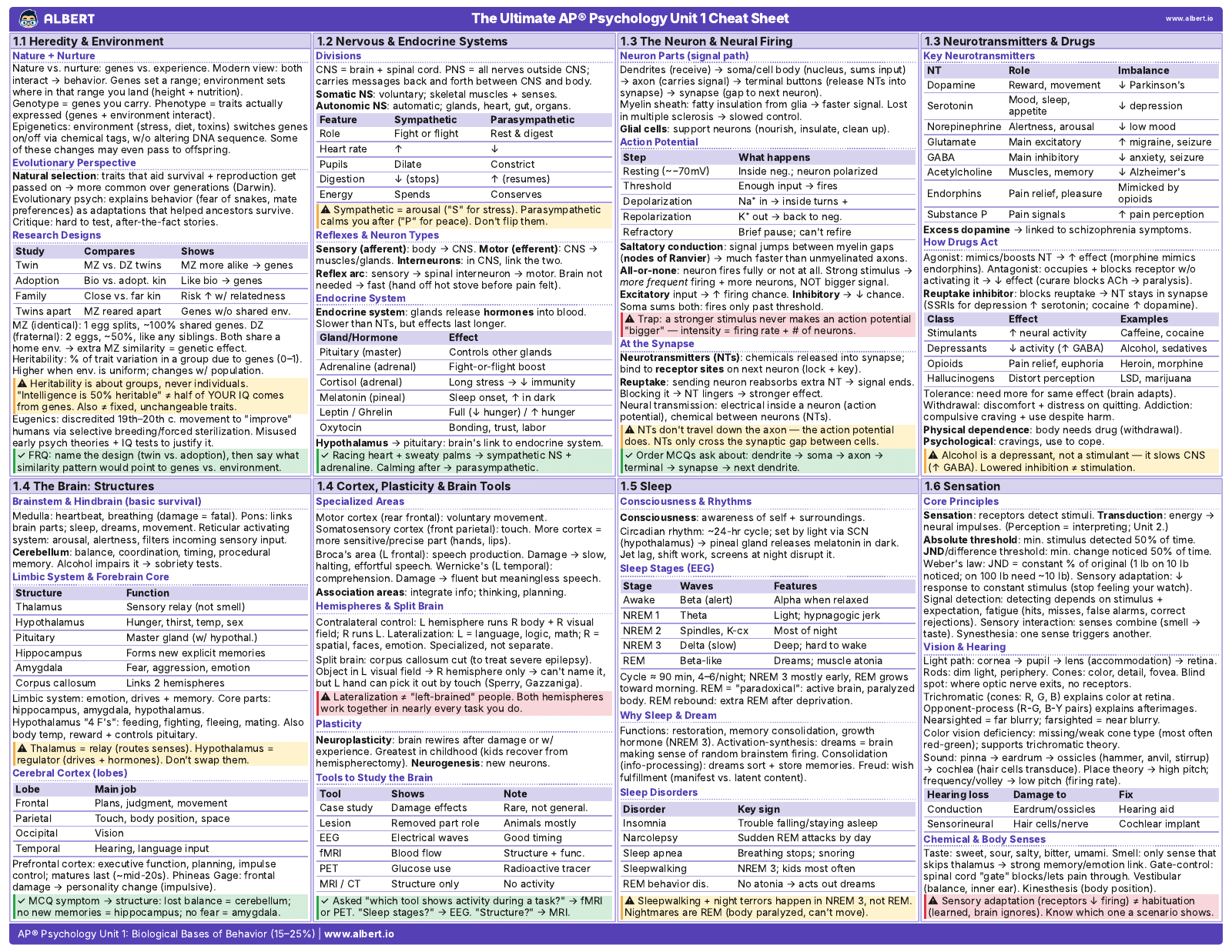
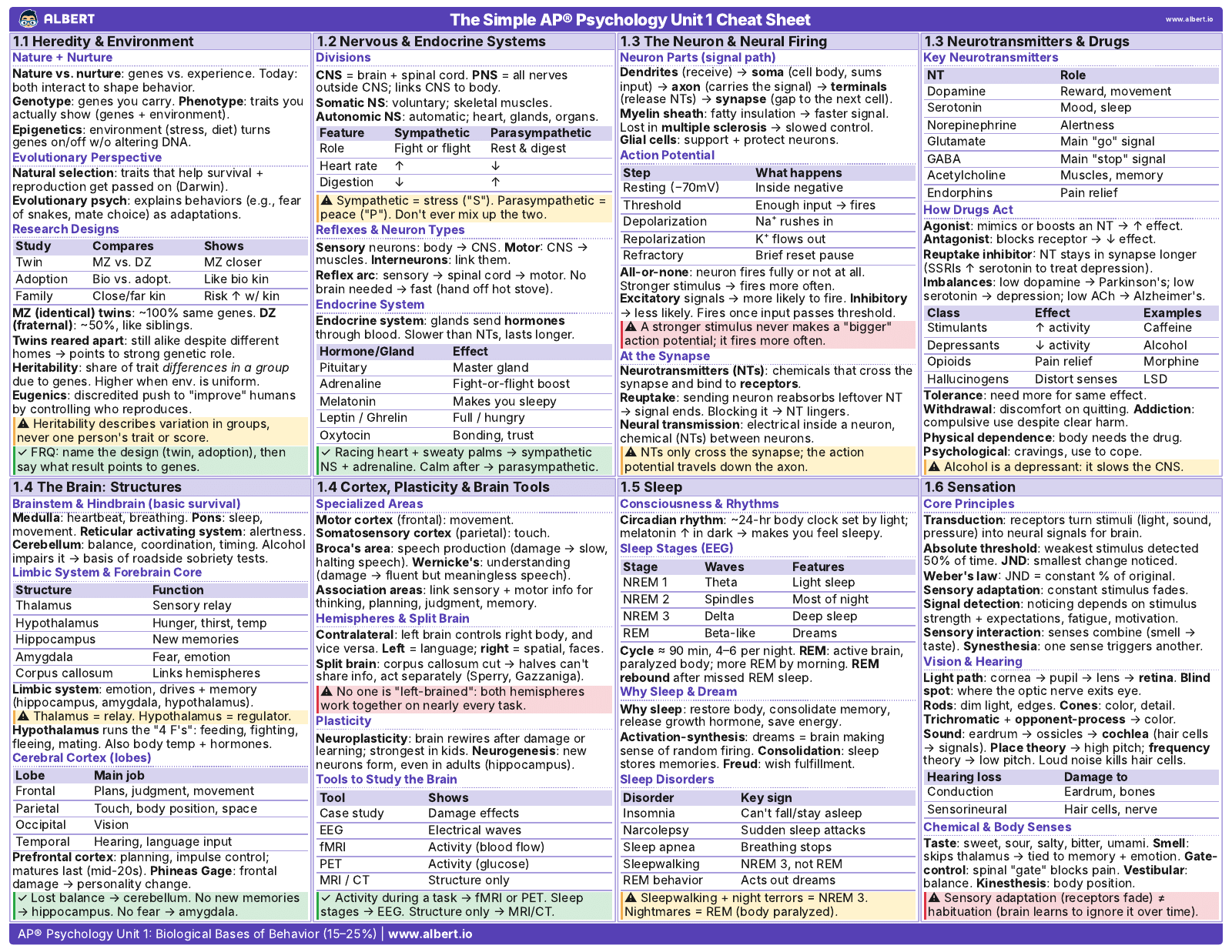
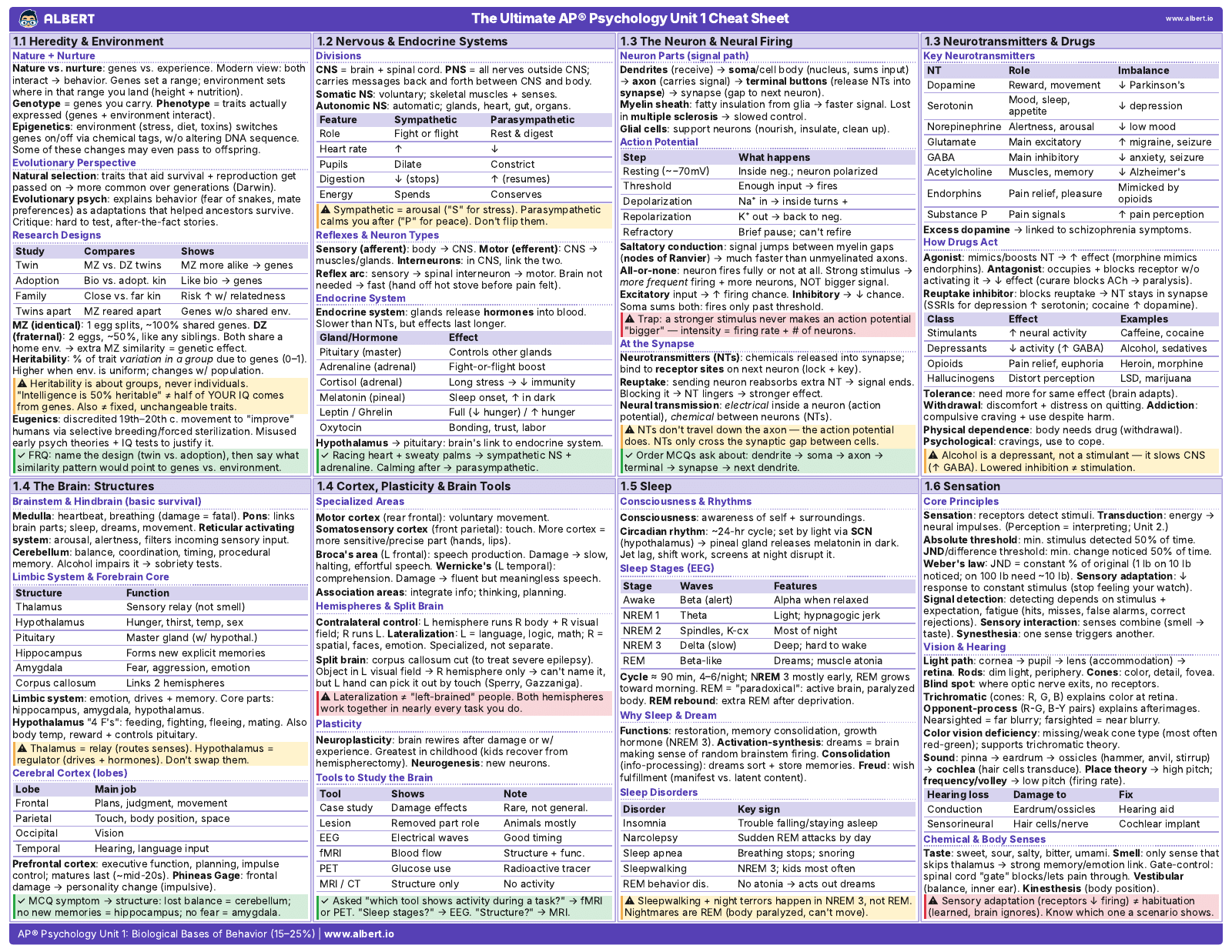
This AP Psych Unit 1 cheat sheet packs Biological Bases of Behavior onto one printable page, from twin studies and neural firing to brain structures, sleep stages, and the senses. Unit 1 makes up 15–25% of the AP® Psychology multiple-choice section. Pick the Simple version for a first pass or the Ultimate version when you want every detail in one place.
Practice AP® Psychology Unit 1 questions on Albert
What’s on the AP Psych Unit 1 Cheat Sheet?
Both versions follow the same eight cards, built around the six topics in the College Board’s AP® Psychology Course and Exam Description: heredity and environment, the nervous and endocrine systems, the neuron, neurotransmitters and drugs, brain structures, the cortex and brain research tools, sleep, and sensation.
The Simple version is for students meeting this material for the first time or rebuilding a shaky foundation. It keeps the definitions you can’t skip, one table per topic, and the single most common trap on each card, with a few words of context on every new term.
The Ultimate version is for the final weeks before the exam. It adds the details that separate a 4 from a 5: the stages of the action potential, which imbalance goes with which neurotransmitter, how each drug class acts at the synapse, the full sleep-disorder table, and both theories of pitch and color vision.
AP® Psychology Unit 1 at a Glance
Unit 1 is the most vocabulary-heavy unit in the course, but nearly every term connects to one question: how does biology produce behavior and experience? Here is what each topic asks you to do.
| Topic | Name | Focus |
|---|---|---|
| 1.1 | Interaction of Heredity and Environment | Twin, adoption, and family studies; heritability; evolutionary perspective |
| 1.2 | Overview of the Nervous System | CNS vs. PNS, sympathetic vs. parasympathetic, reflexes, endocrine glands |
| 1.3 | The Neuron and Neural Firing | Action potential, neurotransmitters, agonists, antagonists, psychoactive drugs |
| 1.4 | The Brain | Structures and functions, lateralization, split brain, plasticity, imaging tools |
| 1.5 | Sleep | Circadian rhythm, sleep stages, dream theories, sleep disorders |
| 1.6 | Sensation | Thresholds, Weber’s law, vision, hearing, chemical and body senses |
Unit 1 counts for 15–25% of the multiple-choice section, so expect roughly 11 to 19 of the 75 questions to come from it. It also shows up constantly in the free-response section, because studies about sleep, drugs, and brain activity make natural sources for the Article Analysis and Evidence-Based questions.
Key Concepts in Unit 1: Biological Bases of Behavior
Heredity, Environment, and How We Study Them
The course no longer treats nature and nurture as a contest. Genes set a range of possible outcomes, and environment decides where in that range a person lands. Epigenetics is the clearest example: stress, diet, or toxins can switch genes on or off without changing the DNA sequence itself.
To separate the two influences, psychologists compare people with known genetic overlap. Identical (monozygotic) twins share about 100% of their genes; fraternal (dizygotic) twins share about 50%, like any siblings. Both kinds of twins grow up in the same home, so if identical twins are more alike on a trait than fraternal twins, the extra similarity points to genes. Adoption studies flip the logic: if adopted children resemble their biological parents more than the parents who raised them, genes matter for that trait.
Worked example: A study finds that identical twins match on a diagnosis 48% of the time and fraternal twins 17% of the time. The gap between 48% and 17% suggests a genetic contribution. The fact that identical twins match less than 100% of the time shows that environment matters too.
Exam tip: Heritability describes variation within a group, never one person. A statement like “this trait is 60% heritable, so 60% of your score comes from your genes” is always wrong.
The Nervous and Endocrine Systems
The central nervous system is the brain and spinal cord. Everything else belongs to the peripheral nervous system, which splits into the somatic system (voluntary movement and the senses) and the autonomic system (heart, glands, digestion). The autonomic system has two branches that work against each other. The sympathetic branch speeds you up for fight or flight. The parasympathetic branch brings you back to rest and digest.
Reflexes show that not every response needs the brain. In a reflex arc, a sensory neuron carries the signal to an interneuron in the spinal cord, which passes it straight to a motor neuron. That is why you pull your hand off a hot pan before you feel the pain.
The endocrine system sends messages through the blood instead of along nerves. Hormones are slower than neurotransmitters but last longer. The hypothalamus directs the pituitary gland, which in turn directs the other glands. Know adrenaline (arousal), melatonin (sleep), leptin and ghrelin (fullness and hunger), oxytocin (bonding), and cortisol (long-term stress).
Worked example: A student’s heart races and her mouth goes dry as she walks into the exam room. Then, once she starts answering questions she knows, her breathing slows. The first reaction is the sympathetic nervous system plus adrenaline. The calm afterward is the parasympathetic nervous system.
Exam tip: “S” for stress and “P” for peace keeps the two autonomic branches straight.
Neurons, Neural Firing, and Drugs
A signal travels from the dendrites to the cell body, down the axon, and out of the terminal buttons into the synapse. Inside the neuron, the message is electrical. At rest, the inside of the cell sits at about −70 millivolts. When incoming signals push it past threshold, sodium ions rush in (depolarization), potassium ions flow out (repolarization), and a brief refractory period follows. Myelin insulates the axon, so the signal jumps between gaps and travels much faster. Multiple sclerosis destroys myelin, which is why it slows movement.
Firing is all-or-none. A stronger stimulus never creates a bigger action potential. It makes neurons fire more often and recruits more of them.
Between neurons, the message is chemical. Neurotransmitters cross the synapse and bind to receptor sites. Drugs work by changing this step. An agonist mimics or boosts a neurotransmitter, an antagonist blocks its receptor, and a reuptake inhibitor keeps it in the synapse longer.
Worked example: SSRIs treat depression by blocking the reuptake of serotonin, so more serotonin stays available in the synapse. Morphine is an agonist because it mimics endorphins, the body’s natural painkillers.
Exam tip: Alcohol is a depressant. It lowers inhibitions by slowing the brain, which is not the same as stimulating it.
The Brain: Structures, Specialization, and Tools
Survival functions live low in the brain: the medulla controls heartbeat and breathing, the reticular activating system controls alertness, and the cerebellum handles balance and coordination. Above them, the thalamus relays incoming sensory information (except smell), the hypothalamus regulates hunger, thirst, temperature, and sex drive, the hippocampus forms new explicit memories, and the amygdala handles fear.
The cortex divides into four lobes: frontal (planning, judgment, movement), parietal (touch and body position), occipital (vision), and temporal (hearing). Broca’s area produces speech; Wernicke’s area understands it. Each hemisphere controls the opposite side of the body, and in most people the left hemisphere leads on language.
Split-brain research shows this clearly. When the corpus callosum is cut to stop severe seizures, an image shown only to the left visual field reaches only the right hemisphere. The patient can’t name the object, but the left hand can pick it out.
Worked example: A researcher wants to see which brain areas become active while participants solve puzzles. An fMRI fits, because it tracks blood flow during a task. An EEG would show the timing of electrical activity well but couldn’t pinpoint the location. An MRI or CT scan would show structure only.
Exam tip: Neuroplasticity, the brain’s ability to rewire, is strongest in childhood. Questions about recovery after brain injury usually hinge on the patient’s age.
Sleep and Sensation
A sleep cycle lasts about 90 minutes and repeats four to six times a night. NREM 1 is light sleep, NREM 2 brings sleep spindles, NREM 3 is deep slow-wave sleep, and REM is when vivid dreams happen. During REM, your brain is highly active while your muscles are paralyzed. Deep sleep dominates early in the night, while REM periods grow longer toward morning.
Sensation starts with transduction, where receptors convert physical energy into neural signals. The absolute threshold is the weakest stimulus you detect half the time. The just-noticeable difference follows Weber’s law: it is a constant proportion of the original stimulus, not a fixed amount.
Worked example: If you can just notice adding 1 pound to a 10-pound backpack, Weber’s law predicts you’d need about 10 extra pounds to notice a change in a 100-pound load.
Exam tip: For color vision, trichromatic theory explains the three types of cones in the retina, and opponent-process theory explains afterimages. For pitch, place theory covers high sounds and frequency theory covers low ones. Know which theory fits which evidence.
How Unit 1 Shows Up on the Exam
The 75 multiple-choice questions mostly test application rather than recall. A typical question describes a person (a patient who can’t form new memories after surgery, a teenager who sleeps until noon, a driver who stops noticing the smell of his car) and asks you to name the structure, process, or concept involved. Others give you a short study summary and ask about its method, variables, or conclusion.
On the free-response section, the Article Analysis Question gives you a summary of a real study and asks you to identify the research method, variables, statistics, ethics, and whether the findings generalize. Sleep deprivation, caffeine, and twin studies are common sources. The Evidence-Based Question asks you to build an argument from three sources. Scorers reward a clear claim, specific evidence cited from the sources, and an explanation that uses the correct psychological concept. A vague mention of “the brain” earns nothing. Naming the hippocampus and explaining its role does.
Common Mistakes in Unit 1
- Mixing up the thalamus and hypothalamus. The thalamus routes sensory information; the hypothalamus regulates drives and hormones.
- Saying a stronger stimulus makes a bigger action potential. Firing is all-or-none. Intensity comes from how often neurons fire and how many fire.
- Placing sleepwalking in REM. Sleepwalking and night terrors happen in NREM 3. Nightmares happen in REM, when the body is paralyzed.
- Confusing sensory adaptation with habituation. Adaptation happens at the receptors; habituation is learned and happens in the brain.
- Applying heritability to individuals. It only describes how much of the variation in a group is linked to genes.
Frequently Asked Questions
Can I use this cheat sheet on the AP® Psychology exam?
No. The exam doesn’t allow notes or reference sheets of any kind. This sheet is a study tool for review sessions, flashcard-style self-quizzing, and the night before the test.
Should I start with the Simple or the Ultimate version?
Start with the Simple AP Psych Unit 1 cheat sheet if the unit still feels new or you’re reviewing it months after learning it. Move to Ultimate once you can explain everything on Simple without looking, because its extra details are where the harder multiple-choice questions live.
How much of the exam is Unit 1?
The College Board weights Unit 1 at 15–25% of the multiple-choice section, the same range as each of the other four units.
What is the hardest part of AP Psych Unit 1?
Most students struggle with the volume of brain structures and neurotransmitters. Learn them as pairs (structure and function, chemical and effect), use the AP Psych Unit 1 cheat sheet tables to quiz yourself, then practice with scenario questions instead of definitions alone.
Is perception part of Unit 1?
No. Unit 1 covers sensation, how receptors detect and transmit stimuli. How the brain organizes and interprets those signals, perception, belongs to Unit 2: Cognition.