
Maximize your score with these resources:
- Albert.io ACT® Enhanced English question banks
- Free ACT® Enhanced English study guides
- Free ACT® Enhanced English score calculator
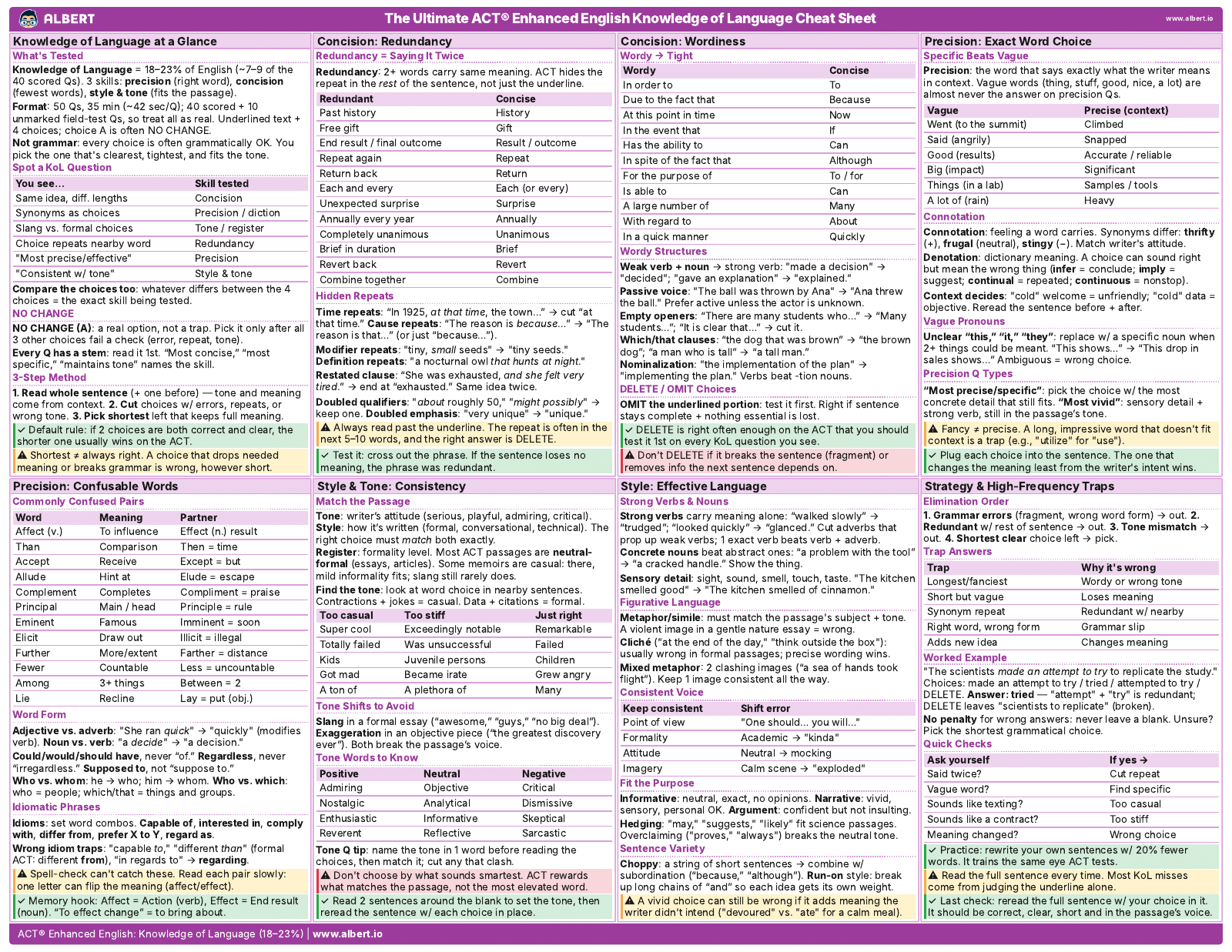
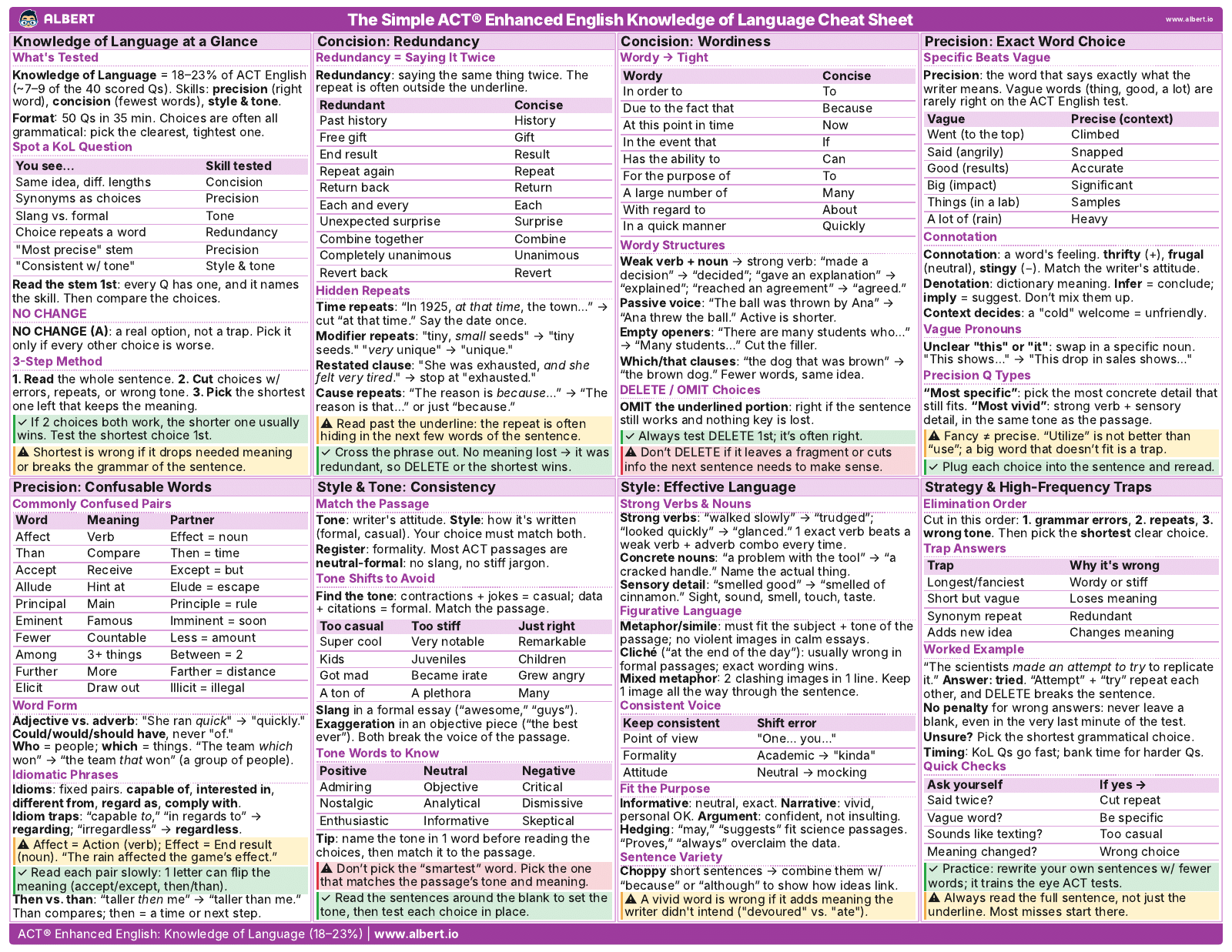
This ACT English Knowledge of Language cheat sheet covers the questions that ask you to choose the clearest, tightest, best-fitting wording. That means cutting redundancy, choosing precise words, and keeping a passage’s tone consistent. Knowledge of Language makes up 18–23% of the ACT® English test. Both versions fit on one page: Simple for a first pass, Ultimate for full detail.
Practice ACT® Enhanced English questions on Albert
What’s on the ACT English Knowledge of Language Cheat Sheet?
Both versions use the same eight cards: an overview of the category, two cards on concision (redundancy and wordiness), two on precision (exact word choice and commonly confused words), two on style and tone, and a final card on strategy and trap answers.
The Simple version gives you the core patterns: the most common redundant and wordy phrases, the confusable word pairs that show up most, a three-step method, and one key warning per card. Start here if you’re new to the enhanced ACT or keep losing points on questions where every answer looks grammatical.
The Ultimate version adds longer phrase tables, hidden-repeat patterns, connotation and idiom traps, tone vocabulary, figurative-language rules, and a worked example with the reasoning behind each wrong answer. Use it in the last few weeks before test day.
ACT English Knowledge of Language at a Glance
According to ACT’s description of the English test, Knowledge of Language questions ask you to use language effectively by making word choice precise and concise and by keeping style and tone consistent. On the enhanced test, that works out to roughly 7 to 9 of the 40 scored questions.
| Skill | What the question asks | How you’ll recognize it |
|---|---|---|
| Concision | Say it in the fewest words without losing meaning | Choices say the same thing at different lengths; one may be DELETE |
| Redundancy | Remove words that repeat an idea | A choice repeats a word or idea elsewhere in the sentence |
| Precision | Pick the word that says exactly what the writer means | Choices are near-synonyms; the stem may say “most precise” or “most specific” |
| Style and tone | Keep the passage’s formality and attitude consistent | Choices range from slang to stiff; the stem may mention tone |
The English test gives you 35 minutes for 50 questions, about 42 seconds each. Ten of the questions are unscored field-test items, and you won’t know which ones. Wrong answers cost nothing, so never leave a question blank.
Key Concepts in Knowledge of Language
Redundancy: Don’t Say It Twice
Redundancy is the easiest Knowledge of Language error to fix once you learn to see it. The catch is that ACT rarely puts both copies of an idea inside the underlined portion. One copy is underlined; the other sits a few words away.
Worked example: “In 1925, at that time, the town had only one paved road.” The choices are NO CHANGE, “during that era,” “back then,” and DELETE the underlined portion. “In 1925” already tells you when. Every choice except DELETE repeats that information, so DELETE is correct.
Watch for pairs that are redundant on their own, too: “past history,” “free gift,” “return back,” “end result,” “combine together.” In each case, the second word already includes the first.
Exam tip: Cross the underlined phrase out and reread the sentence. If nothing is lost, the phrase was redundant.
Wordiness: Fewer Words, Same Meaning
Wordy phrasing isn’t wrong grammatically; it’s just slow. ACT consistently prefers “to” over “in order to,” “because” over “due to the fact that,” and “now” over “at this point in time.” Learn the swaps on the cheat sheet and you’ll spot them in seconds.
Some wordiness comes from sentence structure rather than set phrases. A weak verb plus a noun (“made a decision”) becomes a strong verb (“decided”). Passive voice (“the experiment was conducted by the students”) becomes active (“the students conducted the experiment”). Openers like “There are many people who” or “It is clear that” usually add nothing.
Worked example: “The committee came to the conclusion that the plan should move forward.” The best answer is “concluded that.” It keeps the full meaning in two words instead of five.
Exam tip: Concision has a limit. A shorter choice is wrong if it leaves a fragment or drops information the sentence needs. Check the meaning before picking the shortest answer.
Precision: The Exact Word
Precision questions offer choices that are close in meaning but not identical. Your job is to pick the one that fits the context best. Vague words like “thing,” “stuff,” “good,” and “a lot” are almost never right when a specific option is available.
Connotation matters as much as definition. “Thrifty,” “frugal,” and “stingy” all describe someone careful with money, but they carry positive, neutral, and negative feelings. If the passage admires the person, “stingy” is wrong even though it’s technically accurate.
Worked example: A passage describes a hiker reaching a mountaintop after a long struggle: “After six hours, she finally went to the summit.” The choices are NO CHANGE, “reached,” “arrived,” and “climbed to.” “Went” is vague. “Arrived” needs “at.” “Reached” fits the sense of effort and completion in one word.
Exam tip: Fancy isn’t the same as precise. “Utilize” is not more precise than “use,” and ACT treats unnecessary jargon as a flaw.
Commonly Confused Words
Several precision questions test words that sound alike or look alike: affect and effect, than and then, accept and except, principal and principle, allude and elude, fewer and less, among and between. The wrong choice is usually a real word, so it won’t look misspelled. You have to know the meaning.
Worked example: “The new schedule had a positive affect on attendance.” “Affect” is usually a verb (to influence); the noun meaning “result” is “effect.” The answer is “effect.”
Exam tip: Remember “Affect = Action, Effect = End result,” and read confusable pairs letter by letter. These questions punish skimming.
Style and Tone: Match the Passage
Every ACT passage has a voice. Most are neutral and moderately formal: essays, articles, profiles. Some personal narratives are more relaxed. A tone question asks you to pick the choice that sounds like the rest of the passage.
That rules out slang (“super cool,” “totally failed,” “no big deal”) in a formal essay. It also rules out the opposite: overly stiff words (“a plethora of,” “juvenile persons”) where plain language fits. The right answer usually sits in the middle: “remarkable,” “children,” “many.”
Worked example: In a science article about bee colonies: “Researchers found that the hives totally crashed during the drought.” The choices include “collapsed,” “went belly-up,” and “experienced a precipitous decline in viability.” “Collapsed” matches the article’s neutral, precise voice.
Exam tip: Before reading the choices, name the passage’s tone in one word (neutral, admiring, nostalgic, critical). Then eliminate anything that doesn’t match it.
How Knowledge of Language Shows Up on the Exam
A word or phrase in the passage is underlined, and you choose among four options, the first usually being NO CHANGE. On the enhanced ACT, every English question has a question stem, and for Knowledge of Language the stem usually names the goal directly: “Which choice is most precise?”, “Which choice best maintains the tone of the passage?”, or “Which choice is the most concise?” Read the stem before the choices.
Then compare the choices to confirm the skill. If they say the same thing at different lengths, the question tests concision. If they’re near-synonyms, it tests precision. If they range from casual to stiff, it tests tone. The Quick Checks table on the ACT English Knowledge of Language cheat sheet turns this into a five-second routine. Many of these questions can be answered in 20 to 30 seconds once you know the patterns, which saves time for the slower organization and rhetorical-purpose questions.
Common Mistakes in Knowledge of Language
- Judging only the underlined part. The repeated idea is often outside it. Read the full sentence every time.
- Picking the longest or most sophisticated answer. ACT rewards clarity. If a shorter option says the same thing, choose it.
- Picking the shortest answer automatically. Check that the shortest choice keeps the meaning and grammar. If it doesn’t, move to the next shortest.
- Ignoring connotation. A word with the right definition but the wrong feeling is wrong. Match the writer’s attitude.
- Never choosing DELETE. Many students avoid it. Test it first, since it’s often the cleanest fix for redundancy.
Frequently Asked Questions
Can I use this cheat sheet on the ACT?
No. You can’t bring notes or reference materials into the ACT. Use this sheet to study beforehand and to review your mistakes on practice tests.
Should I start with the Simple or the Ultimate version?
Start with the Simple ACT English Knowledge of Language cheat sheet if you’re still learning the patterns. Switch to Ultimate once the core phrase swaps and confusable pairs feel automatic.
How many Knowledge of Language questions are on the enhanced ACT?
Knowledge of Language is 18–23% of the English score, or roughly 7 to 9 of the 40 scored questions.
Is “shortest answer” a reliable rule?
It’s a strong default, not a law. When two choices are both grammatical and mean the same thing, the shorter one is usually correct. If the shortest choice drops meaning or creates a fragment, it’s wrong.
How is Knowledge of Language different from Conventions of Standard English?
Conventions questions test rules with right and wrong answers: punctuation, agreement, verb forms. Knowledge of Language questions test judgment: several choices may be grammatical, and you pick the one that’s most precise, concise, and consistent in tone.