
Maximize your score with these resources:
- Albert.io AP® Physics 2 question banks
- Free AP® Physics 2 study guides
- Free AP® Physics 2 score calculator
This AP® Physics 2 Unit 10 cheat sheet covers Electric Force, Field, and Potential, the unit that starts the electricity half of AP® Physics 2: Algebra-Based. It’s worth 15–18% of the multiple-choice section. Download it in Simple for a first pass, or Ultimate when you need worked numbers and the traps that cost points.
Practice AP® Physics 2 Unit 10 questions on Albert
What’s on the AP® Physics 2 Unit 10 Cheat Sheet?
Both versions cover all seven Unit 10 topics on the same eight cards: Coulomb’s law, electric vs. gravitational force, charging, electric fields, conductors and insulators, potential energy and potential, equipotentials, and capacitors. Because the exam gives you an equation sheet, the cheat sheet doesn’t just repeat formulas. It shows you how to use them: which quantities are vectors, how each one scales with distance, and which way charges move and why.
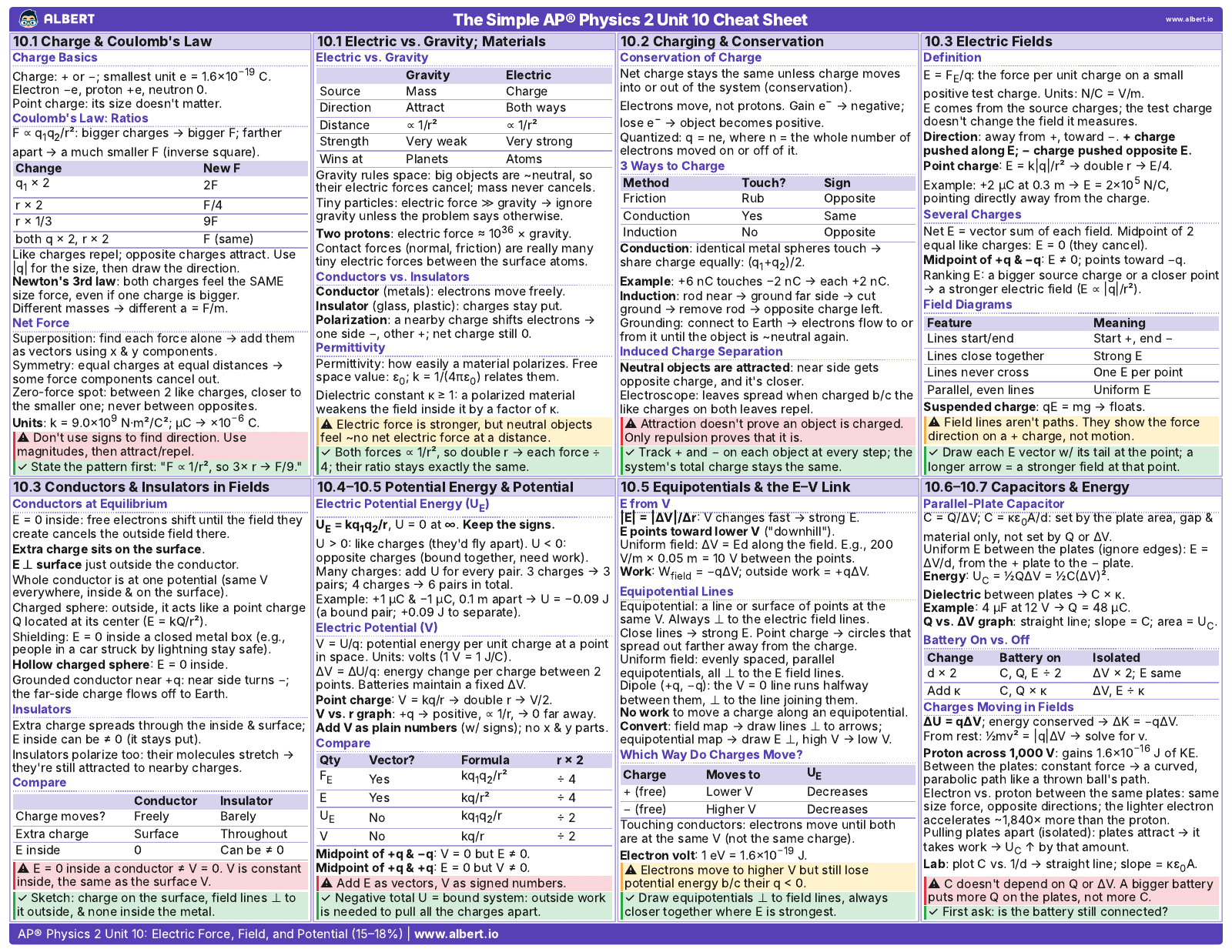
The Simple version is for learning the unit. It keeps one key rule per idea, the ratio tables, the conductor rules, the F-E-U-V comparison and the battery-connected vs. isolated capacitor table, with a few words of explanation the first time a term appears.
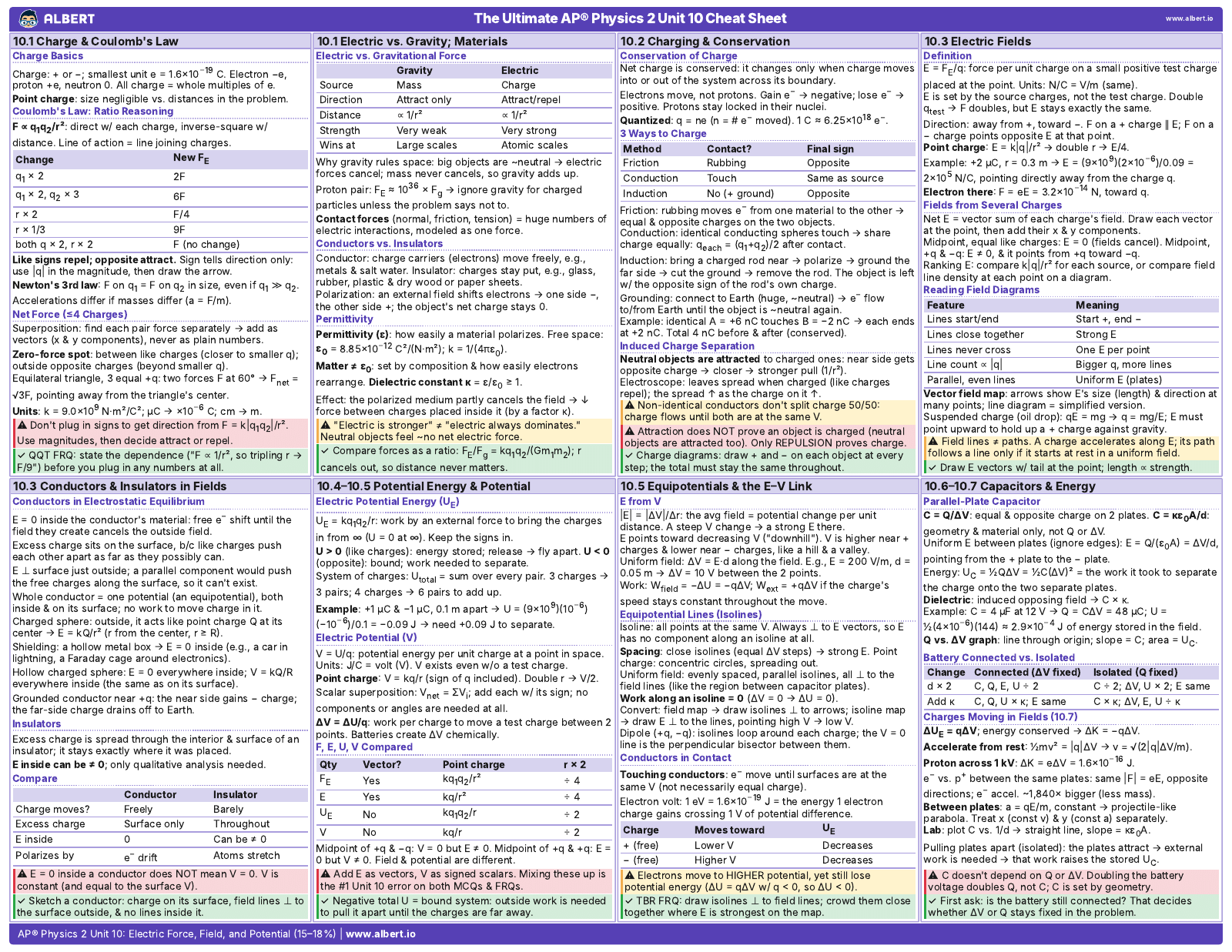
The Ultimate version is for test prep. It adds worked numbers for every topic, net force on a triangle of charges, field-diagram rules, isolines for a dipole, the work done by the field vs. by an outside force, motion of electrons and protons between plates, and the C vs. 1/d graph that shows up in lab questions.
AP® Physics 2 Unit 10 at a Glance
Unit 10 makes up 15–18% of the multiple-choice section. It opens the electricity half of the course, and everything in Unit 11 (circuits) and Unit 12 (magnetism) depends on it.
| Topic | Name | Focus |
|---|---|---|
| 10.1 | Electric Charge and Electric Force | Coulomb’s law, electric vs. gravitational force, permittivity |
| 10.2 | Conservation of Electric Charge and the Process of Charging | Friction, conduction, induction, grounding, polarization |
| 10.3 | Electric Fields | E = F/q, field maps and lines, fields of conductors and insulators |
| 10.4 | Electric Potential Energy | U for pairs of point charges and systems of up to four charges |
| 10.5 | Electric Potential | Scalar superposition, ΔV, equipotential lines, the E–V link |
| 10.6 | Capacitors | Parallel-plate capacitance, uniform field, stored energy, dielectrics |
| 10.7 | Conservation of Electric Energy | ΔU = qΔV and the resulting change in kinetic energy |
Key Concepts in Unit 10: Electric Force, Field, and Potential
Charge and Coulomb’s Law (10.1–10.2)
Charge comes in two signs and is quantized in units of e = 1.6 × 10⁻¹⁹ C. When an object is charged, electrons move; protons stay where they are. Net charge is conserved, so any change in a system’s charge means charge crossed its boundary. Friction transfers electrons between two materials, conduction shares charge by contact, and induction leaves an object with the opposite sign of the nearby charge once it’s grounded and the ground is cut.
Coulomb’s law says the force between two point charges is proportional to the product of the charges and inversely proportional to the square of the distance between them. Worked example: +3 μC and −4 μC sit 0.20 m apart. F = (9.0 × 10⁹)(3 × 10⁻⁶)(4 × 10⁻⁶)/(0.20)2 = 2.7 N, attractive. Double the distance and the force drops to 2.7/4 ≈ 0.68 N. Both charges feel 2.7 N, even though their charges are different.
Electric and gravitational forces share the 1/r² form, but electric forces can attract or repel and are vastly stronger. Gravity still dominates at large scales because large objects are nearly neutral.
Exam tip: use magnitudes in Coulomb’s law and then decide attraction or repulsion. Plugging in signs to get a direction leads to sign errors, especially when you’re adding forces as vectors.
Electric Fields and Conductors (10.3)
The electric field is force per unit charge, E = F/q, measured with a small test charge. The source sets the field; the test charge doesn’t. Fields point away from positive charges and toward negative ones, and a positive charge is pushed along the field while a negative charge is pushed the opposite way.
Worked example: a +2 μC point charge creates a field 0.30 m away of E = (9.0 × 10⁹)(2 × 10⁻⁶)/(0.30)2 = 2.0 × 10⁵ N/C, pointing away from the charge. An electron placed there feels F = eE = 3.2 × 10⁻¹⁴ N toward the charge.
Conductors in electrostatic equilibrium follow fixed rules: the field inside the metal is zero, excess charge sits on the surface, the field just outside is perpendicular to the surface, and the whole conductor is at one potential. Outside a charged sphere, the field is the same as for a point charge at the center. Insulators hold charge where it’s placed, and the field inside them can be nonzero.
Exam tip: on field diagrams, line density shows field strength and lines never cross. Field lines are not the paths charges follow.
Potential Energy and Electric Potential (10.4–10.5)
Electric potential energy for two point charges is U = kq1q2/r, with U = 0 at infinite separation. Keep the signs: positive U means like charges that would fly apart if released; negative U means opposite charges bound together. For a system of charges, add the energy of every pair: three charges have three pairs, four have six.
Electric potential is potential energy per unit charge, V = U/q, and for a point charge V = kq/r. Unlike the field, potential is a scalar, so you add contributions with their signs and no components. Worked example: +2 μC at x = 0 and −2 μC at x = 0.20 m. At the midpoint, the potentials are equal and opposite, so V = 0. The fields from both charges point toward the negative charge, each 1.8 × 10⁶ N/C, so E = 3.6 × 10⁶ N/C. Zero potential doesn’t mean zero field.
The field and potential are linked: |E| = |ΔV|/Δr, and the field points toward lower potential. Equipotential lines are always perpendicular to field lines, and moving a charge along one takes no work.
Exam tip: when you double r, F and E fall to one-fourth, but U and V fall to one-half. Ranking questions often hinge on that difference.
Capacitors and Conservation of Energy (10.6–10.7)
A parallel-plate capacitor holds equal and opposite charge on two plates. Its capacitance, C = κε0A/d, depends only on its geometry and the material between the plates, not on Q or ΔV. Between the plates the field is uniform, E = ΔV/d, and the stored energy is U = ½QΔV = ½C(ΔV)2.
Worked example: plates of area 0.020 m² sit 1.0 mm apart in air. C = (8.85 × 10⁻¹²)(0.020)/(0.0010) ≈ 1.8 × 10⁻¹⁰ F. Connected to 9.0 V, the plates hold Q ≈ 1.6 × 10⁻⁹ C, the field is 9,000 V/m, and the stored energy is about 7.2 × 10⁻⁹ J. An electron that crosses the gap from rest gains ΔK = eΔV ≈ 1.4 × 10⁻¹⁸ J, which works out to a speed of about 1.8 × 10⁶ m/s.
The key question in any capacitor change is whether the battery is still connected. Connected means ΔV stays fixed; isolated means Q stays fixed. Double the plate separation on an isolated capacitor and C halves, ΔV doubles, the field stays the same and the stored energy doubles, because you did work pulling the attracting plates apart.
Exam tip: a charged particle between plates feels a constant force, so treat its motion like projectile motion: constant velocity along the plates, constant acceleration across them.
How Unit 10 Shows Up on the Exam
The AP® Physics 2 exam has 42 multiple-choice questions in 85 minutes (50%) and four free-response questions in 95 minutes (50%). Calculators are allowed throughout, and you get an equation sheet. Unit 10 multiple-choice questions lean on reasoning more than arithmetic: ranking field strength or potential at marked points, predicting how force changes when charge or distance changes, reading field and equipotential maps, and tracing charge through a charging sequence.
On the free-response section, Unit 10 fits each question type. Mathematical Routines may ask for the net force or field from up to four charges, or the speed of a particle accelerated through a potential difference. Translation Between Representations often asks you to draw field vectors or equipotentials, sketch V or U against distance, and link that sketch to an equation. Experimental Design and Analysis can ask you to measure how capacitance depends on plate separation and linearize the data by graphing C against 1/d. Qualitative/Quantitative Translation asks you to explain in words why a quantity changes and then confirm it with the matching equation. Scorers reward correct directions, signs that are tracked consistently, and reasoning that names the relationship (for example, “F is proportional to 1/r²”).
Common Mistakes in Unit 10
- Mistake: adding potentials as vectors or fields as plain numbers. Fix: E and F are vectors, so add components; V and U are scalars, so add with signs.
- Mistake: assuming zero potential means zero field, or the reverse. Fix: at the midpoint of +q and −q, V = 0 but E ≠ 0; at the midpoint of two equal like charges, E = 0 but V ≠ 0.
- Mistake: saying the field inside a conductor is zero, so the potential is zero. Fix: the potential inside is constant and equal to the surface value.
- Mistake: thinking capacitance changes with the battery. Fix: C depends only on area, separation and dielectric; a bigger battery adds charge, not capacitance.
- Mistake: using attraction to prove an object is charged. Fix: neutral objects are attracted to charged ones by polarization; only repulsion proves charge.
Frequently Asked Questions
Can I use this cheat sheet on the exam?
No. You can’t bring your own notes into the AP exam room; the only reference allowed is the official equation sheet College Board provides. The AP® Physics 2 Unit 10 cheat sheet is a study tool for learning how to apply those equations before test day.
Should I start with the Simple or the Ultimate version?
Start with Simple while you’re learning the unit. Switch to Ultimate once you can explain each Simple card without looking, and use its worked numbers to check your problem setups.
What formulas are on the equation sheet for this unit?
The equation sheet includes Coulomb’s law, the definitions of field, potential and capacitance, the point-charge expressions for E, U and V, the parallel-plate equations and the capacitor energy formula, along with the constants k, ε0 and e. What it doesn’t tell you is when each applies, how quantities scale, or which direction things point. That’s what the cheat sheet covers.
How many charges do I need to handle in a calculation?
The course framework limits calculations of force, field, potential energy and potential to four or fewer charges, with more allowed only in highly symmetric arrangements. Practice with three- and four-charge setups, and use symmetry to cancel components before you calculate.
For the full list of topics and learning objectives, see College Board’s AP® Physics 2 course page.