
Maximize your score with these resources:
- Albert.io AP® Psychology question banks
- Free AP® Psychology study guides
- Free AP® Psychology score calculator
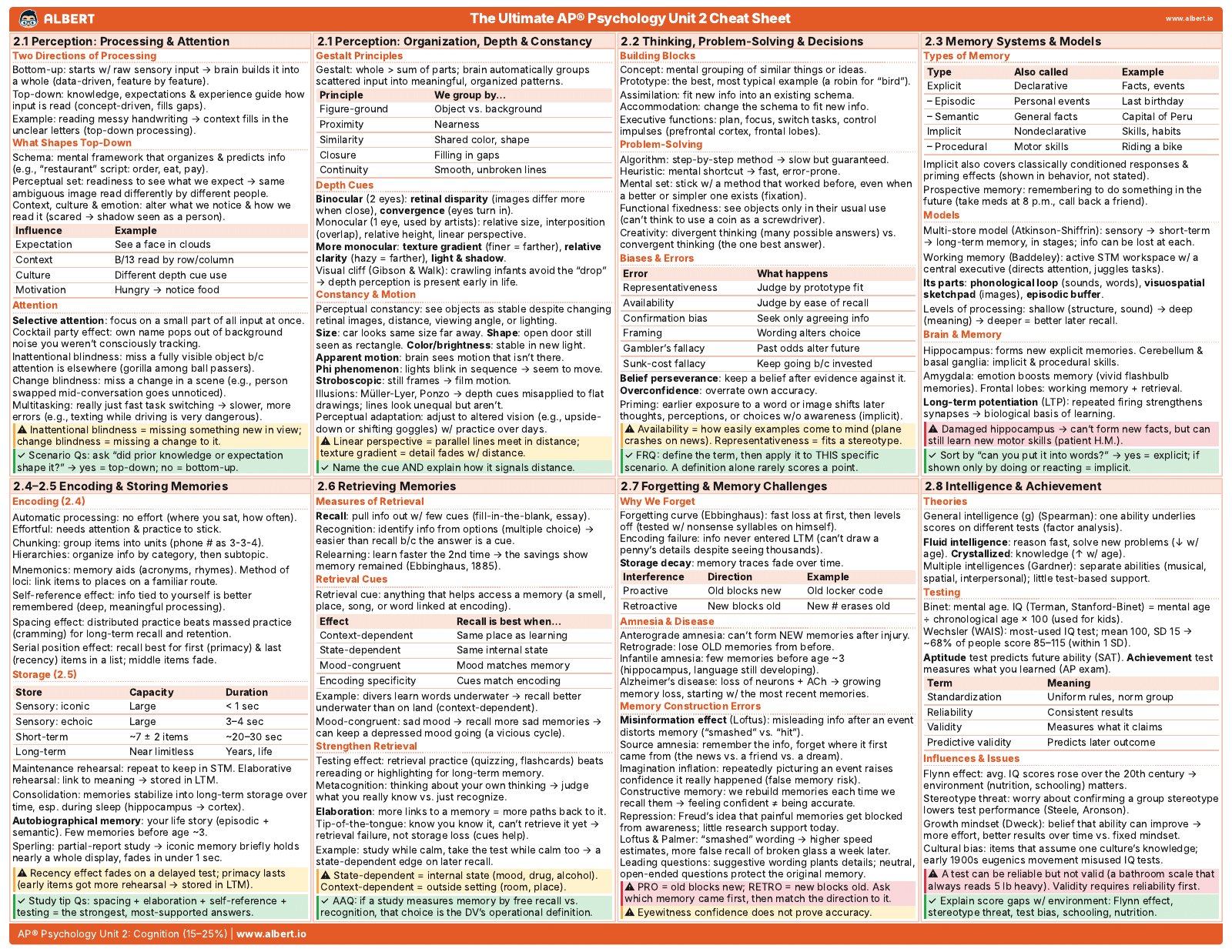
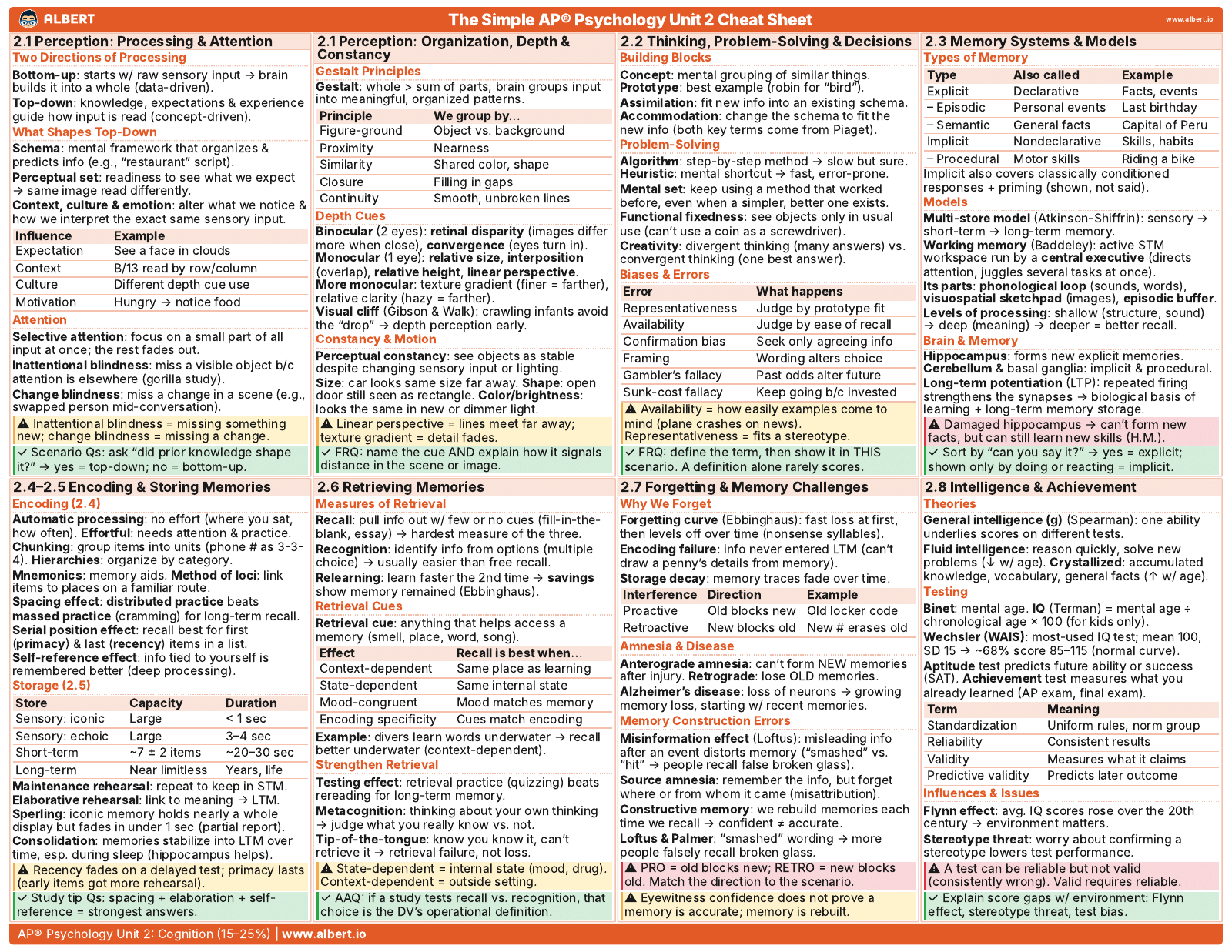
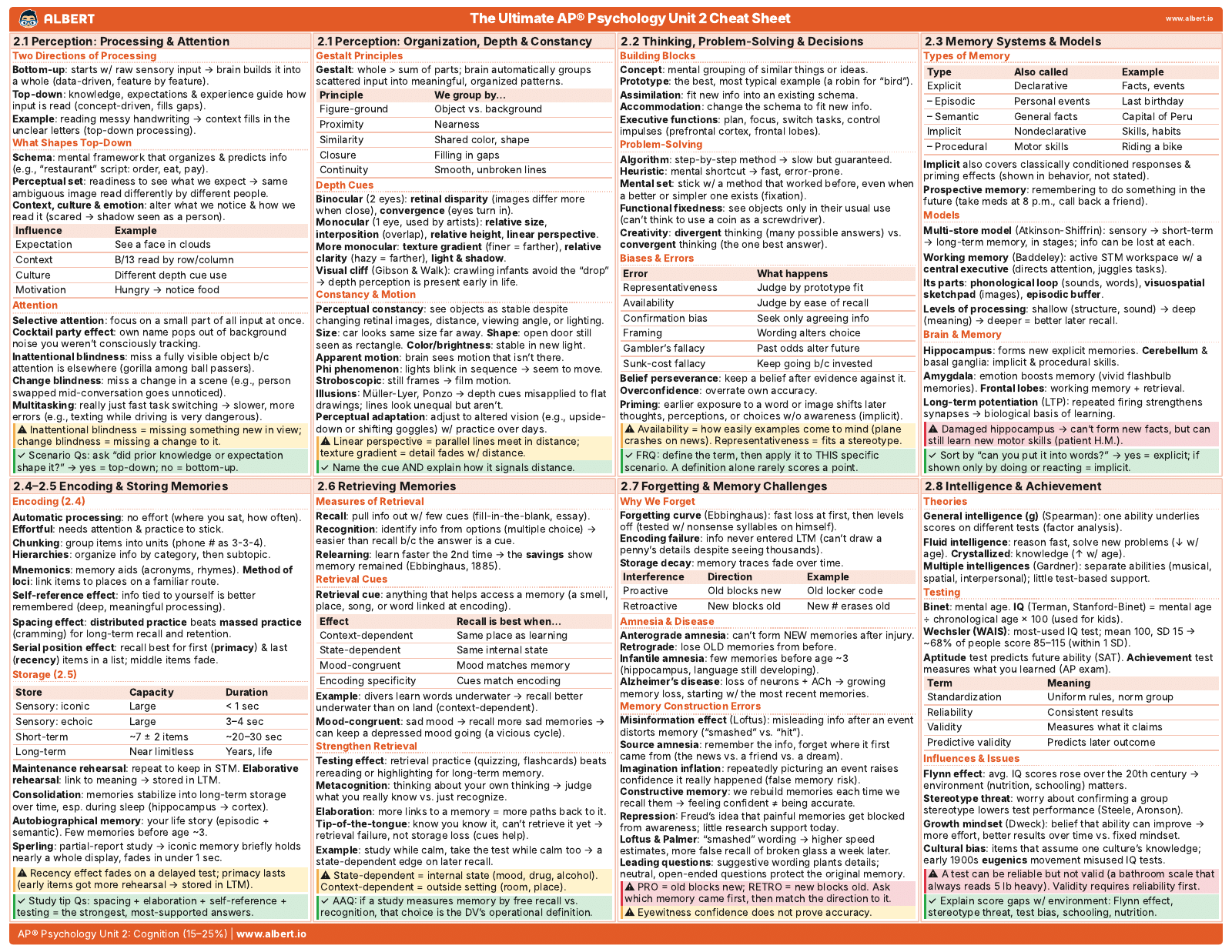
This AP Psych Unit 2 cheat sheet fits Cognition (perception, thinking, memory, and intelligence) on one printable page. The unit carries 15–25% of the multiple-choice score, the same weight as each of the other four units. Use the Simple version to lock in the core terms or the Ultimate version for every study, bias, and test trap.
Practice AP® Psychology Unit 2 questions on Albert
What’s on the AP Psych Unit 2 Cheat Sheet?
Both versions follow the same eight cards, aligned to the AP® Psychology Course and Exam Description: two cards on perception, one on thinking and decision-making, one on memory systems and models, one on encoding and storage, one on retrieval, one on forgetting and memory errors, and one on intelligence and achievement.
The Simple version is for students learning the vocabulary for the first time. It keeps the key definitions, one clear example for each, and the comparison that trips students up most often, like proactive versus retroactive interference.
The Ultimate version is for students aiming at a 4 or 5. It adds the named studies (Sperling, Loftus and Palmer, the visual cliff), the brain structures behind each memory system, more decision-making biases, and the testing terms you need for research-based questions. If you can apply every line on the Ultimate AP Psych Unit 2 cheat sheet to a new scenario, you are ready for this unit.
AP® Psychology Unit 2 at a Glance
Unit 2 explains how people take in information, make sense of it, store it, and use it to reason and solve problems. It accounts for 15–25% of the multiple-choice section of the AP® Psychology exam.
| Topic | Name | Focus |
|---|---|---|
| 2.1 | Perception | Bottom-up and top-down processing, attention, Gestalt principles, depth cues, constancy |
| 2.2 | Thinking, Problem-Solving, Judgments, and Decision-Making | Concepts, schemas, heuristics, biases, creativity |
| 2.3 | Introduction to Memory | Explicit and implicit memory, memory models, brain structures |
| 2.4 | Encoding Memories | Chunking, mnemonics, spacing, serial position |
| 2.5 | Storing Memories | Sensory, short-term, and long-term memory; rehearsal |
| 2.6 | Retrieving Memories | Recall, recognition, retrieval cues, testing effect |
| 2.7 | Forgetting and Other Memory Challenges | Interference, amnesia, misinformation, constructive memory |
| 2.8 | Intelligence and Achievement | Theories of intelligence, test construction, influences on scores |
Key Concepts in Unit 2: Cognition
Perception (Topic 2.1)
Perception is how the brain organizes and interprets sensory input. Bottom-up processing starts with raw sensory details and builds them into a whole. Top-down processing uses knowledge, expectations, and context to interpret what comes in. Schemas and perceptual sets shape top-down processing, which is why two people can look at the same image and see different things.
Attention is limited. Selective attention lets you focus on one conversation in a noisy room, but it also explains inattentional blindness, failing to see a visible object because your attention is elsewhere, and change blindness, failing to notice a change in a scene.
The brain also organizes input using Gestalt principles (figure-ground, proximity, similarity, closure, continuity) and judges distance with binocular cues (retinal disparity, convergence) and monocular cues (relative size, interposition, relative height, linear perspective, texture gradient).
Worked example: a student sees the same symbol as “B” when reading across a row of letters and as “13” when reading down a column of numbers. The symbol did not change; the context did. That is top-down processing.
Exam tip: when a scenario hinges on what someone already knows or expects, it is top-down. When it hinges on the raw features of a stimulus, it is bottom-up.
Thinking and Decision-Making (Topic 2.2)
Concepts group similar things, and a prototype is the best example of a concept. When new information fits an existing schema, we assimilate it; when it does not, we accommodate by changing the schema. To solve problems, we use algorithms (step-by-step procedures that guarantee an answer) or heuristics (fast mental shortcuts that can lead to errors).
Several biases distort judgment. The availability heuristic judges likelihood by how easily examples come to mind. The representativeness heuristic judges by how well something matches a prototype. Confirmation bias leads people to seek only information that supports what they already believe. Framing shows that the way a choice is worded changes decisions, and functional fixedness keeps people from seeing new uses for familiar objects.
Worked example: after seeing news coverage of a plane crash, a traveler decides driving is safer, even though flying is safer per mile. Dramatic crashes come to mind easily, so the traveler overestimates their likelihood. That is the availability heuristic.
Exam tip: a definition alone rarely earns credit on a free-response question. Define the term, then show how it works in the specific scenario.
Memory Systems, Encoding, and Storage (Topics 2.3–2.5)
Explicit memory includes facts (semantic) and personal experiences (episodic) that you can consciously state. Implicit memory includes skills and habits (procedural) and conditioned responses that show up in behavior. The hippocampus helps form new explicit memories, while the cerebellum and basal ganglia support implicit and procedural memory.
The multi-store model describes memory as moving from sensory memory to short-term memory to long-term memory. Baddeley’s working memory model treats short-term memory as an active workspace with a central executive, a phonological loop, a visuospatial sketchpad, and an episodic buffer. The levels of processing model holds that deeper processing, focused on meaning, produces better recall than shallow processing focused on sound or appearance.
Encoding improves with chunking, mnemonics such as the method of loci, the self-reference effect, and the spacing effect: distributed practice beats cramming. Short-term memory holds about 7 ± 2 items for roughly 20 to 30 seconds without rehearsal, while long-term memory has nearly unlimited capacity.
Worked example: a student memorizes a 10-digit phone number by grouping it as 3-3-4. Ten separate digits exceed short-term capacity, but three chunks fit easily. That is chunking.
Exam tip: sort a memory by asking, “Can you put it into words?” If yes, it is explicit. If it shows up only in performance, like riding a bike, it is implicit.
Retrieval, Forgetting, and Memory Errors (Topics 2.6–2.7)
Retrieval can be measured by recall (producing information with few cues), recognition (identifying it from options), or relearning (learning it faster the second time). Retrieval cues help: context-dependent memory is best in the same setting as learning, and state-dependent memory is best in the same internal state. The testing effect shows that practicing retrieval through quizzes beats rereading.
Forgetting has several causes. Ebbinghaus’s forgetting curve shows rapid early loss that then levels off. Proactive interference happens when old information blocks new information; retroactive interference happens when new information blocks old. Anterograde amnesia prevents new memories from forming, while retrograde amnesia erases older ones.
Memory is also reconstructive. In Loftus and Palmer’s study, participants who heard that cars “smashed” into each other were more likely to report seeing broken glass that was never there. That is the misinformation effect.
Worked example: a student who switches from Spanish to French keeps using Spanish words on French quizzes. Old learning is interfering with new learning, so this is proactive interference.
Exam tip: for interference questions, figure out which memory is getting in the way. If the older memory blocks the newer one, it is proactive; if the newer blocks the older, it is retroactive.
Intelligence and Achievement (Topic 2.8)
Spearman’s general intelligence (g) holds that one underlying ability influences performance across different tests. Fluid intelligence, the ability to reason quickly and solve new problems, tends to decline with age, while crystallized intelligence, accumulated knowledge, tends to grow. Gardner proposed multiple intelligences, though test-based support for them is limited.
A good test is standardized (given and scored the same way and compared to a norm group), reliable (gives consistent results), and valid (measures what it claims to measure). Aptitude tests predict future performance, while achievement tests measure what someone has already learned. The Flynn effect, the rise in average IQ scores over the 20th century, and stereotype threat both show that environment affects test scores.
Worked example: a bathroom scale that always reads 5 pounds too heavy is reliable, because it gives the same reading each time, but it is not valid, because it does not measure true weight. A test can be reliable without being valid, but not valid without being reliable.
Exam tip: know the difference between types of reliability (test-retest, split-half) and types of validity (content, predictive). Research questions often ask about them.
How Unit 2 Shows Up on the Exam
The AP® Psychology exam has 75 multiple-choice questions and two free-response questions: an Article Analysis Question, where you evaluate a research study, and an Evidence-Based Question, where you use evidence from several sources to support a claim.
Unit 2 appears often in scenario-based multiple-choice questions that ask you to identify the concept at work, such as a heuristic, a depth cue, or a type of interference. Memory and cognition studies also make natural material for the Article Analysis Question, where you might identify the independent and dependent variables, explain how a variable was operationally defined, or judge whether results generalize. Scorers reward precise vocabulary applied directly to the scenario or study in front of you.
Common Mistakes in Unit 2
- Mistake: mixing up proactive and retroactive interference. Fix: proactive means old blocks new; retroactive means new blocks old.
- Mistake: confusing inattentional blindness with change blindness. Fix: inattentional blindness is missing something new in view; change blindness is missing a change.
- Mistake: swapping the availability and representativeness heuristics. Fix: availability depends on how easily examples come to mind; representativeness depends on how well something fits a prototype.
- Mistake: assuming a reliable test must be valid. Fix: reliability means consistency; validity means accuracy. A test can be consistently wrong.
- Mistake: treating confident memories as accurate. Fix: memory is reconstructive, and confidence does not guarantee accuracy.
Frequently Asked Questions
Can I use this cheat sheet on the exam?
No. Notes are not allowed on the AP® Psychology exam. Use the AP Psych Unit 2 cheat sheet as a study tool to review terms and test yourself.
Should I start with the Simple or the Ultimate version?
Start with Simple if the vocabulary is new. Once you can define and apply every term on it, move to Ultimate for the named studies, brain structures, and testing concepts.
Which Unit 2 topics show up most often?
Memory topics (encoding, retrieval, interference, and the misinformation effect) and decision-making biases appear often in scenario questions. Make sure you can tell similar terms apart.
How should I practice with this sheet?
Cover one card and write a real-life example for each term from memory, then check against the sheet. Follow up with AP® Psychology Unit 2 practice questions built around scenarios and research studies.