
Maximize your score with these resources:
- Albert.io AP® African American Studies question banks
- Free AP® African American Studies study guides
- Free AP® African American Studies score calculator
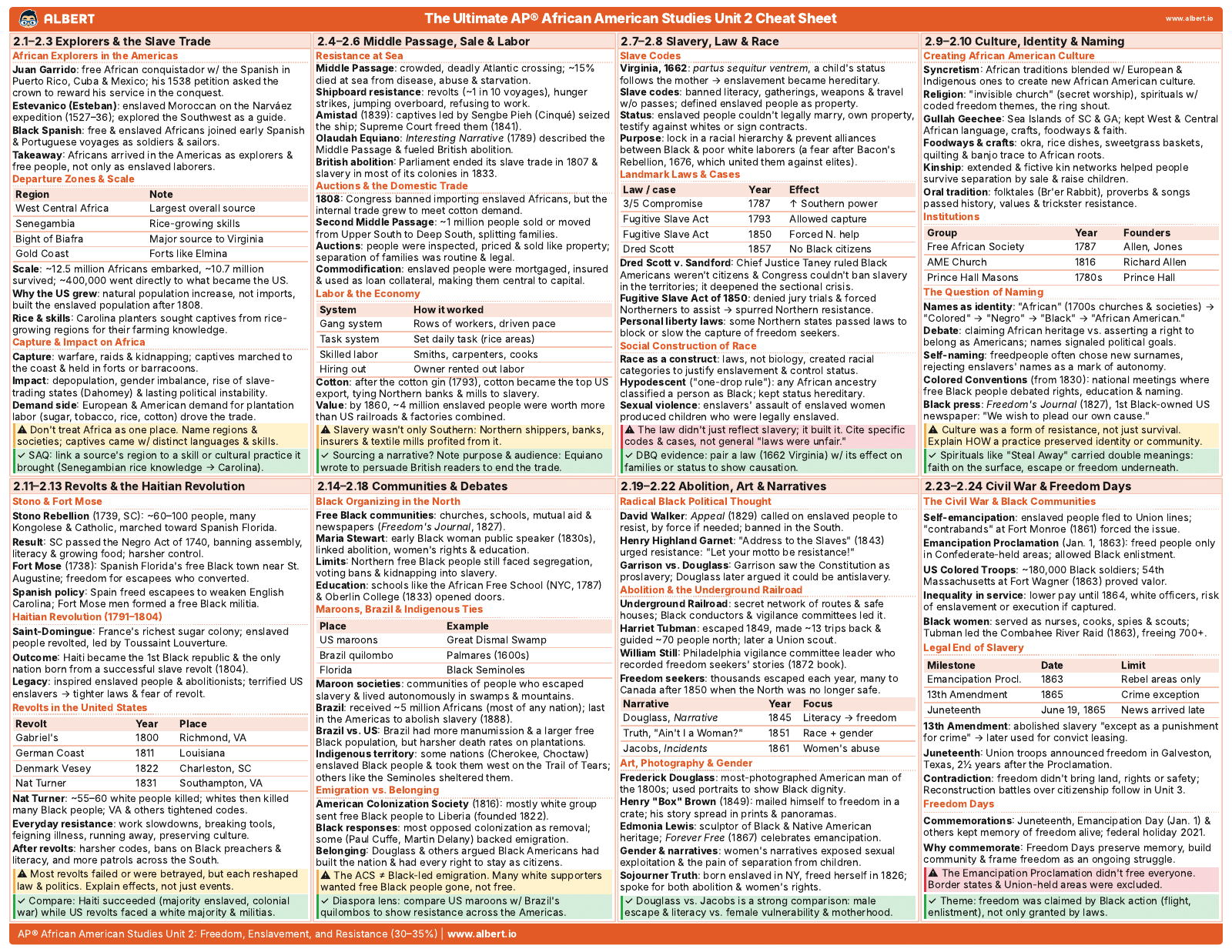
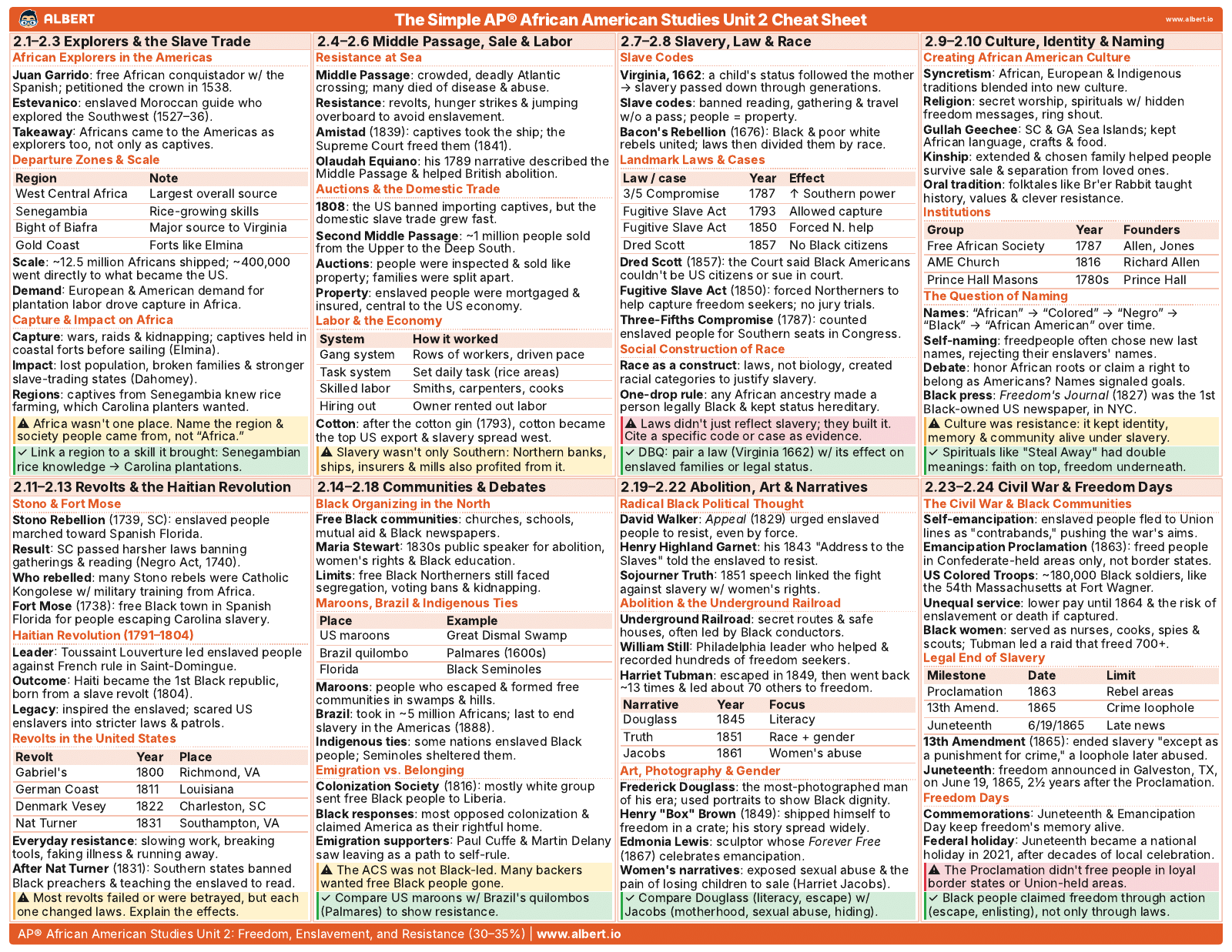
This AP® African American Studies Unit 2 cheat sheet covers Freedom, Enslavement, and Resistance, from the first Africans in the Americas through the Civil War and Juneteenth. Unit 2 is the largest unit in AP® African American Studies, worth 30–35% of the exam. The Simple version gives you the core people, laws, and events; the Ultimate version adds the dates, sources, and comparisons that strengthen SAQs and the DBQ.
Practice AP® African American Studies Unit 2 questions on Albert
What’s on the AP® African American Studies Unit 2 Cheat Sheet?
Both versions follow the 24 topics in the College Board’s AP® African American Studies Course and Exam Description, grouped onto eight cards: explorers and the slave trade, the Middle Passage and labor, slavery and the law, culture and naming, revolts and the Haitian Revolution, communities and emigration debates, abolition and narratives, and the Civil War and Freedom Days.
The Simple version is for a first pass or a quick review. It keeps the key people (Juan Garrido, Toussaint Louverture, Nat Turner, Harriet Tubman, Frederick Douglass), the major laws and cases, and the main forms of resistance, each in a short line.
The Ultimate version is built for source analysis and argument. It adds the scale of the slave trade, the 1662 Virginia law and the one-drop rule, the Negro Act of 1740, Brazil as a diasporic comparison, the American Colonization Society debate, radical thinkers like David Walker and Henry Highland Garnet, and the limits of the Emancipation Proclamation and the Thirteenth Amendment.
AP® African American Studies Unit 2 at a Glance
Unit 2 covers roughly the 16th century to 1865 and carries 30–35% of the exam score, more than any other unit. Its themes of resistance, community, and the meaning of freedom also run through Units 3 and 4.
| Topics | Focus |
|---|---|
| 2.1–2.3 | African explorers, departure zones in Africa, capture, and the impact of the slave trade. |
| 2.4–2.6 | Resistance on slave ships, auctions, the domestic slave trade, and enslaved labor. |
| 2.7–2.8 | Slave codes, landmark cases, and the social construction of race. |
| 2.9–2.10 | African American culture, institutions, identity, and the question of naming. |
| 2.11–2.13 | The Stono Rebellion, Fort Mose, the Haitian Revolution, and US revolts. |
| 2.14–2.18 | Northern Black organizing, maroon societies, Brazil, Indigenous territory, and emigration debates. |
| 2.19–2.22 | Radical Black thought, abolition, the Underground Railroad, art, and slave narratives. |
| 2.23–2.24 | The Civil War, emancipation, and Freedom Days such as Juneteenth. |
Key Concepts in Unit 2: Freedom, Enslavement, and Resistance
Explorers, the Slave Trade, and the Middle Passage
The unit opens with Africans who came to the Americas as explorers and free people, such as Juan Garrido, who served with Spanish expeditions, and Estevanico, who explored the Southwest. The transatlantic slave trade then carried about 12.5 million Africans across the Atlantic. Captives came from distinct regions, including West Central Africa, Senegambia, and the Bight of Biafra, and brought skills, languages, and traditions with them. On the Middle Passage, many resisted through revolts, hunger strikes, and refusal.
Worked example: A source describes Carolina planters seeking captives from Senegambia. Connect the source to the region’s rice-growing knowledge, which shaped the Lowcountry economy. That link between African origins and American development is the kind of analysis SAQs reward.
Exam tip: Avoid treating Africa as a single place. Naming the region and society shows precise knowledge.
Labor, the Domestic Slave Trade, and the Economy
After Congress banned the import of enslaved Africans in 1808, the domestic slave trade moved about a million people from the Upper South to the cotton-growing Deep South, separating countless families. Enslaved people worked under gang and task systems and as skilled artisans. After the cotton gin, cotton became the leading US export, and Northern banks, shippers, insurers, and textile mills profited along with Southern planters.
Worked example: An auction notice lists people for sale with their ages and skills. Use it as evidence that enslaved people were treated as property and capital, and explain how sale broke apart families.
Exam tip: Showing that slavery shaped the national economy, not only the South, adds depth to an argument.
Slavery, Law, and the Construction of Race
Laws created and protected slavery. Virginia’s 1662 law made a child’s status follow the mother, so slavery passed from generation to generation. Slave codes banned literacy, gatherings, and travel without passes. The Fugitive Slave Act of 1850 required Northerners to help capture freedom seekers, and Dred Scott v. Sandford (1857) declared that Black Americans could not be citizens. These laws helped turn race into a legal category used to justify enslavement.
Worked example: A DBQ document quotes the 1662 Virginia law. Explain its purpose (to secure a hereditary labor force) and its effect (enslaved women’s children were born enslaved, even when fathered by enslavers).
Exam tip: Cite specific laws and cases. “The laws were unfair” earns little; “the 1662 Virginia law made slavery hereditary” earns credit.
Culture, Community, and Identity
Enslaved and free Black people built a distinct African American culture through syncretism, blending African, European, and Indigenous traditions. Spirituals, the ring shout, secret worship, folktales, and foodways preserved memory and community. The Gullah Geechee people of the Sea Islands kept many West and Central African practices. Free Black communities founded institutions such as the Free African Society (1787) and the AME Church (1816), and debated what to call themselves, from “African” to “Colored” to “Negro.”
Worked example: A spiritual like “Steal Away” can be read on two levels: as a religious song and as a coded message about escape. Analyzing that double meaning shows culture as a form of resistance.
Exam tip: When a question asks about culture, explain how the practice preserved identity or community, not just what it was.
Revolts, Maroons, and the Haitian Revolution
Resistance ranged from daily acts, such as work slowdowns and running away, to armed revolt. The Stono Rebellion (1739) led South Carolina to pass harsher laws, while Spanish Florida’s Fort Mose offered freedom to escapees. The Haitian Revolution (1791–1804) created the first Black republic and inspired enslaved people across the Americas. In the United States, revolts led by Gabriel (1800), Denmark Vesey (1822), and Nat Turner (1831) were crushed, but each changed Southern law. Maroon communities, from the Great Dismal Swamp to Brazil’s Palmares, built autonomous lives outside slavery.
Worked example: Compare the Haitian Revolution with Nat Turner’s revolt. Haiti succeeded in a colony where enslaved people were the vast majority; Turner’s revolt faced a white majority and armed militias. The comparison explains different outcomes.
Exam tip: Explain a revolt’s effects (new laws, fear, inspiration), not just the event itself.
Abolition, Narratives, and the Road to Freedom
Black abolitionists led the fight against slavery. David Walker’s Appeal (1829) and Henry Highland Garnet’s 1843 address called for resistance. The Underground Railroad, with conductors like Harriet Tubman and organizers like William Still, helped thousands escape. Slave narratives by Frederick Douglass (1845) and Harriet Jacobs (1861) exposed slavery’s cruelty, with Jacobs revealing the particular abuses enslaved women faced. During the Civil War, enslaved people freed themselves by fleeing to Union lines, and about 180,000 Black men served in the US Colored Troops. The Emancipation Proclamation (1863), the Thirteenth Amendment (1865), and Juneteenth marked the legal end of slavery, each with limits.
Worked example: Explain why Juneteenth matters. Union troops announced freedom in Galveston, Texas, on June 19, 1865, more than two years after the Proclamation, showing that freedom depended on enforcement and that Black communities kept its memory alive through commemoration.
Exam tip: Note the limits of emancipation: the Proclamation applied only to Confederate-held areas, and the Thirteenth Amendment allowed slavery as punishment for crime.
How Unit 2 Shows Up on the Exam
The AP® African American Studies exam has 60 source-based multiple-choice questions in 70 minutes (60% of the score), a short written question about your Individual Student Project, and a free-response section with three short-answer questions and one document-based question. The Individual Student Project, scored by your teacher, also counts toward your AP score.
Because Unit 2 carries 30–35% of the exam, expect many multiple-choice sets built around its sources: narratives, laws, speeches, images, and maps. Short-answer questions often ask you to describe a source’s argument or explain a development such as the domestic slave trade or a form of resistance. Unit 2 is also a frequent focus for the document-based question, where you’ll need a defensible claim, evidence from the documents, and outside evidence, such as a specific law, revolt, or abolitionist.
Common Mistakes in Unit 2
- Treating resistance as only armed revolt. Culture, escape, literacy, and everyday acts were resistance too.
- Overstating the Emancipation Proclamation. It didn’t free people in border states or Union-held areas.
- Confusing the American Colonization Society with Black-led emigration. The ACS was mostly white, and most Black Americans opposed it.
- Writing about slavery as only Southern. Northern businesses profited, and Northern states had their own restrictions on free Black people.
- Using general claims instead of specific evidence. Name the law, case, revolt, or person.
Frequently Asked Questions
Can I use this cheat sheet on the AP® African American Studies exam?
No. Notes aren’t allowed on the AP exam. Use the cheat sheet to study, review sources, and prepare before test day.
Should I start with the Simple or the Ultimate version?
Start with Simple if you’re new to Unit 2 or want a quick refresher of the key people and events. Switch to Ultimate when you’re preparing for SAQs and the DBQ, since it adds the specific dates, laws, and comparisons that earn evidence points.
How much of the AP® African American Studies exam is Unit 2?
Unit 2 is weighted at 30–35% of the exam, the largest share of the four units. Its themes also connect to later units on Reconstruction, civil rights, and Black political thought.
What’s the best way to study the sources in Unit 2?
For each major source, practice identifying the author, purpose, audience, and historical context, then connect it to a broader development. Short practice sets of source-based questions help you build that habit before the exam.