
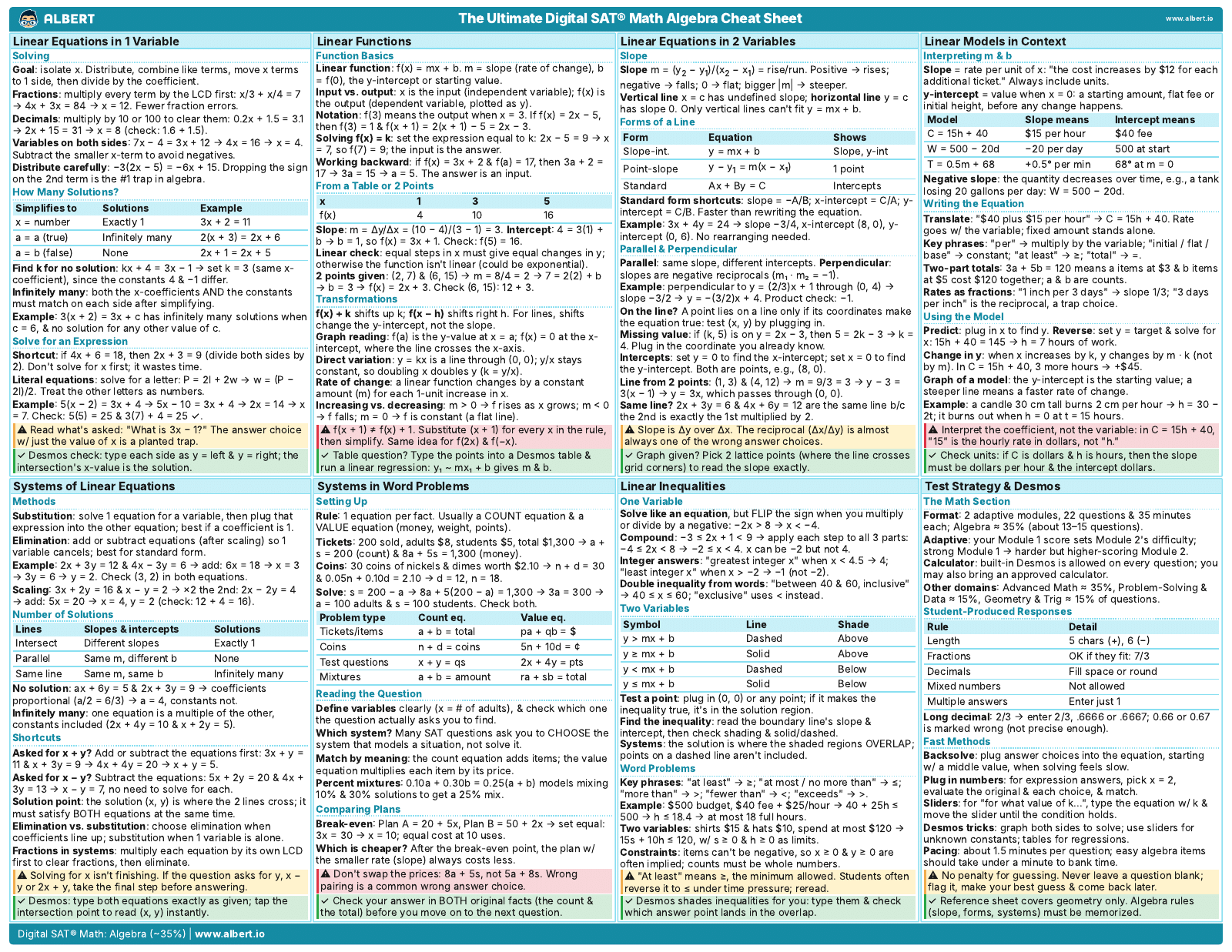
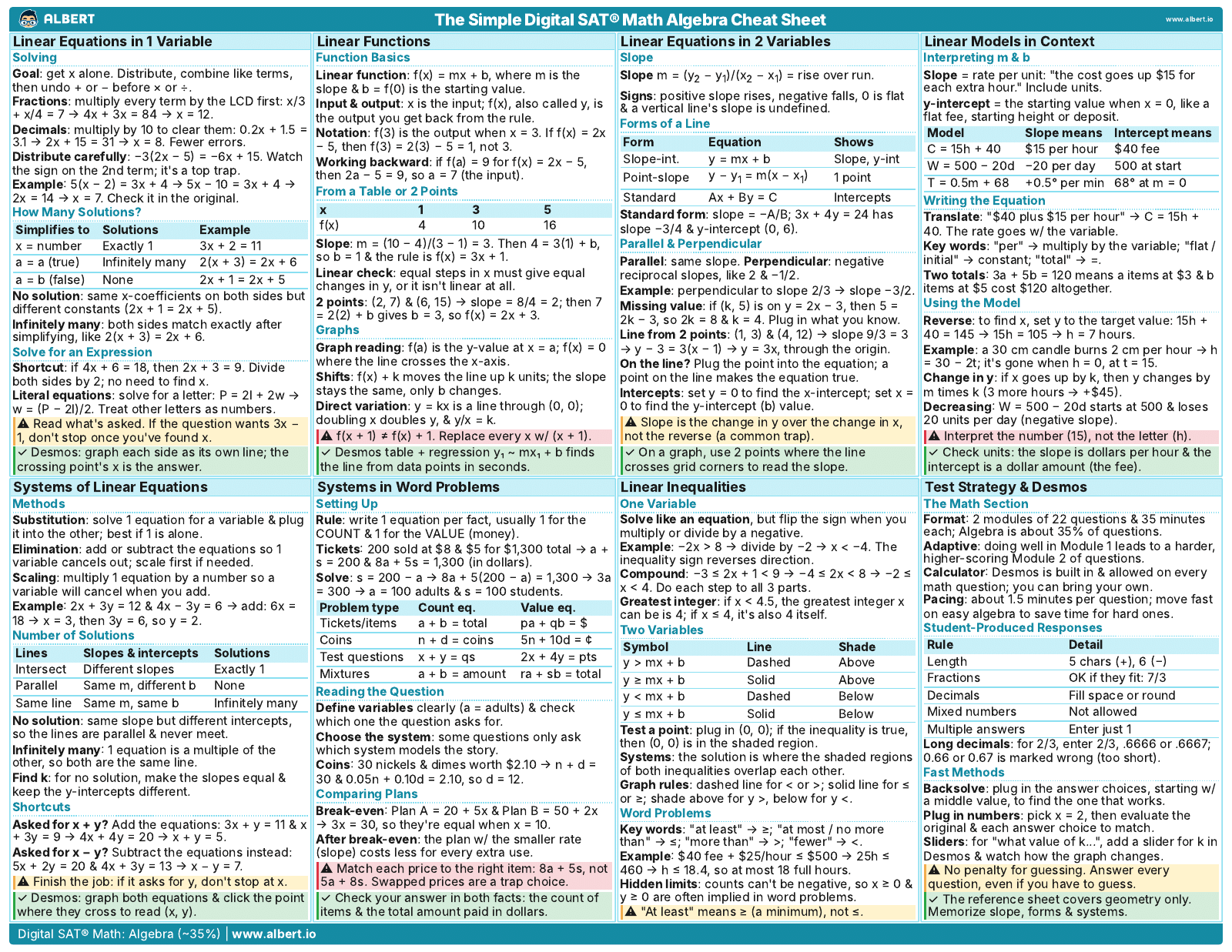
This Digital SAT Math Algebra cheat sheet covers the linear skills the test checks most: one-variable equations, linear functions, lines and slope, linear models in context, systems of equations, and inequalities. Algebra makes up about 35% of the Digital SAT® Math section, roughly 13 to 15 questions. The Simple version reviews the core rules; the Ultimate version adds shortcuts, traps, and Desmos strategies.
Practice Digital SAT® Math questions on Albert
What’s on the Digital SAT Math Algebra Cheat Sheet?
The sheet follows the five Algebra skills in the College Board’s SAT Math specifications: linear equations in one variable, linear functions, linear equations in two variables, systems of two linear equations, and linear inequalities in one or two variables. Eight cards cover those skills plus test strategy.
The Simple version keeps the essentials: how to solve and check linear equations, how to read slope and intercept, the three forms of a line, how to solve a system, and how to graph an inequality, with a short example for each.
The Ultimate version adds what separates fast, accurate scorers: finding k for “no solution” or “infinitely many solutions” questions, solving for an expression without finding x, building a line from a table, choosing the right system for a word problem, student-produced response rules, and Desmos shortcuts for graphing, sliders, and regressions.
Digital SAT Math Algebra at a Glance
The Digital SAT Math section has 44 questions in two adaptive modules of 22 questions and 35 minutes each. Algebra is one of four content domains and carries about 35% of the questions, tied with Advanced Math for the largest share.
| Skill | What you need to do |
|---|---|
| Linear equations in one variable | Solve, count solutions, and solve for an expression. |
| Linear functions | Use function notation, build f(x) = mx + b from tables or points, and read graphs. |
| Linear equations in two variables | Find slope and intercepts; write and compare equations of lines. |
| Linear models in context | Interpret slope and intercept with units; write equations from words. |
| Systems of two linear equations | Solve by substitution or elimination; decide how many solutions exist. |
| Linear inequalities | Solve one-variable inequalities and graph or test two-variable inequalities. |
Key Concepts in Digital SAT Math Algebra
Linear Equations in One Variable
To solve a linear equation, distribute, combine like terms, collect the variable on one side, and divide. Clear fractions by multiplying every term by the least common denominator, and clear decimals by multiplying by 10 or 100. Some equations have no solution (they simplify to a false statement like 1 = 5) or infinitely many solutions (they simplify to a true statement like 6 = 6).
Worked example: If 4x + 6 = 18, what is 2x + 3? Instead of solving for x, divide both sides by 2: 2x + 3 = 9. The SAT often asks for an expression, and the value of x alone is a common wrong answer.
Test tip: For “no solution” questions, make the x-coefficients on both sides equal and the constants different. For “infinitely many,” make both match.
Linear Functions
A linear function has the form f(x) = mx + b, where m is the slope (the rate of change) and b = f(0) is the starting value. Function notation asks for outputs: f(3) is the value of the function when x = 3. To build a function from a table or two points, find the slope from the change in outputs over the change in inputs, then solve for b.
Worked example: A table shows f(1) = 4, f(3) = 10, and f(5) = 16. The slope is (10 − 4)/(3 − 1) = 3. Using f(1) = 4 gives 4 = 3(1) + b, so b = 1 and f(x) = 3x + 1. Check: f(5) = 16.
Test tip: f(x + 1) is not f(x) + 1. Substitute (x + 1) for every x in the rule.
Lines, Slope, and Linear Models in Context
Slope is rise over run, (y₂ − y₁)/(x₂ − x₁). Lines can be written in slope-intercept form (y = mx + b), point-slope form, or standard form (Ax + By = C), where the slope is −A/B. Parallel lines share a slope, and perpendicular lines have negative reciprocal slopes. In word problems, the slope is a rate (dollars per hour) and the y-intercept is a starting amount (a flat fee).
Worked example: A repair service charges C = 15h + 40 dollars for h hours. The 15 means the cost increases by $15 for each additional hour, and the 40 is a $40 fee charged even for zero hours. If the bill is $145, then 15h + 40 = 145 and h = 7 hours.
Test tip: When asked to interpret a coefficient, describe the number with units and context, not the variable.
Systems of Linear Equations
Solve a system by substitution (isolate a variable and plug it into the other equation) or elimination (add or subtract the equations so one variable cancels). Two lines with different slopes cross at exactly one point. Parallel lines, with the same slope and different intercepts, have no solution. Identical lines have infinitely many solutions.
Worked example: A school sold 200 tickets: adult tickets for $8 and student tickets for $5, for $1,300 total. The system is a + s = 200 and 8a + 5s = 1,300. Substituting s = 200 − a gives 3a = 300, so a = 100 adult tickets and s = 100 student tickets.
Test tip: If a question asks for x + y or x − y, try adding or subtracting the equations before solving for each variable separately.
Linear Inequalities
Solve a linear inequality like an equation, but flip the inequality sign when you multiply or divide by a negative number. For two-variable inequalities, a dashed boundary line means the line is not included (< or >), a solid line means it is (≤ or ≥), and you shade above for “greater than” and below for “less than.” The solution to a system of inequalities is the region where the shading overlaps.
Worked example: A student has a $500 budget for a room that costs a $40 fee plus $25 per hour. The inequality is 40 + 25h ≤ 500, so 25h ≤ 460 and h ≤ 18.4. The student can book at most 18 full hours.
Test tip: “At least” means ≥ and “at most” means ≤. Reversing these is one of the most common errors under time pressure.
Desmos and Student-Produced Responses
The built-in Desmos graphing calculator is available on every Digital SAT Math question. Graph each side of an equation to find solutions, graph two equations to find a system’s intersection, use a slider for an unknown constant, or enter a table and run a linear regression. About a quarter of the questions are student-produced responses, where you type your own answer: up to five characters for a positive answer and six for a negative one, with fractions allowed but no mixed numbers.
Worked example: If an answer is 2/3, you can enter 2/3, .6666, or .6667. Entering 0.66 or 0.67 is marked wrong because it isn’t precise enough.
Test tip: There’s no penalty for guessing, so answer every question, and flag hard ones to revisit.
How Algebra Shows Up on the Digital SAT
Algebra questions appear throughout both modules, from quick one-step equations to multi-step word problems. Because the test is adaptive, your performance on the first module determines whether the second module is easier or harder, and a harder second module allows a higher score. Strong algebra in Module 1 matters.
Many algebra questions are written in context: a phone plan, a ticket sale, a savings account. You may be asked to solve the problem, to choose the equation or system that models it, or to interpret what a number in a model means. Wrong answer choices are built from predictable mistakes: a reversed slope, a dropped negative sign, swapped prices, an unflipped inequality, or the value of x when the question asked for an expression.
Common Mistakes in SAT Algebra
- Answering with x when the question asks for an expression such as 3x − 1.
- Forgetting to flip the inequality when dividing by a negative.
- Using Δx/Δy for slope. Slope is the change in y over the change in x.
- Swapping coefficients in a word-problem system, such as 5a + 8s instead of 8a + 5s.
- Entering a rounded decimal that’s too short on a student-produced response.
Frequently Asked Questions
Can I use this cheat sheet on the Digital SAT?
No. You can’t bring notes into the SAT. The test includes a reference sheet, but it only covers geometry formulas, so the algebra rules on this cheat sheet need to be memorized.
Should I start with the Simple or the Ultimate version?
Start with Simple if you want a quick review of the core rules. Move to Ultimate once those feel automatic, since it adds the shortcuts and traps that matter on the harder second module.
How many Algebra questions are on the Digital SAT?
About 35% of the 44 math questions, or roughly 13 to 15, test Algebra. Algebra skills also support Advanced Math and Problem-Solving and Data Analysis questions.
Should I use Desmos for algebra questions?
Use it when it’s faster or when you want to check your work, such as finding where two lines intersect or testing answer choices. For simple equations, solving by hand is often quicker. Practice both ways so you know which to choose on test day.