
Maximize your score with these resources:
- Albert.io AP® World History question banks
- Free AP® World History study guides
- Free AP® World History score calculator
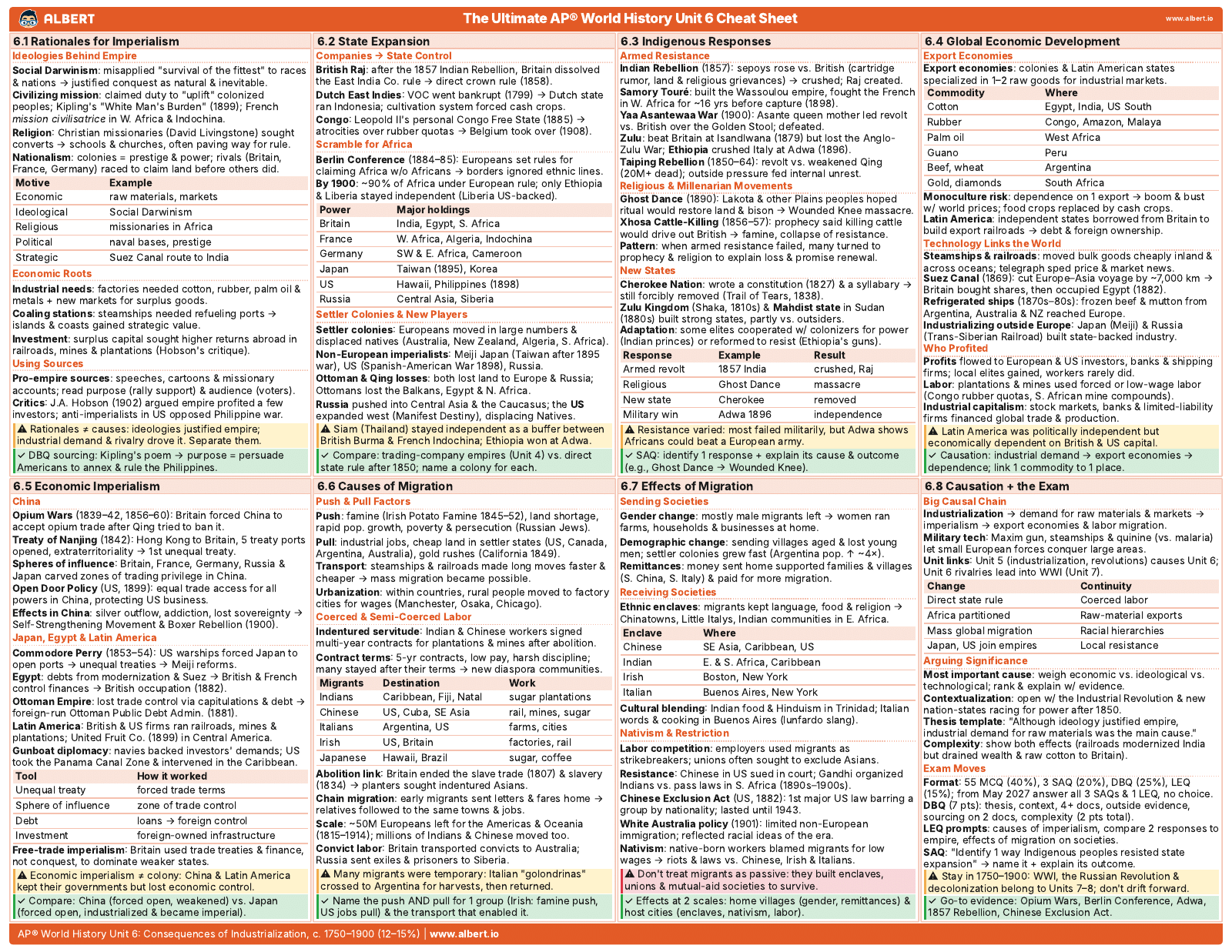
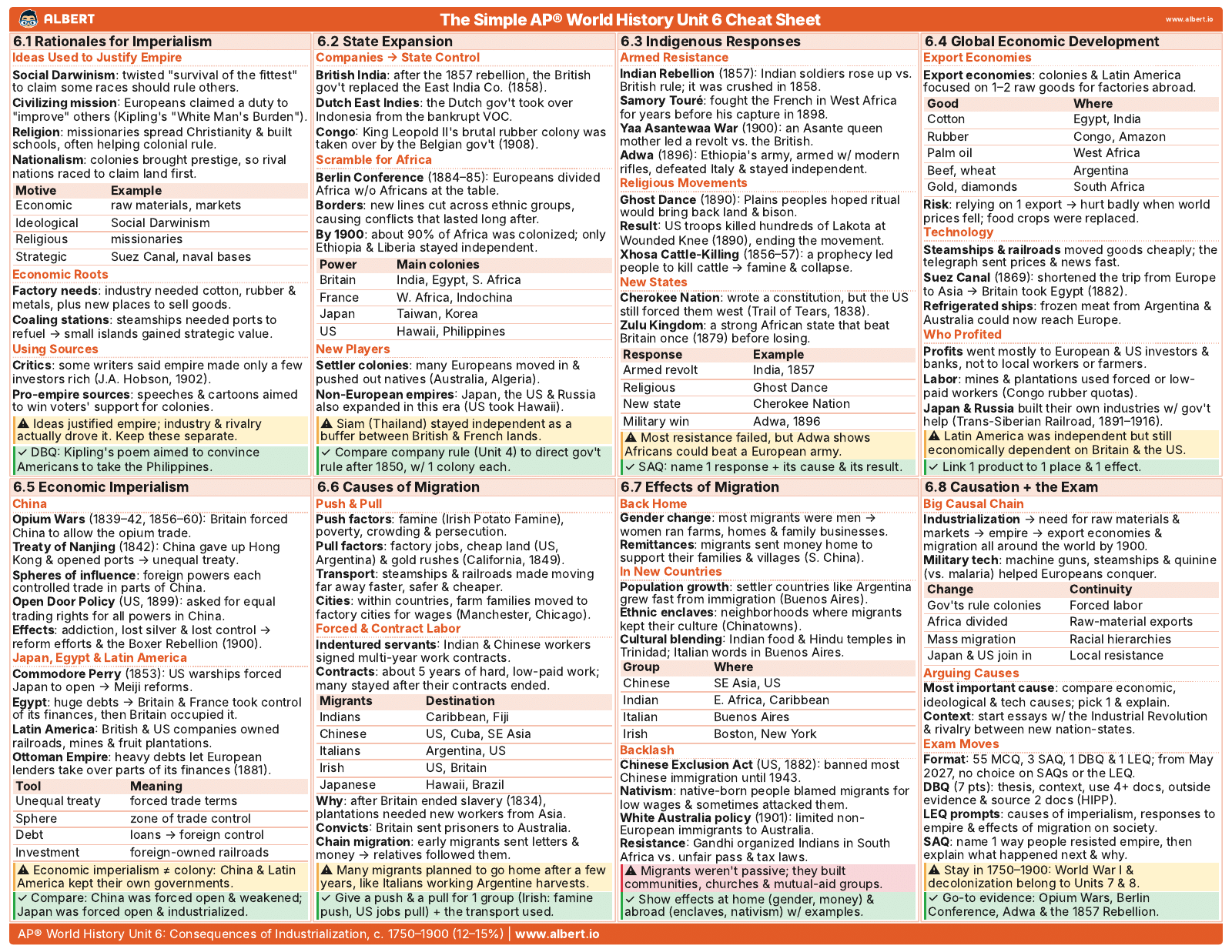
This AP World Unit 6 cheat sheet covers the consequences of industrialization from c. 1750 to 1900: why empires expanded, how states took control of Africa and Asia, how Indigenous peoples resisted, export economies, economic imperialism, and global migration. Unit 6 makes up 12–15% of the AP® World History: Modern exam. Choose Simple for the essentials or Ultimate for full essay evidence.
Practice AP® World History Unit 6 questions on Albert
What’s on the AP World Unit 6 Cheat Sheet?
Both versions follow Unit 6 of the College Board’s AP® World History: Modern course, with one card for each CED topic. Card 1 covers the rationales for imperialism (6.1), card 2 covers state expansion (6.2), and card 3 covers Indigenous responses (6.3). Cards 4 and 5 cover global economic development and economic imperialism (6.4 and 6.5). Cards 6 and 7 cover the causes and effects of migration (6.6 and 6.7), and card 8 ties the unit together with causation (6.8) and the exam moves you need.
The Simple version gives you the key ideologies, the major colonial powers, the best-known resistance movements, the main export commodities, the Opium Wars, and the push and pull factors behind migration. Start there if the unit is new to you.
The Ultimate version adds the evidence that earns essay points: the shift from company to crown rule in India, the Congo Free State, the Berlin Conference and its borders, Samory Touré and Yaa Asantewaa, the Xhosa Cattle-Killing, the Ottoman Public Debt Administration, gunboat diplomacy, indentured labor routes, chain migration, and the Chinese Exclusion Act.
AP World Unit 6 at a Glance
Unit 6 covers c. 1750 to 1900 and makes up 12% to 15% of the multiple-choice section. It shares Period 3 with Unit 5, so expect the two to appear together in stimulus sets and essays.
| Topic | Name | Focus |
|---|---|---|
| 6.1 | Rationales for Imperialism | Ideologies and economic motives behind empire |
| 6.2 | State Expansion | From trading companies to direct state rule; the Scramble for Africa |
| 6.3 | Indigenous Responses to State Expansion | Armed resistance, religious movements, and new states |
| 6.4 | Global Economic Development | Export economies and the technology that linked them |
| 6.5 | Economic Imperialism | Unequal treaties, spheres of influence, and foreign investment |
| 6.6 | Causes of Migration in an Interconnected World | Push and pull factors, indentured and convict labor |
| 6.7 | Effects of Migration | Gender roles, ethnic enclaves, nativism, and exclusion laws |
| 6.8 | Causation in the Imperial Age | How industrialization drove empire and migration |
Key Concepts in Unit 6: Consequences of Industrialization
Why Empires Expanded
Industrial economies needed raw materials such as cotton, rubber, palm oil, and copper, and they needed new markets for factory goods. Steamships needed coaling stations, which gave small islands strategic value. Ideologies justified the push: Social Darwinism misapplied ideas about natural selection to races and nations, the “civilizing mission” claimed a duty to remake colonized societies, and missionaries sought converts. Nationalism added a race for prestige among Britain, France, Germany, and newer powers.
Worked example: A DBQ includes Rudyard Kipling’s 1899 poem “The White Man’s Burden.” For sourcing, you might explain that Kipling’s purpose was to persuade Americans to take control of the Philippines after the Spanish-American War, which helps explain why the poem presents empire as a moral duty rather than an economic opportunity.
Exam tip: Separate justifications from causes. Ideologies explained empire to voters; industrial demand and rivalry between states drove it.
State Expansion and Indigenous Responses
After 1850, states increasingly took direct control from trading companies. Britain replaced East India Company rule with the British Raj in 1858 after the Indian Rebellion of 1857. The Dutch government took over Indonesia after the VOC collapsed, and Belgium took the Congo from King Leopold II in 1908 after reports of atrocities tied to rubber quotas. The Berlin Conference of 1884 to 1885 set rules for claiming African territory without any African participants, and by 1900 only Ethiopia and Liberia remained independent. Japan, the United States, and Russia also expanded.
Responses ranged widely. Samory Touré fought the French in West Africa for years, Yaa Asantewaa led an Asante revolt against the British in 1900, and Ethiopia defeated Italy at Adwa in 1896. When armed resistance failed, some turned to religious movements such as the Ghost Dance among the Lakota or the Xhosa Cattle-Killing in southern Africa. Others built new states, as the Cherokee did with a written constitution, though the United States still forced them west.
Worked example: An SAQ asks you to explain one way Indigenous peoples resisted state expansion. A full answer: “In 1896, Ethiopian forces under Menelik II, armed with modern rifles, defeated the Italian army at Adwa, which allowed Ethiopia to remain independent during the Scramble for Africa.”
Exam tip: Argue the degree of success. Most resistance failed militarily, but it shaped colonial policy and later nationalist movements.
Export Economies and Economic Imperialism
Colonies and independent Latin American states specialized in exporting one or two raw goods: cotton from Egypt and India, rubber from the Congo and the Amazon, guano from Peru, beef and wheat from Argentina, and gold and diamonds from South Africa. Steamships, railroads, the telegraph, refrigerated ships, and the Suez Canal tied these economies to European and US markets, while profits flowed mainly to foreign investors.
Economic imperialism let powers dominate without formal colonies. Britain fought the Opium Wars to force China to accept opium imports, and the Treaty of Nanjing in 1842 gave Britain Hong Kong and opened treaty ports. Foreign powers carved out spheres of influence in China, and the United States called for an Open Door Policy. Commodore Perry’s warships forced Japan to open its ports in 1853 and 1854, debt brought British occupation of Egypt in 1882, and British and US companies owned much of Latin America’s railroads and plantations.
Worked example: Compare China’s and Japan’s responses to being forced open. Both signed unequal treaties under military pressure, but Japan responded with rapid state-led industrialization in the Meiji era and became an imperial power itself, while the Qing struggled with internal rebellion and lost further control to foreign powers.
Migration: Causes and Effects
Millions moved in this period. Push factors included famine, such as the Irish Potato Famine of 1845 to 1852, land shortages, and persecution. Pull factors included factory jobs, cheap land in the United States, Argentina, Canada, and Australia, and gold rushes. Steamships and railroads made the journeys faster and cheaper. After Britain abolished slavery in 1834, plantations turned to indentured workers from India and China, who signed multi-year contracts to work in the Caribbean, Fiji, Natal, Southeast Asia, and the Americas. Britain also transported convicts to Australia.
Migration reshaped both sending and receiving societies. Because most migrants were men, women in home villages took on more work and responsibility, and remittances supported families. In new countries, migrants formed ethnic enclaves such as Chinatowns and Indian communities in East Africa and the Caribbean. They also faced nativism and exclusion, including the US Chinese Exclusion Act of 1882.
Exam tip: For migration questions, name the group, the push factor, the pull factor, and the transportation that made the move possible.
How Unit 6 Shows Up on the Exam
The AP® World History: Modern exam has 55 multiple-choice questions, 3 short-answer questions, 1 document-based question, and 1 long essay question. Starting with the May 2027 exam, you answer all three short-answer questions and a single long essay question with no choice, while course content and scoring rubrics stay the same. Unit 6 often appears in multiple-choice sets built around political cartoons, maps of colonial Africa, trade data, and excerpts from colonial officials or resistance leaders.
Essay prompts for this period commonly ask about the causes of imperialism, compare responses to empire, or ask about the effects of migration. On the DBQ, scorers reward a defensible thesis, contextualization that reaches beyond the documents, use of at least four documents, outside evidence, sourcing for two documents, and complex reasoning such as weighing multiple causes.
Common Mistakes in Unit 6
- Mistake: Treating ideologies as the cause of imperialism. Fix: Present them as justifications and tie the main causes to industrial demand and rivalry.
- Mistake: Calling China a colony. Fix: Describe China as subject to economic imperialism, with spheres of influence and unequal treaties.
- Mistake: Assuming all resistance failed. Fix: Use Adwa as evidence of successful resistance and explain its outcome.
- Mistake: Describing migrants only as victims. Fix: Show how they built enclaves, sent remittances, and organized for their rights.
- Mistake: Drifting into World War I. Fix: Keep Unit 6 evidence between 1750 and 1900.
Frequently Asked Questions
Can I use this cheat sheet on the exam?
No. Notes are not allowed on the AP® World History: Modern exam. This AP World Unit 6 cheat sheet is a study tool for reviewing before practice questions, unit tests, and the exam.
Should I start with the Simple or the Ultimate version?
Start with Simple to learn the main ideas and examples. Move to Ultimate when you are writing practice DBQs and LEQs and need more specific evidence.
What is the difference between imperialism and economic imperialism?
Imperialism usually means formal political control of a territory, like British India. Economic imperialism means controlling another country’s economy through trade treaties, loans, or investment while it keeps its own government, as in Qing China or much of Latin America.
How does Unit 6 connect to Unit 5?
Unit 5 covers revolutions and industrialization, and Unit 6 covers their consequences. Many essays ask you to explain how industrialization caused imperialism and migration, so review the two units together.