
Maximize your score with these resources:
- Albert.io AP® World History question banks
- Free AP® World History study guides
- Free AP® World History score calculator
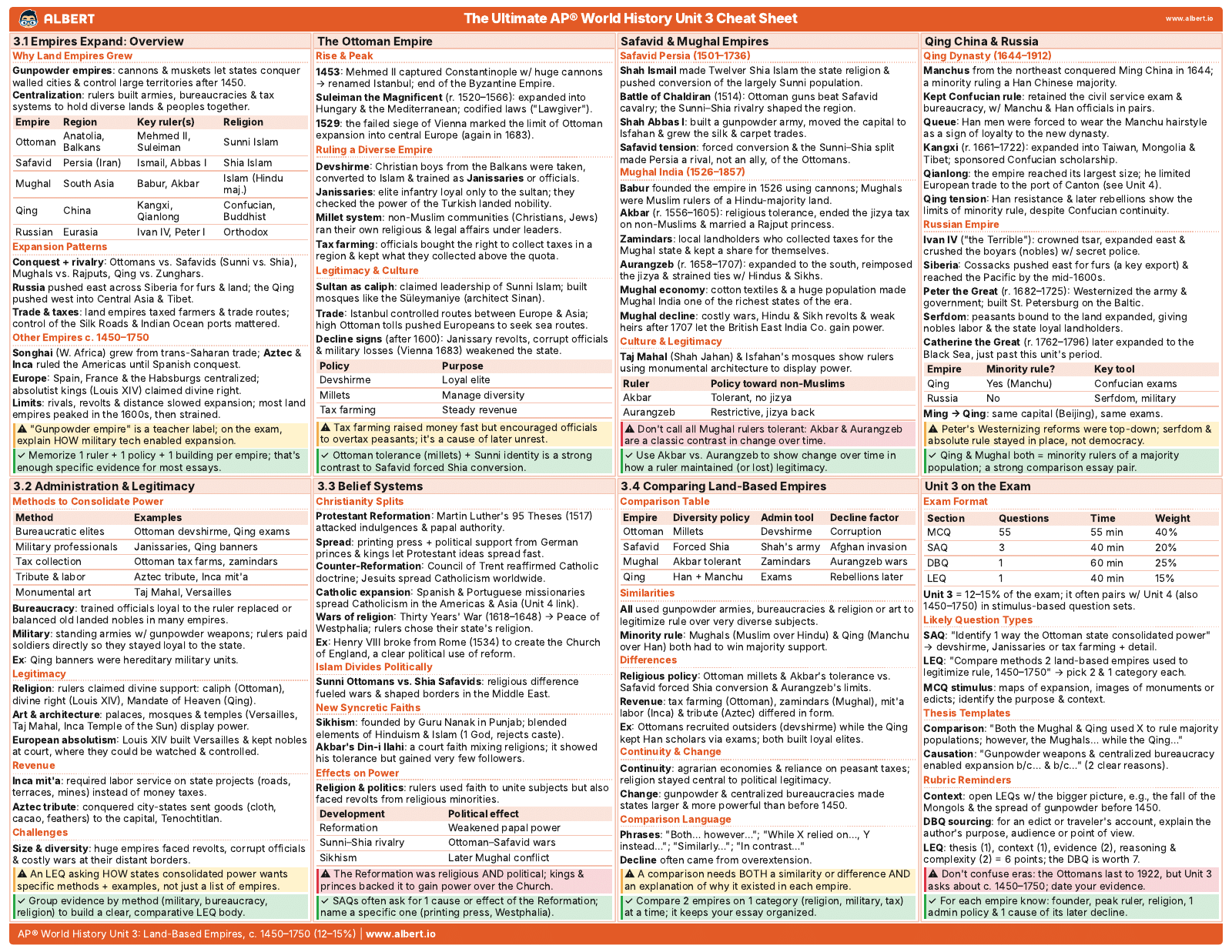
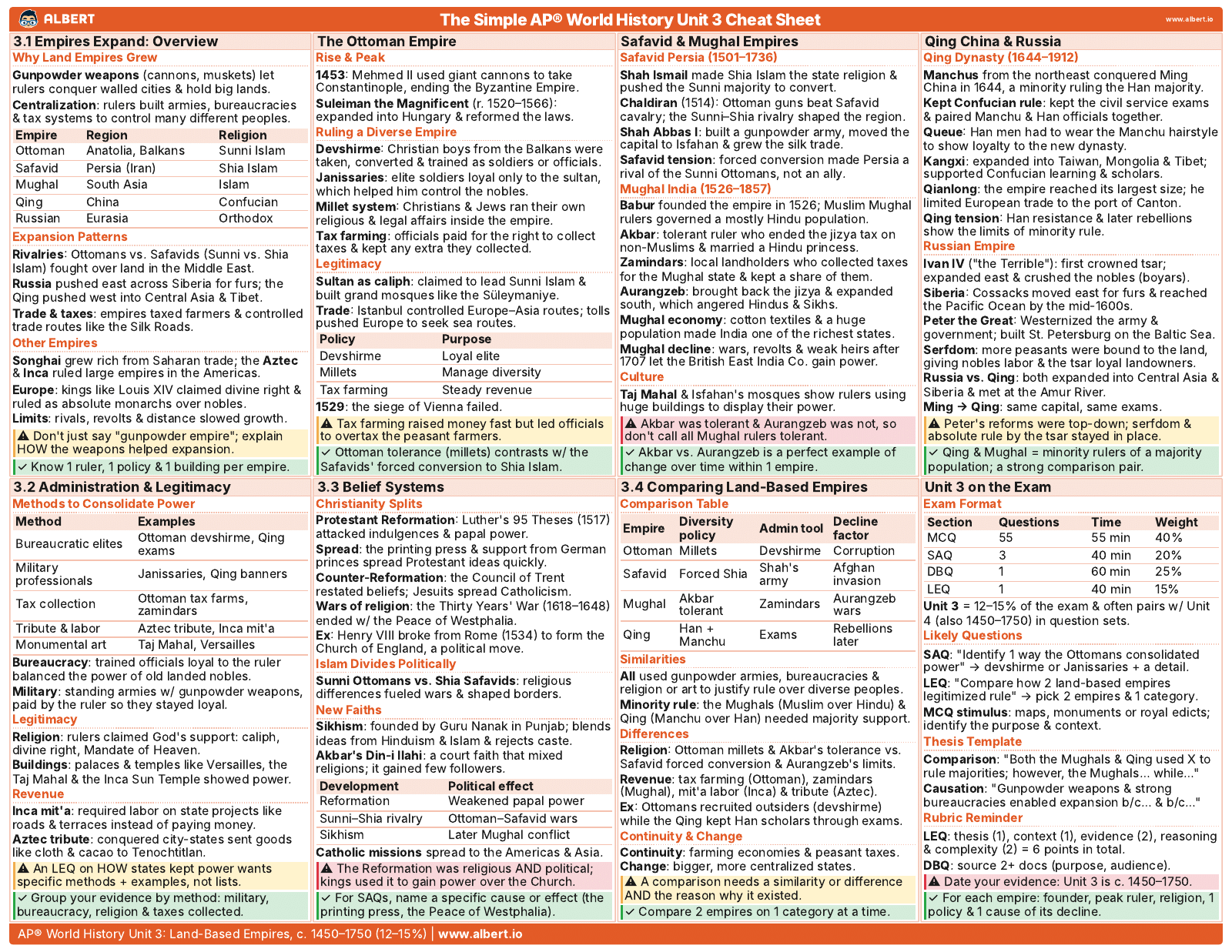
This AP World Unit 3 cheat sheet covers the land-based empires of c. 1450 to 1750: the Ottoman, Safavid, Mughal, Qing, and Russian empires, how they expanded, how they ruled diverse populations, how religion shaped their politics, and how they compare. Unit 3 makes up 12% to 15% of the AP® World History: Modern exam. Choose the Simple version for the essentials or the Ultimate version for every ruler, policy, and comparison.
Practice AP® World History Unit 3 questions on Albert
What’s on the AP World Unit 3 Cheat Sheet?
Both versions follow Unit 3 of the College Board’s AP® World History: Modern course. The first four cards cover empire expansion (topic 3.1) with an overview and individual cards for the Ottomans, the Safavids and Mughals, and the Qing and Russia. The next three cover administration and legitimacy (3.2), belief systems (3.3), and comparison (3.4). The last card covers the exam format and question types.
The Simple version gives you a table of the major empires, the key rulers and policies of each, the main methods states used to consolidate power, the Protestant Reformation and the Sunni–Shia split, a comparison table, and thesis templates.
The Ultimate version adds dates and battles such as Chaldiran and the siege of Vienna, trade and decline for each empire, Qianlong and Catherine the Great, European absolutism, Henry VIII and Catholic missions, comparison language, and DBQ and LEQ reminders. Start with Simple, then move to Ultimate when you are writing practice essays.
AP World Unit 3 at a Glance
| Topic | Name | Focus |
|---|---|---|
| 3.1 | Empires Expand | How gunpowder and centralization enabled growth |
| 3.2 | Empires: Administration | Bureaucracy, military, taxes, and legitimacy |
| 3.3 | Empires: Belief Systems | The Reformation, Sunni–Shia conflict, and Sikhism |
| 3.4 | Comparison in Land-Based Empires | Similarities and differences in how empires ruled |
Unit 3 accounts for 12% to 15% of the exam. The exam has 55 multiple-choice questions (40%), three short-answer questions (20%), one document-based question (25%), and one long essay (15%).
Key Concepts in Land-Based Empires
Why Land Empires Expanded
Between 1450 and 1750, rulers used gunpowder weapons to conquer walled cities and hold large territories. Centralized states built standing armies, bureaucracies, and tax systems to control diverse populations. Rivalries drove much of this growth: the Sunni Ottomans and Shia Safavids fought over the Middle East, Russia pushed east across Siberia for furs, and the Qing expanded west into Central Asia and Tibet.
Exam tip: Don’t stop at the label “gunpowder empire.” Explain how military technology made expansion possible, such as Ottoman cannons breaching the walls of Constantinople in 1453.
The Ottoman Empire
Mehmed II captured Constantinople in 1453 and renamed it Istanbul, ending the Byzantine Empire. Under Suleiman the Magnificent (r. 1520–1566), the empire expanded into Hungary and the Mediterranean, though the failed siege of Vienna in 1529 marked its limit in central Europe. The Ottomans used the devshirme system to recruit Christian boys from the Balkans, who were converted and trained as Janissaries or officials loyal only to the sultan. The millet system let Christian and Jewish communities run their own religious and legal affairs, and tax farming raised revenue by letting officials collect taxes in exchange for a fee.
The Safavid and Mughal Empires
Shah Ismail made Shia Islam the official religion of Safavid Persia and pushed the largely Sunni population to convert. The Ottomans defeated the Safavids at Chaldiran in 1514, and the Sunni–Shia rivalry shaped the region for centuries. Shah Abbas I later built a gunpowder army and moved the capital to Isfahan.
In South Asia, Babur founded the Mughal Empire in 1526. Mughal rulers were Muslims governing a Hindu majority. Akbar (r. 1556–1605) ended the jizya tax on non-Muslims and promoted tolerance, while Aurangzeb (r. 1658–1707) reimposed the jizya and expanded south through costly wars. Zamindars, local landholders, collected taxes for the state.
Exam tip: Akbar and Aurangzeb make an ideal pairing for change over time in how a ruler maintained legitimacy.
Qing China and Russia
The Manchus conquered Ming China in 1644 and founded the Qing dynasty. As a minority ruling a Han majority, they kept the Confucian civil service exams and paired Manchu and Han officials, but they also required Han men to wear the Manchu queue hairstyle. Kangxi and Qianlong expanded into Taiwan, Mongolia, Tibet, and Central Asia.
In Russia, Ivan IV became the first crowned tsar and crushed the power of the nobles. Cossacks pushed across Siberia for furs, reaching the Pacific by the mid-1600s. Peter the Great Westernized the army and government and built St. Petersburg, while serfdom tied more peasants to the land.
Administration and Legitimacy
Empires used several methods to consolidate power: bureaucratic elites (the devshirme and Qing exams), professional militaries (the Janissaries and Qing banners), tax systems (tax farming and zamindars), and tribute or labor (Aztec tribute and the Inca mit’a). Rulers also claimed legitimacy through religion, as caliph, by divine right, or through the Mandate of Heaven, and through monumental architecture such as the Taj Mahal, Versailles, and the Inca Temple of the Sun.
Belief Systems
Martin Luther’s 95 Theses in 1517 launched the Protestant Reformation, which spread through the printing press and support from German princes. The Catholic Church responded with the Counter-Reformation, including the Council of Trent and Jesuit missions. Religious wars, including the Thirty Years’ War, ended with the Peace of Westphalia in 1648. In South Asia, Guru Nanak founded Sikhism, which blended elements of Hinduism and Islam.
Exam tip: The Reformation was political as well as religious. Rulers such as Henry VIII used it to gain power over the Church.
Comparing Land-Based Empires
All of these empires used gunpowder armies, bureaucracies, and religion or art to justify their rule over diverse subjects. They differed in religious policy, from Ottoman millets and Akbar’s tolerance to Safavid forced conversion, and in how they raised revenue. The Mughals and Qing make a strong comparison because both were minority rulers who needed the support of a majority population.
How Unit 3 Shows Up on the AP World Exam
Multiple-choice questions often use maps of expansion, images of monuments, or excerpts from royal edicts and ask about purpose and context. Short-answer questions might ask you to identify one way the Ottoman state consolidated power or one effect of the Protestant Reformation. Long essays often ask you to compare how two land-based empires legitimized or consolidated their rule between 1450 and 1750.
The long essay is scored out of 6 points: thesis (1), contextualization (1), evidence (2), and analysis and reasoning (2). The DBQ is worth 7 points. Organize comparison essays by category, such as military, bureaucracy, or religion, and compare two empires within each category.
A Sample Comparison Thesis
Suppose a long essay asks you to compare the methods two land-based empires used to legitimize and consolidate power between 1450 and 1750. A strong thesis names both empires, a similarity, a difference, and the reason behind them: “Both the Mughal and Qing empires, as minority rulers, relied on existing bureaucratic traditions to govern large majority populations; however, the Mughals under Akbar won support through religious tolerance, while the Qing preserved Confucian exams but imposed Manchu customs such as the queue.”
Each body paragraph can then take one part of the thesis, give specific evidence (the end of the jizya, the paired Manchu and Han officials), and explain how that evidence shows the similarity or difference. Ending with a change over time, such as Aurangzeb’s reversal of Akbar’s policies, can help you earn the complexity point.
Common Mistakes in AP World Unit 3
- Calling every Mughal ruler tolerant. Fix: contrast Akbar’s tolerance with Aurangzeb’s policies.
- Listing empires instead of methods. Fix: organize evidence by how states kept power.
- Treating the Reformation as only religious. Fix: explain its political effects.
- Using evidence from the wrong period. Fix: keep examples within c. 1450 to 1750.
- Comparing without explaining. Fix: give the reason behind each similarity or difference.
Frequently Asked Questions
Can I use this cheat sheet on the exam?
No. Notes aren’t allowed on the AP® World History exam. Use the cheat sheet as a study tool to build specific evidence you can recall on test day.
Should I start with the Simple or the Ultimate version?
Start with the Simple version of the AP World Unit 3 cheat sheet to learn each empire’s key rulers and policies. Move to Ultimate when you want extra evidence for essays and comparisons.
Which empires matter most for Unit 3?
The Ottoman, Safavid, Mughal, and Qing empires appear most often, with Russia close behind. Know one founder, one peak ruler, the main religion, one administrative policy, and one cause of decline for each.
What were the devshirme and the Janissaries?
The devshirme was the Ottoman practice of taking Christian boys from the Balkans, converting them to Islam, and training them for state service. The most capable became officials, and many became Janissaries, an elite infantry loyal only to the sultan, which helped him balance the power of the Turkish nobility.
How does Unit 3 connect to Unit 4?
Both cover c. 1450 to 1750. Unit 3 focuses on land-based empires, while Unit 4 covers maritime exploration and trade. Questions often combine them, such as how the Qing responded to European traders.