

Maximize your score with these resources:
- Albert.io AP® Precalculus question banks
- Free AP® Precalculus cheat sheets
- Free AP® Precalculus score calculator
Conic sections form one of the most visually rich and practically useful topics in AP® Precalculus. Every conic — circle, parabola, ellipse, hyperbola — comes from slicing a double cone at a different angle, and each one shows up in real-world settings: satellite dishes focus signals along a parabola, planets trace elliptical orbits, and radio navigation systems such as LORAN use hyperbolas to pinpoint locations. Mastering conic sections equations means you can move fluently between a geometric picture and its algebraic description, a skill the AP® exam tests repeatedly.
This article covers the standard forms for each conic, walks through worked examples, introduces asymptotes for hyperbolas, and finishes with exam-day strategies.
What We Review
What Are Conic Sections?
A conic section is any curve produced by the intersection of a plane and a right circular double cone. The angle at which the plane meets the cone determines the shape:
- Circle. The plane cuts perpendicular to the cone’s axis, producing a closed curve where every point is the same distance from the center.
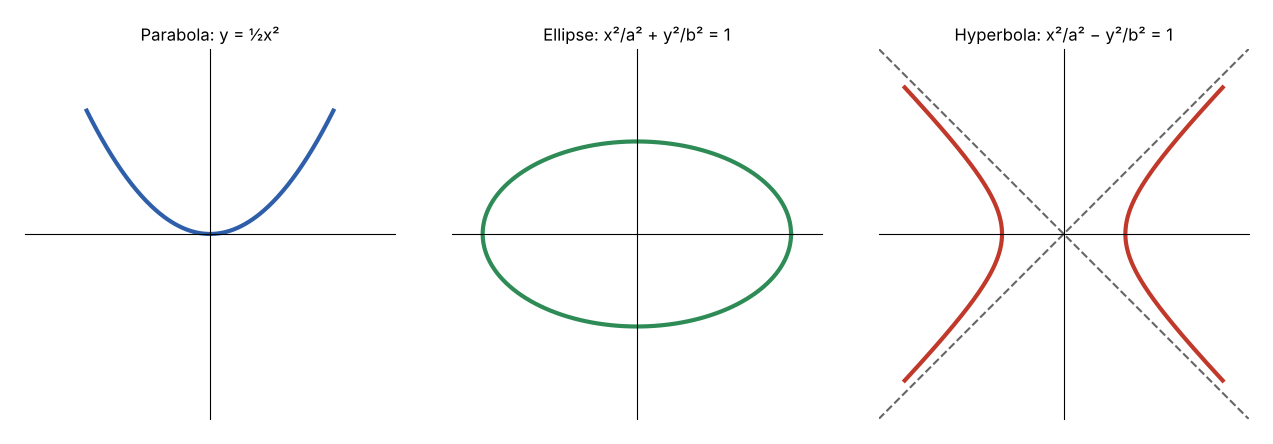
- Parabola. The plane is parallel to one side of the cone. The result is an open, U-shaped curve with a single vertex.
- Ellipse. The plane cuts at an angle but passes entirely through one nappe (half) of the cone, creating an elongated closed curve. The sum of distances from any point on the ellipse to its two foci is constant.
- Hyperbola. The plane cuts through both nappes of the cone, producing two separate mirror-image branches. The difference of distances from any point on the hyperbola to its two foci is constant.


Each conic can be described by a general second-degree equation \(Ax^2 + Bxy + Cy^2 + Dx + Ey + F = 0\), but for AP® Precalculus the standard forms below are far more useful because they expose the center, radii, and orientation at a glance.
Conic Sections and Parabolas
A parabola is defined by the set of all points equidistant from a fixed point (the focus) and a fixed line (the directrix). This reflective property is why parabolic mirrors and antennas funnel energy to a single focal point.
The standard equations for parabolas with vertex at \((h, k)\) are:
| Opening Direction | Standard Form |
|---|---|
| Up or down | \(a(y – k) = (x – h)^2\) |
| Left or right | \((y – k)^2 = a(x – h)\) |
When \(a > 0\) the parabola opens upward (or to the right); when \(a < 0\) it opens downward (or to the left).
Example: Find the equation of a parabola with vertex \((2, -3)\) that opens upward and passes through \((3, 0)\).
Start from the upward-opening form \(a(y + 3) = (x – 2)^2\). Substitute the point \((3, 0)\):
\(a(0 + 3) = (3 – 2)^2\) \(3a = 1 \Rightarrow a = \frac{1}{3}\)The final equation is \(\frac{1}{3}(y + 3) = (x – 2)^2\). A quick check confirms the vertex \((2, -3)\) satisfies the equation (both sides equal zero) and the point \((3, 0)\) gives \(\frac{1}{3}(3) = 1 = 1^2\).
Ellipses
An ellipse is the set of all points where the sum of distances to two foci remains constant. When both semi-axes are equal the ellipse becomes a circle, making the circle a special case.
The standard equation for an ellipse centered at \((h, k)\) is:
\(\frac{(x – h)^2}{a^2} + \frac{(y – k)^2}{b^2} = 1\)Here \(a\) is the horizontal semi-axis and \(b\) is the vertical semi-axis. When \(a > b\) the major axis is horizontal; when \(b > a\) it is vertical. The foci lie along the major axis at a distance \(c = \sqrt{a^2 – b^2}\) (or \(c = \sqrt{b^2 – a^2}\)) from the center.
Example: Write the equation of an ellipse centered at \((4, 1)\) with horizontal radius 3 and vertical radius 2.
Identify the values: \(h = 4\), \(k = 1\), \(a = 3\), \(b = 2\). Substitute directly:
\(\frac{(x – 4)^2}{9} + \frac{(y – 1)^2}{4} = 1\)Because \(a > b\), the major axis runs horizontally. The foci are at \((4 \pm \sqrt{5},\; 1)\).
Hyperbolas
A hyperbola is the set of all points where the absolute difference of distances to two foci is constant. Unlike an ellipse, a hyperbola has two separate branches that open in opposite directions.
The standard equations for hyperbolas centered at \((h, k)\) are:
| Opening Direction | Standard Form |
|---|---|
| Left and right | \(\frac{(x – h)^2}{a^2} – \frac{(y – k)^2}{b^2} = 1\) |
| Up and down | \(\frac{(y – k)^2}{b^2} – \frac{(x – h)^2}{a^2} = 1\) |
The positive fraction tells you which direction the branches open. If the \(x\)-term is positive, the branches go left and right; if the \(y\)-term is positive, they go up and down.
Example: Find the equation of a hyperbola centered at the origin with \(a = 4\) and \(b = 3\) that opens left and right.
Substitute \(h = 0\), \(k = 0\), \(a = 4\), \(b = 3\) into the left/right form:
\(\frac{x^2}{16} – \frac{y^2}{9} = 1\)The vertices are at \((\pm 4, 0)\) and the foci are at \((\pm 5, 0)\) since \(c = \sqrt{a^2 + b^2} = \sqrt{16 + 9} = 5\).
Asymptotes of Hyperbolas
Every hyperbola has two asymptotes — straight lines that the branches approach but never touch. The asymptotes pass through the center of the hyperbola and serve as guides for sketching the curve by hand.
For a hyperbola centered at \((h, k)\) that opens left and right, the asymptote equations are:
\(y – k = \pm \frac{b}{a}(x – h)\)For a hyperbola that opens up and down with this same labeling, the asymptotes are still \(y – k = \pm \frac{b}{a}(x – h)\).
Example: Find the asymptotes of \(\frac{(x – 1)^2}{25} – \frac{(y + 2)^2}{16} = 1\).
Identify the values: \(h = 1\), \(k = -2\), \(a^2 = 25\) so \(a = 5\), \(b^2 = 16\) so \(b = 4\). The asymptote equation gives:
\(y + 2 = \pm \frac{4}{5}(x – 1)\)This produces two lines: \(y = -2 + \frac{4}{5}(x – 1)\) and \(y = -2 – \frac{4}{5}(x – 1)\). Drawing these lines first, then sketching the branches between them, is the fastest way to graph a hyperbola accurately.
Quick Reference Chart
| Conic | Standard Form | Key Feature | How to Identify |
|---|---|---|---|
| Circle | \((x – h)^2 + (y – k)^2 = r^2\) | All points equidistant from center | Same coefficients on \(x^2\) and \(y^2\), same sign |
| Parabola | \(a(y – k) = (x – h)^2\) | One squared term only | Only \(x^2\) or only \(y^2\) appears |
| Ellipse | \(\frac{(x-h)^2}{a^2} + \frac{(y-k)^2}{b^2} = 1\) | Sum of distances to foci is constant | Both squared terms, same sign, different coefficients |
| Hyperbola | \(\frac{(x-h)^2}{a^2} – \frac{(y-k)^2}{b^2} = 1\) | Difference of distances to foci is constant | Both squared terms, opposite signs |
Test-Taking Strategies for Conic Section Problems
Use the mnemonic SCOPE — Signs of squared terms, Center from \((h, k)\), Orientation from the positive term, Parameters \(a\) and \(b\), Extra features (foci, asymptotes, directrix) — to systematically classify and solve any conic problem.
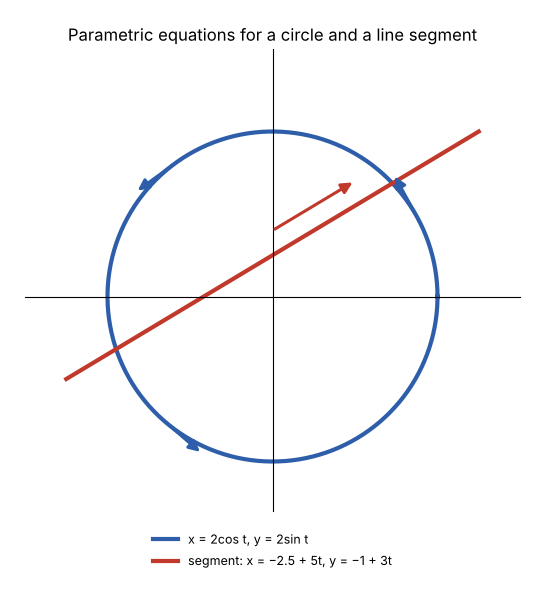
Cross-topic connections. Conics link to parametric equations (an ellipse parametrizes with \(\cos\) and \(\sin\), a hyperbola with \(\sec\) and \(\tan\)), to polar equations (each conic has a polar form involving eccentricity), and to implicitly defined functions (every conic equation is an implicit relation between \(x\) and \(y\)). The AP® exam frequently asks you to move between these representations.
Common question formats. Expect questions that give you a general equation and ask you to identify the conic type, provide the center and a point and ask for the full equation, require you to find foci or asymptotes from the standard form, or present a graph and ask which equation matches. Completing the square is the most commonly tested algebraic skill in this unit.
Frequent student mistakes. The number one error is forgetting to complete the square properly when converting from general form to standard form — students often forget to add the same constant to both sides. Another common mistake is confusing the roles of \(a\) and \(b\): for ellipses, \(c^2 = a^2 – b^2\) (where \(a > b\) along the major axis), while for hyperbolas \(c^2 = a^2 + b^2\). Mixing up these formulas puts foci in the wrong location. Finally, students sometimes identify a hyperbola as an ellipse (or vice versa) because they miss the sign difference between the squared terms.
Test-day shortcuts. To quickly classify a conic from the general equation \(Ax^2 + Cy^2 + Dx + Ey + F = 0\) (assuming \(B = 0\)): if \(A = C\) it is a circle, if \(A\) or \(C\) is zero it is a parabola, if \(A\) and \(C\) have the same sign but are not equal it is an ellipse, and if they have opposite signs it is a hyperbola. This check takes about five seconds and eliminates wrong answer choices immediately.
Time management tips. Completing the square can be time-consuming — budget about two minutes for a problem that requires it. If you are running low on time, check whether the answer choices can be distinguished just by identifying the conic type and center (which you can read off quickly), rather than computing every parameter. On free-response questions, always write the final equation in standard form even if the problem does not explicitly ask for it, since partial credit depends on showing you reached the correct structure.
Check for Understanding
Think you’ve got it? Complete the quiz below to make sure. Download your results at the end.