

Maximize your score with these resources:
- Albert.io AP® Calculus question banks
- Free AP® Calculus cheat sheets
- Free AP® Calculus score calculator
Derivatives measure how a function changes at any specific point. When formulas are unavailable or functions are too complicated for standard differentiation rules, you can estimate derivatives numerically using difference quotients and tables. The AP® Calculus AB-BC curriculum expects you to interpret derivative data, set up approximation formulas, and evaluate which methods yield the most accurate results.
What We Review
Estimating Derivatives: Methods at a Glance
| Method | Formula | When to Use | Accuracy |
|---|---|---|---|
| Forward Difference | [f(x+h) − f(x)] / h | Only right-side data available | Lower — one-sided bias |
| Backward Difference | [f(x) − f(x−h)] / h | Only left-side data available | Lower — one-sided bias |
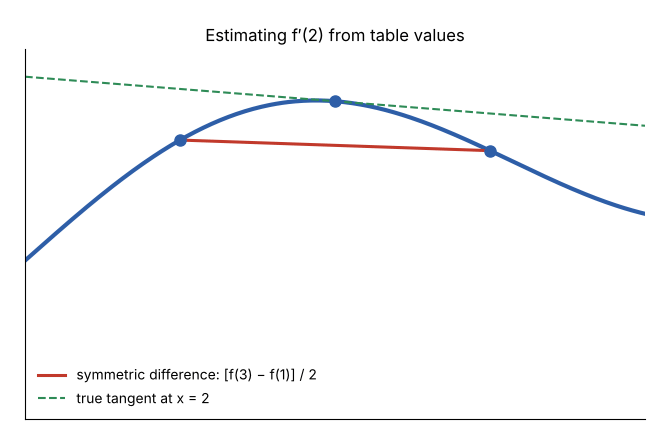
| Symmetrical Difference | [f(x+h) − f(x−h)] / (2h) | Points on both sides available | Higher — balances both sides; AP® preferred |
| Table-based estimation | Choose h = spacing between rows | Given a data table | Depends on spacing and method used |
Check for Understanding
Use the quiz below to test your understanding of the key concepts presented in this article.
What Is a Derivative?
Fundamental Idea of a Derivative
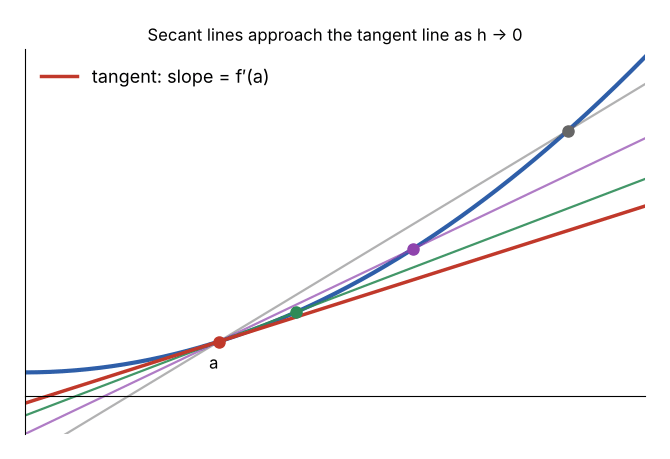
A derivative represents the instantaneous rate of change of a function. At a point \(x = a\), the derivative \(f'(a)\) is the slope of the tangent line to the curve. The formal definition uses a limit:
\(\displaystyle f'(a) = \lim_{h \to 0} \frac{f(a + h) – f(a)}{h}\)This tells you exactly how fast and in which direction the function changes at \(x = a\). On the AP exam, you won’t always have explicit formulas. Instead, you’ll work with tables or graphs and estimate this slope numerically.
Why Estimate Derivatives?
Three common scenarios require derivative estimation: experimental data (you have collected measurements but no formula), complex functions (the function is too complicated to differentiate using standard rules), and piecewise or implicit functions (derivatives aren’t defined everywhere or the formula is hidden). Numerical estimation bridges these gaps, letting you analyze behavior using nearby points.
Approaches to Estimating Derivatives
Difference Quotients
The difference quotient approximates slope using two nearby points:
\(\displaystyle \frac{f(x + h) – f(x)}{h}\)Here, \(h\) is a small increment. The secant line slope becomes closer to the tangent slope as \(h\) shrinks. Key balance: \(h\) must be small enough to capture local behavior but large enough to avoid calculator round-off errors. Typical AP problems use \(h = 0.1, 0.01,\) or \(0.001\).
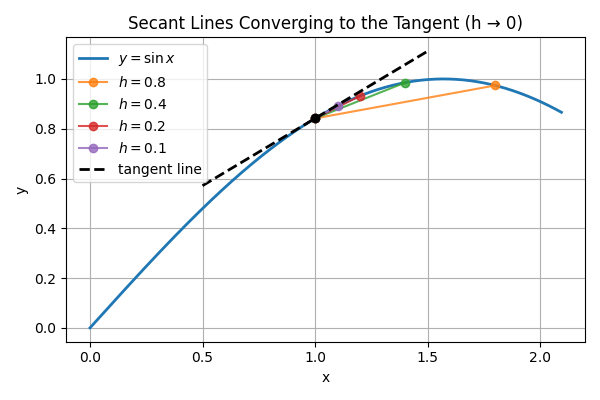
As \(h\) decreases, the secant line slope approaches the tangent line slope at the point of interest.
Symmetrical Difference Quotients
A symmetrical difference quotient reduces error by averaging the slopes on both sides of \(x\):
\(\displaystyle \frac{f(x + h) – f(x – h)}{2h}\)This two-sided approach often outperforms one-sided estimates because it balances positive and negative deviations. Expect to see this formula on the AP exam—it’s a tested skill. When you have a table with evenly spaced data, this method is usually more accurate than a standard difference quotient.
Using a Derivative Table
Most AP free-response problems give you a derivative table—a list of x-values with corresponding f(x)-values. Your task is to: identify the point where you need to estimate \(f'(x)\); choose nearby points that are as close and as symmetrical as possible; apply the appropriate difference quotient formula; then check consistency—if the data looks erratic, your estimate may have large error.
Example 1: Estimating from Tabulated Data
Problem: Use this derivative table for \(f(x)\) to estimate \(f'(2.0)\).
| x | f(x) |
|---|---|
| 1.9 | 3.00 |
| 2.0 | 3.14 |
| 2.1 | 3.26 |
| 2.2 | 3.36 |
Solution (Standard Difference Quotient):
- Identify the points closest to \(x = 2.0\): use \(x = 2.0\) and \(x = 2.1\) (forward difference).
- Apply the formula with \(h = 0.1\): \(\displaystyle f'(2.0) \approx \frac{f(2.1) – f(2.0)}{0.1} = \frac{3.26 – 3.14}{0.1} = \frac{0.12}{0.1} = 1.2\)
- Answer: \(f'(2.0) \approx 1.2\)
Alternative (Symmetrical Difference): For improved accuracy, use \(x = 1.9\) and \(x = 2.1\): \(\displaystyle f'(2.0) \approx \frac{f(2.1) – f(1.9)}{2(0.1)} = \frac{3.26 – 3.00}{0.2} = \frac{0.26}{0.2} = 1.3\). This symmetrical estimate (1.3) balances the forward and backward slopes, often providing better accuracy than the forward difference alone (1.2).
Example 2: Using Symmetrical Difference
Problem: For function \(g(x)\) with the table below, find \(g'(5.0)\) using the symmetrical difference quotient.
| x | g(x) |
|---|---|
| 4.9 | 6.10 |
| 5.0 | 6.20 |
| 5.1 | 6.29 |
| 5.2 | 6.37 |
Solution:
- Center on \(x = 5.0\); choose \(x = 4.9\) and \(x = 5.1\) (\(h = 0.1\)).
- Substitute into the symmetrical formula: \(\displaystyle g'(5.0) \approx \frac{g(5.1) – g(4.9)}{2(0.1)} = \frac{6.29 – 6.10}{0.2} = \frac{0.19}{0.2} = 0.95\)
- Answer: \(g'(5.0) \approx 0.95\)
Key insight: The two-sided approach balances the rate of change on both sides of the point, reducing bias from steep or shallow sections of the curve.
Quick Reference: Key Terms and Definitions
| Term | Definition |
|---|---|
| Derivative | Rate of change of a function at a specific point; the slope of the tangent line. |
| Difference Quotient | One-sided approximation: [f(x+h) − f(x)] / h. Fast to compute but less accurate. |
| Symmetrical Difference | Two-sided approximation: [f(x+h) − f(x−h)] / (2h). More accurate, preferred on AP exams. |
| Secant Line | A line connecting two points on a curve; its slope is a difference quotient. |
| Tangent Line | A line touching the curve at exactly one point; its slope is the derivative. |
| Increment h | The horizontal distance between points used in estimation. Smaller h gives more accuracy, but too small risks round-off error. |
Test-Taking Strategies
Mnemonic: “SYM for Accuracy”
When you see a data table, think SYM (symmetrical). Use \(\frac{f(x+h) – f(x-h)}{2h}\) whenever possible—it’s the safer, more accurate choice on AP free-response questions. Also remember: “Balance the h”—always check that the points you choose are equally spaced around your target point. Unequal spacing introduces bias.
Cross-Topic Connections
Limits (Topic 1.1): Derivative estimation is an approximation of the limit definition \(\lim_{h \to 0} \frac{f(x+h) – f(x)}{h}\). On multitopic problems, explaining why you’re using a particular h value demonstrates limit understanding.
Graphical Analysis (Topics 5.x): Derivative estimates help you sketch the derivative graph. Where \(f'(x)\) is positive, the original curve is increasing. Table-based problems often ask you to sketch or interpret derivative behavior.
Implicit Differentiation (Topic 3.2): For implicitly defined curves, you may have a table of values but no explicit formula. Numerical estimation is your only tool. Expect “find dy/dx at this point” questions using tables.
Common Question Formats
“Estimate f'(a) using the table” (Part 1): Standard setup—identify the point, pick nearby values, apply a difference quotient formula. Usually worth 1–2 points for correct setup and answer.
“Justify whether f’ is increasing or decreasing” (Part 2): Estimate f’ at two or more points, then compare estimates. If f’ values are increasing, then f”(x) > 0 (concave up).
“Compare methods” (Part 3): Problems may ask you to estimate using both standard and symmetrical differences, then explain why one is more reliable.
“Interpret the estimate in context”: If the table represents position vs. time, f’ is velocity. Articulate your numerical answer in real-world terms (e.g., “the object is moving at approximately 1.3 meters per second”).
Frequent Student Mistakes and How to Avoid Them
Forgetting to divide by h (or 2h): Write the full formula before plugging in numbers. The denominator is crucial.
Using unequal spacing in the symmetrical quotient: Always verify that x − h and x + h are both in your table and equally distant from x.
Choosing points that are too far apart: If h is large, the secant line may miss important curve behavior. Err on the side of smaller, more densely spaced values.
Mixing up f and f’ values: The table gives you f(x), not f'(x). You are computing f’ from the f values. Double-check which you’re using in your formula.
Test-Day Shortcuts and Time Management
Pre-scan the table: Before writing anything, identify all rows near your target point.
Symmetrical is default: On the AP exam, always default to the symmetrical difference quotient unless the problem explicitly asks for a one-sided approach.
Line up your arithmetic: Write the numerator and denominator on separate lines. This reduces sign errors and makes it easy for the grader to follow your work.
Round smartly: Round to 2–3 decimal places unless the table uses different precision.
FRQ Allocation: A typical free-response question asking you to estimate a derivative and interpret it should take 3–5 minutes. Multiple-choice derivative estimation usually requires only one difference quotient calculation.